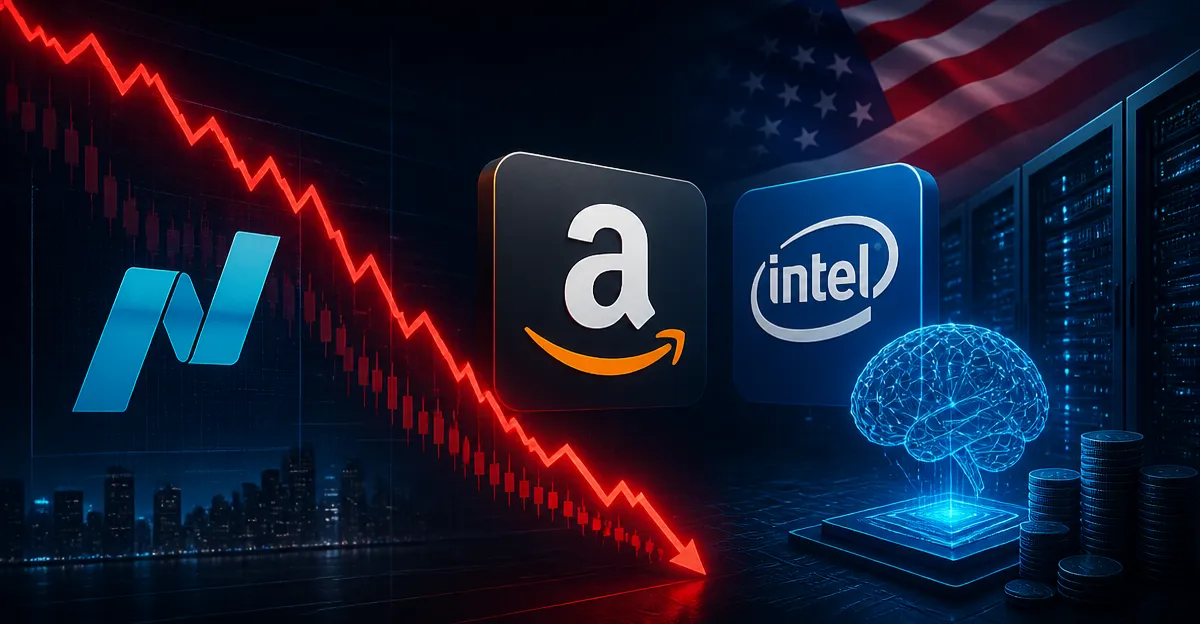
October 30, 2026, (Inside AI) — Nasdaq 100 futures fell more than 2% before the opening bell on Friday after Amazon and Intel delivered quarterly results that deepened investor anxiety over the cost of the artificial intelligence buildout. Amazon shares dropped 7.2% in premarket trading. Intel plunged 25%. Together, the two companies stood to erase roughly $300 billion in market value if losses held through the session.
The selloff extends a turbulent stretch for the AI trade. Investors have grown uneasy about the billions that large technology firms have poured into data centers, chips, and power capacity while waiting for stronger evidence of returns. Amazon reported a sharp cash outflow in the third quarter and signaled another increase in capital expenditures next year. Intel warned it would burn cash this year because of a weak PC market, manufacturing bottlenecks, and heavy spending to expand production.
At 4:04 a.m. ET, Dow E-minis were down 25 points, or 0.05%. S&P 500 E-minis were down 77.5 points, or 1%. Nasdaq 100 E-minis were down 640 points, or 2.16%. The damage spread across semiconductors. Nvidia fell 2.5%, AMD slid 7%, and Broadcom lost about 4%.
The reaction marks a shift in how Wall Street judges AI companies. Growth alone no longer satisfies investors. The market now wants to know the price of that growth.
"This is a good example of how the AI trade has changed," said Jake Behan, head of capital markets at Direxion. "At this point, the market isn't just asking how fast you can grow. It's asking what you have to spend to get there."
The anxiety has a financing dimension. Several companies have tapped the bond market to fund AI infrastructure. Microsoft, the only major technology firm to avoid a cash-burn scare this quarter, still raised $25 billion through a debt sale on Thursday. Rising borrowing costs make debt-funded spending harder to justify. The Federal Reserve held its main lending rate steady earlier this week, but analysts viewed the decision as a pause. Data compiled by LSEG shows the Fed is expected to hike rates by more than 50 basis points by mid-2027, with a hike possible as soon as December.
Alphabet slipped 0.9%, extending losses after a record selloff in the previous session. The Google parent reported disappointing results in its search-advertising business and a sharp increase in cash outflows. Meta reported cash burn in the September quarter last week.
Why The AI Capex Race Faces A Debt Test
The scale of the spending is without precedent in modern technology. Amazon, Microsoft, Alphabet, and Meta have collectively committed hundreds of billions of dollars to AI infrastructure. Much of that money now flows through credit markets rather than operating cash flow. That structure introduces a variable the AI trade did not face during its early rally: the cost of capital. When borrowing was cheap, debt-funded expansion looked efficient. As rate expectations turn higher, the same strategy invites scrutiny. The companies that can fund AI growth from internal cash flow will likely separate from those that cannot.
The weekly picture offers a partial counterpoint. The S&P 500 and the Nasdaq were on course for weekly gains after the AI trade received a brief reprieve earlier this week. That reprieve came when AI lab Anthropic unveiled its US IPO filing. On a monthly basis, the indexes diverge. The Nasdaq was set for a monthly drop after two consecutive monthly gains. The S&P 500 and the Dow were headed for a positive month.
Nine of the 11 S&P 500 sectors were set for monthly gains, barring technology and communication services. The communication services sector was headed for its worst monthly showing since April 2022.
Elsewhere in premarket trading, Reddit slid 21.1% after CEO Steve Huffman warned that total daily active unique visitors could fall by a low double-digit percentage in the fourth quarter. Energy giants Chevron and ExxonMobil were among the prominent companies reporting before the bell.
The Friday session will test whether investors treat the Amazon and Intel warnings as company-specific problems or as evidence of a broader repricing of AI ambition. The answer may shape technology valuations through the rest of the year.