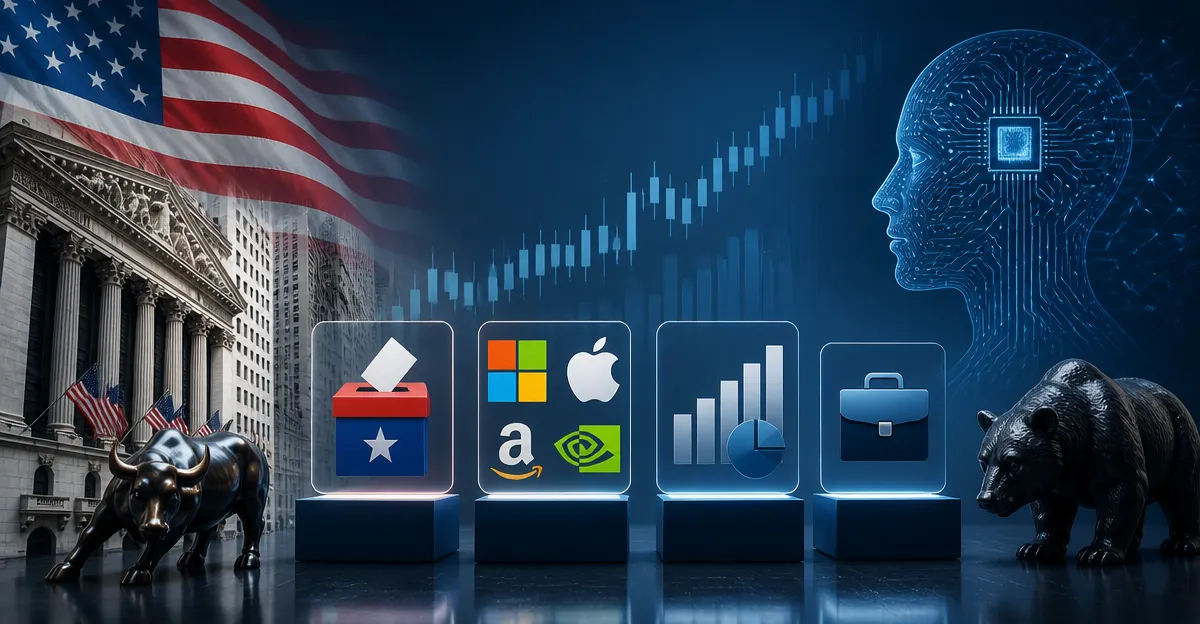
October 30, 2026, (Inside AI) — A convergence of political and financial risk is set to collide with Wall Street next week. US midterm elections on Tuesday, a dense slate of corporate earnings, and the monthly jobs report will test an equity market already rattled by fresh doubts over the artificial intelligence trade.
The immediate trigger for the latest turbulence came from Alphabet, the parent company of Google. Its quarterly results, released Thursday, showed heavy cash burn tied to data center expansion and revenue that fell short of expectations. Shares plunged more than 12%, dragging major indexes lower and reigniting fears about the financing required to sustain the AI investment boom.
That anxiety is unlikely to fade quickly. Apple, AMD, and Palantir are among the major technology and AI players due to report in the coming days. Meanwhile, the midterm elections could reshape the regulatory landscape for AI, particularly regarding the energy-intensive data centers that underpin it.
The stock market "seems a bit troubled to me, and I think that really stems from the AI fears that seem to be persistent, if not building," Marta Norton, chief investment strategist at retirement and wealth services provider Empower, said in an interview. "There is still some digestion around what we saw with earnings this week."
The political dimension adds a layer of uncertainty. Tuesday's elections will determine whether Democrats can wrest control of Congress from President Donald Trump's Republican party. Democrats are widely predicted to win the House of Representatives, but the Senate remains more doubtful. Republicans controlled both chambers during the first two years of the Trump administration.
Investors are bracing for increasing pushback on data centers, whose impact on energy costs and the environment has led to intense public opposition. A Democratic sweep is expected to bring more scrutiny, even if doubts remain that any viable legislation will pose serious risks to AI investment.
"To the extent that the Democrats really do have a significant blue wave, I think that will be seen as negative for both the AI names, for tech to some extent in general, and maybe even for the market as a whole," Rick Meckler, partner at Cherry Lane Investments, said.
Local and state races in Texas and elsewhere are also being watched for their implications for the data-center buildout. Defense and healthcare are other sectors sensitive to election results, and a Democratic sweep could bring more regulatory scrutiny for Wall Street banks and crypto firms.
The broader market has shown resilience despite the AI wobble. As October winds down, the energy and financial sectors were set for solid monthly gains, as were defensive groups such as utilities and healthcare. The S&P 500 was last up about 1% for October and over 12% on the year.
"The market is much more broad than people generally want to give it credit for," Chris Galipeau, head market strategist at the Franklin Templeton Institute, said.
Earnings performance has underpinned equity gains so far in 2026. With about half of the S&P 500 having reported third-quarter results, overall earnings were on pace to rise 31% for the period, according to LSEG IBES data on Thursday. But investors are punishing some reports. Caterpillar shares sank 9% on Thursday after the company stuck to its annual sales growth forecast despite strong demand for its power equipment from data centers.
"The earnings bar is very high," Galipeau said. "And if you miss or don't jump over that bar, you're in trouble."
Apple reports on Monday, with the iPhone maker's shares up 28% so far this year. Results are also expected from semiconductor companies AMD and Qualcomm as well as Palantir, which offers another view of the AI trade. McDonald's, Amgen, and ConocoPhillips are among over 100 S&P 500 companies due to report next week.
Next Friday's employment report for October will give a critical read into the health of the US economy. Data on Thursday showed the US economy in the third quarter grew at its fastest pace in a year, as consumers maintained robust spending and businesses doubled down on investment in AI. The Federal Reserve this week upgraded its assessment of the economy as it held interest rates steady.
"I think the missing piece of this strong economic growth narrative is the lack of job growth," Matthew Miskin, co-chief investment strategist at Manulife John Hancock Investments, said.
The week ahead will test whether the market can absorb political shocks and earnings disappointments without losing faith in the AI narrative that has driven gains. For now, the message from strategists is clear: the bar is high, and the margin for error is thin.