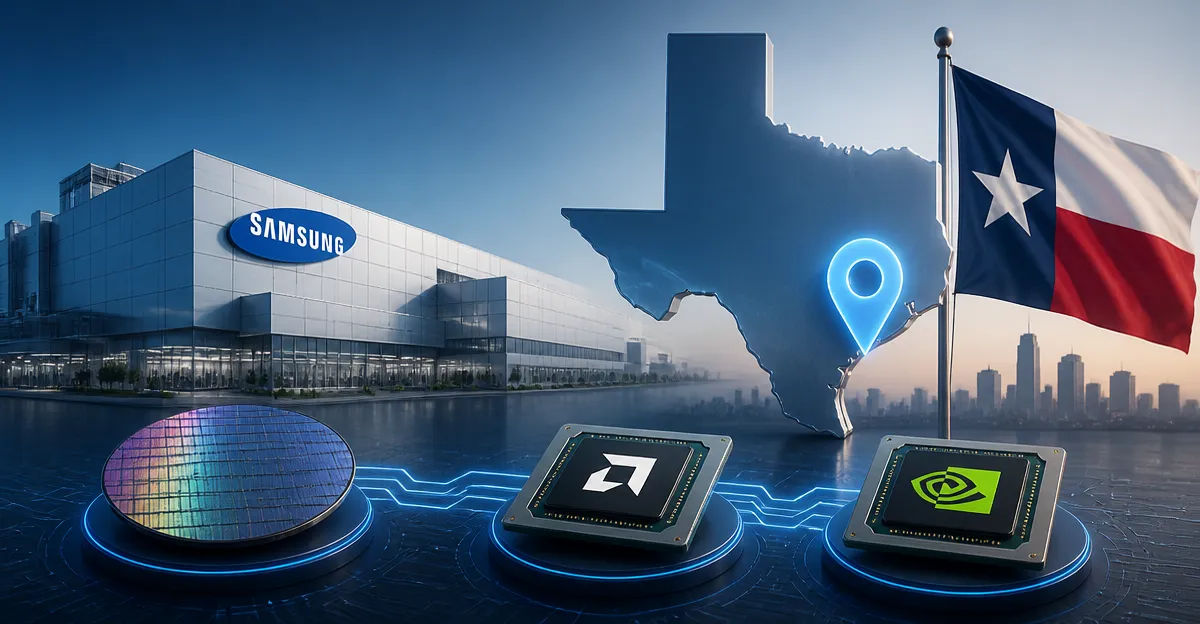
November 3, 2026, (Inside AI) — Samsung Electronics will use its second foundry plant in Taylor, Texas, to produce base dies for high-bandwidth memory (HBM) chips for AMD and Nvidia, according to a report by South Korea's Maeil Business Newspaper on Tuesday, citing industry sources. The base die is a critical component in HBM stacks, acting as the logic layer that connects memory to GPUs in AI accelerators.
The report did not specify production timelines or volumes. Samsung has not publicly confirmed the plan. The Taylor plant, announced in 2021, has faced delays. Its first phase was initially slated to begin production in 2024 but was pushed to 2026. The second plant is part of Samsung's broader $44 billion investment in Texas.
HBM has become a bottleneck in AI chip supply. Nvidia's latest GPUs rely on HBM3E, and AMD's MI300 series uses HBM3. Both companies depend on Samsung's rival SK Hynix for most of their HBM needs. SK Hynix currently leads the HBM market, but Samsung aims to catch up by 2025. Base die production is a key differentiator because it requires advanced foundry logic, not just memory manufacturing.
Samsung's Foundry Bet Faces Execution Risk
Samsung's foundry business has struggled with yield issues at advanced nodes. The company's 3nm process, which would likely be used for base dies, has lower yields than TSMC's, according to industry analysts. Winning AMD and Nvidia as customers for base dies would be a significant validation. However, it also puts Samsung in direct competition with TSMC, which currently produces base dies for AMD's MI300 and Nvidia's HBM partners.
Read: Samsung Q3 profit jumps nearly nine-fold as AI memory boom lifts chip earnings
In a related development, Samsung announced in October that it would supply HBM3E to Nvidia, but the deal was for memory chips, not base dies. The base die is a separate logic chip that sits at the bottom of the HBM stack. Producing it requires a foundry process, not a memory process. That is why Samsung's foundry plant in Taylor is central to this report.
The Taylor plant's second phase, which this report refers to, was expected to focus on advanced logic. If Samsung dedicates it to base dies for AMD and Nvidia, it would mark a shift from general-purpose foundry services to specialized AI component manufacturing. That could help Samsung differentiate its foundry offering. It also aligns with the U.S. CHIPS Act goals of building domestic AI supply chains.
AMD and Nvidia have not commented on the report. Samsung declined to comment on specific customers. The Maeil Business report said the base dies would be produced using Samsung's 4nm process. That process is more mature than 3nm and has better yields. However, it still lags TSMC's 4nm in performance and power efficiency.
Industry observers note that Samsung's HBM business has been slow to gain traction. The company's HBM3E chips only recently passed Nvidia's qualification tests. Producing base dies in-house could give Samsung more control over quality and supply. But it also adds complexity. Base dies must be designed to work with specific HBM stacks and GPU architectures. That requires close collaboration with AMD and Nvidia.
Samsung's Taylor plant has faced construction delays and subsidy negotiations. The U.S. government awarded Samsung $6.4 billion in CHIPS Act funding in April 2024. The plant was originally scheduled to start mass production in 2024, but Samsung delayed it to 2026 due to market conditions and technical challenges. The second plant was planned for 2027. If the report is accurate, Samsung may be accelerating those plans.
For AMD and Nvidia, diversifying base die suppliers reduces reliance on TSMC. TSMC currently produces base dies for AMD's MI300 and for Nvidia's HBM partners. But TSMC's capacity is tight, and the company is prioritizing its own customers. Having Samsung as a second source could alleviate supply constraints. However, Samsung must prove it can meet the quality and volume requirements.
The report comes as HBM demand is expected to surge. Market research firm TrendForce estimates that HBM revenue will grow 156% in 2024 and another 80% in 2025. The base die is a small but essential part of that market. It accounts for about 10% of the cost of an HBM stack, according to estimates. But its importance is growing as HBM stacks become more complex.
Samsung's foundry business posted an operating loss in the third quarter of 2024. The company has been trying to win large customers to fill its plants. Winning AMD and Nvidia for base dies would be a major win. But it would also require Samsung to prove its advanced packaging capabilities, as base dies must be integrated with HBM stacks.
Neither Samsung nor AMD nor Nvidia have issued official statements. The Maeil Business report is based on unnamed industry sources. Inside AI could not independently verify the claim. If confirmed, the deal would mark a significant shift in the AI chip supply chain, with Samsung taking on a more central role in HBM production.

If a research paper dropped this week, Mahesh has already read it. He covers AI tools and vibe coding for builders who need to know what is worth their time and what is not.