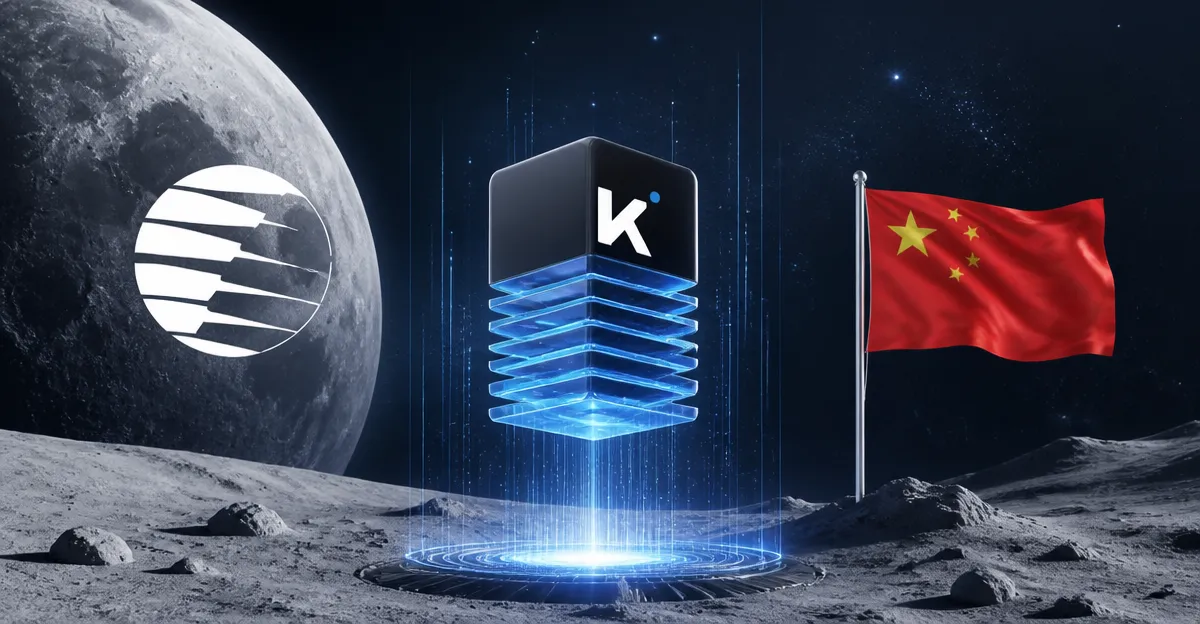
November 5, 2026, (Inside AI) — Moonshot AI has published the full weights of its flagship multimodal model, Kimi K3.1 Pro, on Hugging Face, allowing organizations to download and deploy the system on their own infrastructure. The release marks a significant shift for the Chinese AI developer, which had previously offered the model only through its consumer applications and commercial API.
The model is built on a mixture-of-experts architecture with 2.8 trillion total parameters, of which roughly 104 billion activate during each inference. It supports a context window of approximately one million tokens. Moonshot says K3.1 Pro extends its predecessor, Kimi K3, with expanded reinforcement learning targeting coding, 3D creation, financial research, and long-running agent tasks.
The open-weight release carries weight beyond a single product launch. It gives enterprises in regulated industries a path to run a frontier-class multimodal model inside their own security perimeter, without sending data to a third-party API. It also intensifies competition among Chinese AI labs, several of which have increasingly shipped open weights to win developer mindshare against closed US rivals.
Huawei Backs The Release With Inference Stack
Huawei has announced inference support for K3.1 Pro through vLLM Ascend and SGLang, covering its Atlas A3 and Ascend 950 systems. The pairing is notable. It signals that Moonshot intends the model to run on domestic Chinese silicon, not only on Nvidia hardware that export controls have made scarce in China.
The technical profile explains why deployment support matters. A 2.8 trillion parameter model is far too large to fit on a single accelerator node. Serving it requires expert parallelism, where different experts in the mixture-of-experts layer reside on different devices. The vLLM Ascend and SGLang integrations give operators tooling to distribute that workload across Huawei clusters.
The one million token context window also raises infrastructure demands. Long-context inference multiplies memory pressure on key-value caches, and operators will need to tune serving configurations carefully to keep latency acceptable. Moonshot's decision to publish weights alongside a named inference stack suggests the company wants to lower that operational barrier for adopters.
The reinforcement learning expansion deserves scrutiny. Moonshot lists coding, 3D creation, financial research, and long-running agent tasks as target domains. Those are precisely the workloads where enterprises have struggled to justify closed API costs at scale. Open weights change the economics, because heavy users can amortize inference on owned hardware rather than paying per token.
The release also fits a broader pattern. Chinese labs including DeepSeek and Alibaba's Qwen team have used open-weight distributions to build global developer communities. Moonshot's move places it in that same camp, even as its consumer app competes on user experience. The strategy trades some direct revenue for ecosystem influence and deployment ubiquity.
Independent verification of the model's benchmark claims will take time. Open weights allow researchers to test the system directly, which typically produces more credible performance data than vendor-reported evaluations. That transparency may help or hurt Moonshot, depending on how K3.1 Pro performs under third-party scrutiny.
The release does not resolve questions about licensing terms for commercial use, which Moonshot has not detailed in the announcement. Enterprises evaluating the model will need clarity on those terms before committing infrastructure. The availability of Huawei inference support also ties adoption partly to Ascend hardware availability, which remains constrained by manufacturing capacity.
For now, the weights are live and the inference stack is named. Developers can begin testing K3.1 Pro on their own terms, and the results of that testing will determine whether Moonshot's open-weight bet pays off.

Sofia spent years studying how machines parse human language before pivoting to cover the systems now rewriting it. She reads technical papers the way others read news and looking for what the numbers are actually saying beneath the headlines.