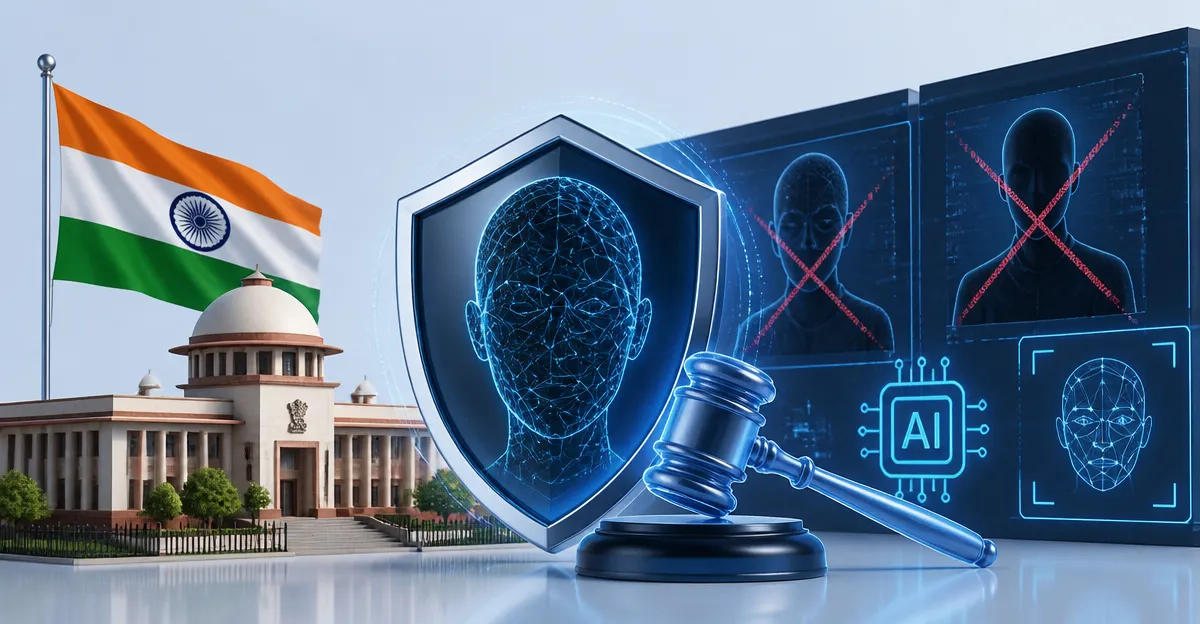
November 5, 2026, (Inside AI) — The Delhi High Court has handed actor Kriti Sanon an interim victory in her fight against AI-generated deepfakes and impersonation. Justice Purushaindra Kumar Kaurav restrained websites, social media accounts, and AI platforms from using her identity to create or circulate sexually explicit deepfakes, impersonate her, or falsely suggest an association with her. The order, passed on her plea seeking protection of personality rights, also directed the take-down of URLs containing objectionable material and instructed authorities to issue blocking directions to websites hosting pornographic deepfakes.
The case lands as courts worldwide grapple with the fallout of generative AI tools that can clone faces and voices at near-zero cost. Sanon's suit is among the first in India to test how existing personality rights law applies to synthetic media. The court's order is interim, and the matter will be heard next on December 10. But the ruling already sketches a framework for how Indian courts may treat AI impersonation, a category of harm that sits awkwardly between privacy, publicity, and defamation.
Court Draws Line Between Publicity And Privacy
Sanon alleged widespread misuse of her name, image, likeness, and voice. Her complaints included people offering bookings for her appearances, fake social media profiles, AI-generated and morphed images, merchandise bearing her pictures, AI chatbots and synthetic voice models presented as her, and pornographic deepfake content. Senior advocate Pravin Anand, appearing for the actor, submitted that the objectionable content was multiplying daily, much of it created using AI tools. He said the relief sought at this stage was confined to protecting her right to publicity and privacy.
The court's order restrains the defendants from uploading, hosting, generating, or making available further material of a similar nature. That includes material impersonating her or falsely representing an association with her, sexually explicit or morphed images, videos or audio, including AI-generated ones, chatbots or voice models presented as her, and merchandise of the kind placed on record. The court clarified that its observations are prima facie and only for this interim arrangement. It also noted that the order does not restrain news, review, criticism, commentary, satire, parody, caricature, or fan expression.
Read: India Supreme Court Proposes Ban on AI in Judicial Decision-Making
In its reasoning, the court offered a detailed primer on personality rights. It noted that the term is not a single cause of action but a description of several distinct claims: the right of publicity, passing off, the right of privacy, defamation, and, where conditions are met, rights under the Trade Marks Act, 1999 and the Copyright Act, 1957, including performers' rights. The court distinguished between two interests. Privacy, dignity, and reputation are personal interests that cannot be assigned and end with the person. The right of publicity protects the commercial value of identity and can be licensed.
"The rights are available to every individual. Fame bears on whether an identity has commercial value and on the loss caused by its misuse; it is not a condition of the right. Equally, the mere use of a person's identity is not, by itself, unlawful," the court observed.
The court also held that a plaintiff in a personality rights suit must indicate, defendant-wise and content-wise, the claims being made and the material supporting them. All claims cannot be put under one umbrella and met with one omnibus injunction. That procedural point may prove as consequential as the substantive relief. It signals that courts will demand granular pleadings in an era when a single plaintiff may face dozens of infringing accounts and platforms.
The Delhi High Court's insistence on defendant-wise and content-wise claims reflects a practical reality of AI-era litigation. Deepfake content spreads across platforms faster than any single injunction can chase. By requiring specificity, the court is pushing plaintiffs toward targeted, evidence-backed requests rather than broad takedown orders that risk overreach. This approach could shape how future personality rights suits are drafted in India, especially as more public figures confront synthetic impersonation. It also places a heavier evidentiary burden on celebrities, who must now document each infringing instance rather than rely on blanket protection.
Why The Ruling Matters Beyond One Actor
The case arrives amid growing global concern over non-consensual intimate imagery generated by AI. India currently lacks a dedicated law for deepfake harms, though the government has floated draft rules and advisories for platforms. Existing remedies rely on a patchwork of privacy jurisprudence, trademark law, and IT Act provisions. The Delhi High Court's order does not create new law, but it applies old doctrines to new facts. That alone makes it a reference point.
The court's distinction between publicity and privacy carries weight. Publicity rights protect commercial value and can be licensed, which means platforms that strike deals with celebrities may operate lawfully. Privacy rights protect dignity and cannot be waived. For AI chatbots and voice models, the line matters. A licensed voice clone for a film promotion may be permissible. An unlicensed one presented as the actor is not. The order restrains chatbots and voice models presented as Sanon, a direct response to synthetic media that mimics identity without consent.
Read: Andhra Pradesh High Court Flags AI-Generated Affidavit, Warns Advocates
The carve-out for satire, parody, and commentary also deserves attention. It preserves expressive freedom while targeting commercial impersonation and explicit content. Courts in the United States and Europe have wrestled with similar balances under right-of-publicity and GDPR frameworks. India's approach, at least in this interim order, leans toward protecting the individual while leaving room for legitimate speech.
The matter will be heard again on December 10, when defendants may respond. Until then, the order stands as a temporary shield. For Sanon, it offers relief from content she says was multiplying daily. For the broader Indian legal system, it offers a template, however provisional, for handling AI-generated impersonation. The court's emphasis on content-wise claims may frustrate plaintiffs seeking quick, broad relief. But it also guards against sweeping orders that could chill lawful expression. How the court refines these principles in December will determine whether this interim order becomes a lasting precedent or a narrow fix.

Sofia spent years studying how machines parse human language before pivoting to cover the systems now rewriting it. She reads technical papers the way others read news and looking for what the numbers are actually saying beneath the headlines.