November 5, 2026, (Inside AI) — A Democratic sweep in the U.S. midterm elections has reshaped the political map and rattled the artificial intelligence trade, sending chipmaker stocks in Taiwan and South Korea sharply lower while lifting Chinese technology rivals and clean energy shares across global markets. The results, which put traditionally Republican states like Texas and Georgia in Democratic hands, have introduced a new layer of political risk into a sector that had grown accustomed to favorable treatment from Washington.
The two states had become central to the U.S. AI build-out, hosting large data center projects and semiconductor supply chain investments. Markets reacted swiftly, with the AI trade experiencing what one market observer described as huge amounts of volatility, principally in Asian chipmaking hubs. The political shift also raised questions about the future of Elon Musk's business empire, with stocks in the orbit of SpaceX falling sharply.
Washington's New Guardrails Reshape AI Trade
The election outcome does not appear to signal a broad slowdown in AI development, according to market participants. Instead, the expectation is that Washington will pursue targeted policy measures focused on how AI infrastructure gets deployed. "I don't think there's an expectation that AI as a whole is going to be slowed down. But I do think we'll hear a lot coming out of Washington, looking at some ideas of policies that are not overall regulation, but maybe some guardrails as to how this gets rolled out going forward, particularly the infrastructure of AI," said one market analyst, speaking about the post-election policy environment.
That distinction matters for investors. Broad AI regulation would threaten the entire sector's growth trajectory. Infrastructure-focused guardrails, by contrast, could redirect capital toward compliant projects and create winners and losers within the supply chain. The sharp declines in Asia-Pacific chipmakers suggest markets are already pricing in disruption to the hardware pipeline that feeds U.S. data centers.
Read: AI Stock Selloff Tests US Market Resilience as Tech Sector Falls 6.8%
Meanwhile, Chinese technology companies emerged as potential beneficiaries. If Washington places limits on the U.S. AI sector, Chinese firms could capture market share in regions where American products face new restrictions. The gains for these companies reflect a bet that geopolitical friction will accelerate domestic alternatives to U.S. technology.
The political calculus extends beyond policy. Musk's record spending against Democratic candidates has made him a focal point for the incoming majority. "There's almost two camps: there's gonna be everyone else, and Elon Musk. And I think the Elon Musk reset is going to be more of an inquisition if you will. They may be bringing him in. He talked about it when SpaceX came public, that a change of government could affect their growth going forward. I definitely think it will. I think the Democrats are not going to forget the fact that he spent a record for one person, spending money against them in these things," the analyst added.
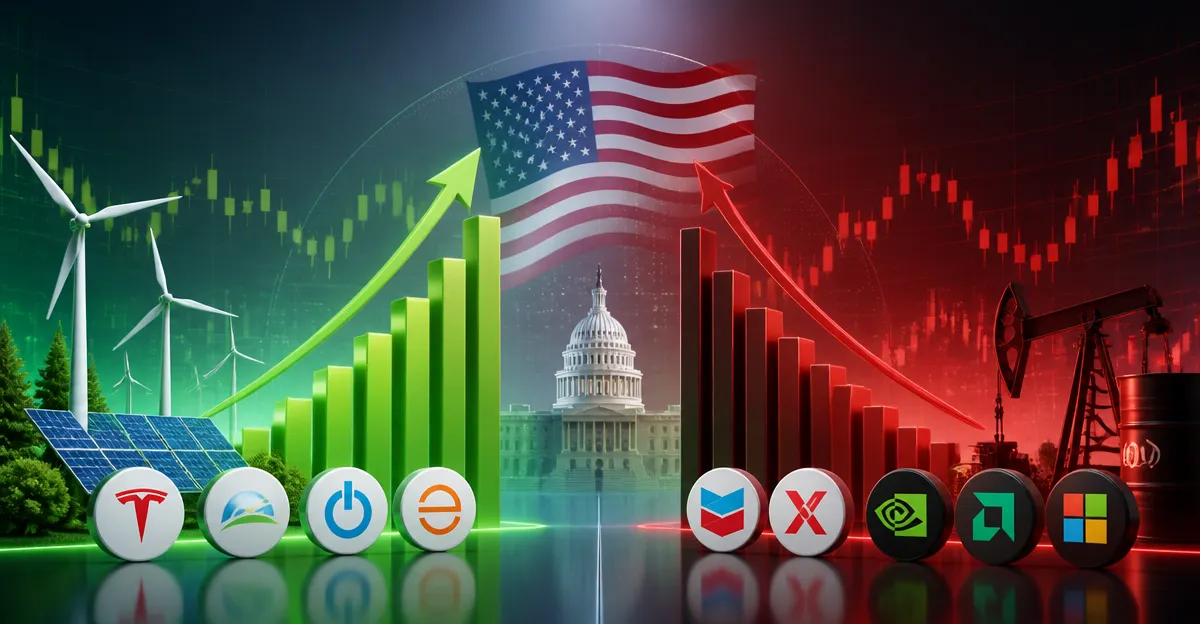
Clean energy stocks posted outsized gains across global markets, a direct response to the Democratic sweep. The shift in congressional power likely improves the outlook for renewable energy subsidies and climate-focused infrastructure spending, which had faced headwinds under Republican leadership. The rotation out of AI hardware and into green energy reflects a broader repricing of political risk across sectors.
Oil and liquefied natural gas prices fell as the prospect of resolution in the Middle East conflict eased supply concerns. Prices remain above pre-war levels but have retreated from recent highs. The easing energy costs could provide relief to data center operators facing rising power bills, though the political transition introduces uncertainty about future energy policy.
The midterm results arrive at a delicate moment for the AI industry. Companies have committed hundreds of billions of dollars to data center construction, chip fabrication plants, and energy contracts. Any policy shift that alters the economics of those investments could ripple through supply chains and capital markets for years. The volatility in Asian chipmakers offers an early signal of how sensitive the sector has become to political developments in Washington.
For now, the market's verdict is clear: green energy and Chinese technology stocks are the winners, while AI hardware and Musk-affiliated companies face a reckoning. The coming months will reveal whether the new Congress pursues the infrastructure guardrails that analysts expect, or whether the political appetite for confrontation with the tech sector runs deeper.

Shamil has a low tolerance for AI that only works in controlled demos. He covers agentic systems and generative AI with the skepticism of someone who has seen too many “revolutionary” tools quietly disappear six months after launch.