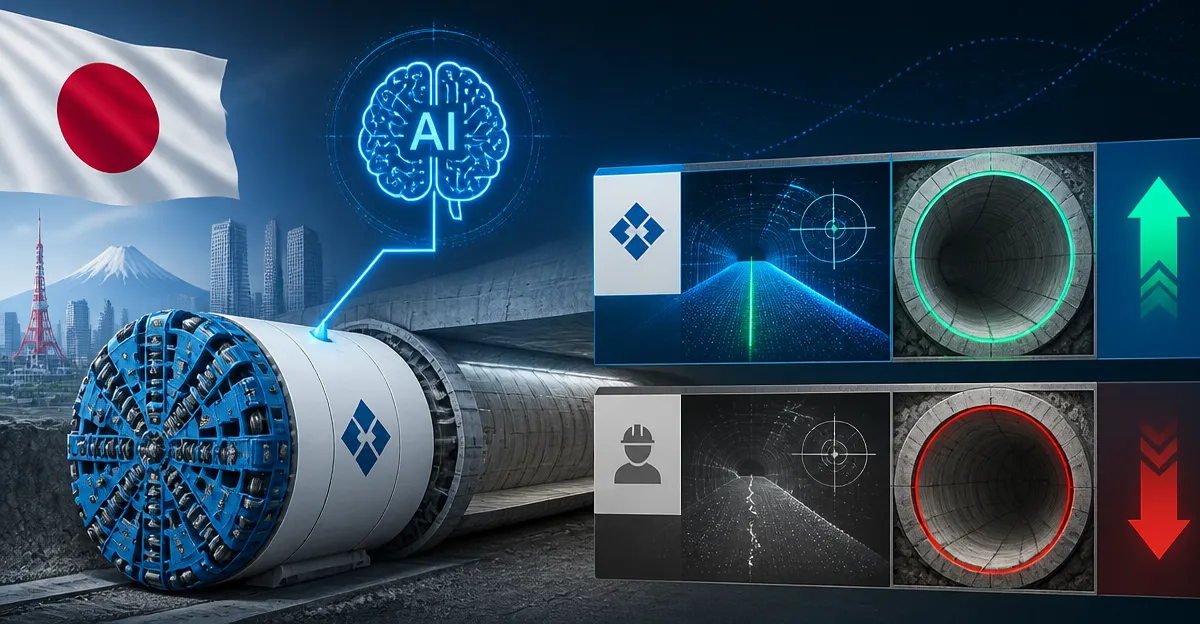
November 5, 2026, (Inside AI) — Japanese general contractor Taisei Corporation has demonstrated autonomous operation of a giant tunnel-boring machine using artificial intelligence, with the self-operating excavator outperforming veteran human operators in precision, according to sources familiar with the tests. The company began testing the autonomous system about a year ago at a construction site in Japan, marking a significant step toward automating one of the most challenging tasks in civil engineering.
The achievement matters because tunnel boring is a high-stakes, low-tolerance activity. Even minor deviations in alignment can cause costly delays, surface subsidence, or structural damage. Human operators rely on experience and real-time sensor data to steer massive machines through unpredictable geology. Taisei's AI system appears to have matched or exceeded that expertise, suggesting a future where critical infrastructure projects can proceed with greater speed and safety.
Inside the AI That Steers a 1,000-Ton Machine
Tunnel-boring machines (TBMs) are colossal cylindrical devices that excavate tunnels through rock and soil. Steering them requires constant adjustments to cutterhead rotation, thrust, and articulation. Taisei's AI likely uses machine learning to process data from sensors monitoring ground conditions, machine orientation, and vibration. The system then makes real-time control decisions, learning from each project to improve.
While Taisei has not disclosed technical details, the company's test results indicate the AI achieved better precision than human operators. This could mean fewer corrective maneuvers, reduced wear on cutting tools, and smoother tunnel walls. The implications for cost and timeline are substantial, as tunneling often accounts for a large share of infrastructure budgets.
Read: Global Industrial Robot Fleet Crosses 5 Million Units, IFR Says
Industry experts note that autonomous tunneling has been a goal for years. The challenge lies in the unpredictable nature of underground geology. AI can generalize from past data but may struggle with unexpected obstacles. Taisei's success suggests the technology has matured enough to handle real-world variability.
The development also raises questions about workforce impact. Skilled TBM operators are highly trained and well-compensated. If AI can outperform them, contractors may need fewer operators, shifting roles toward supervision and maintenance. However, Taisei's demonstration likely involved human oversight, and full autonomy may still be years away.
Taisei's move aligns with a broader trend in Japan's construction industry, which faces severe labor shortages due to an aging population. Automation is seen as a solution to maintain productivity. Similar efforts are underway in other sectors, including autonomous excavators and drones for site surveys.
According to sources, the test took place at a tunnel project in Japan, though the exact location and duration were not disclosed. Taisei has not announced commercial deployment plans, but the successful demonstration could accelerate adoption.
This breakthrough also invites comparison with other autonomous construction projects globally. For instance, companies in Europe and North America are developing self-driving construction equipment, but few have tackled the complexity of TBMs. Taisei's achievement positions Japan at the forefront of this niche.
Read: Dongfeng's Xiaodong Humanoid Robot to Enter Factory in October
As the construction industry grapples with digital transformation, Taisei's AI-guided TBM offers a glimpse of a future where machines handle the most demanding tasks. The company's next steps will be watched closely by competitors and regulators alike.

Tobias is less interested in what a robot or a prompt can do today than in what it means for tomorrow. He writes about prompt engineering and robotics for readers who want context, not just specs.