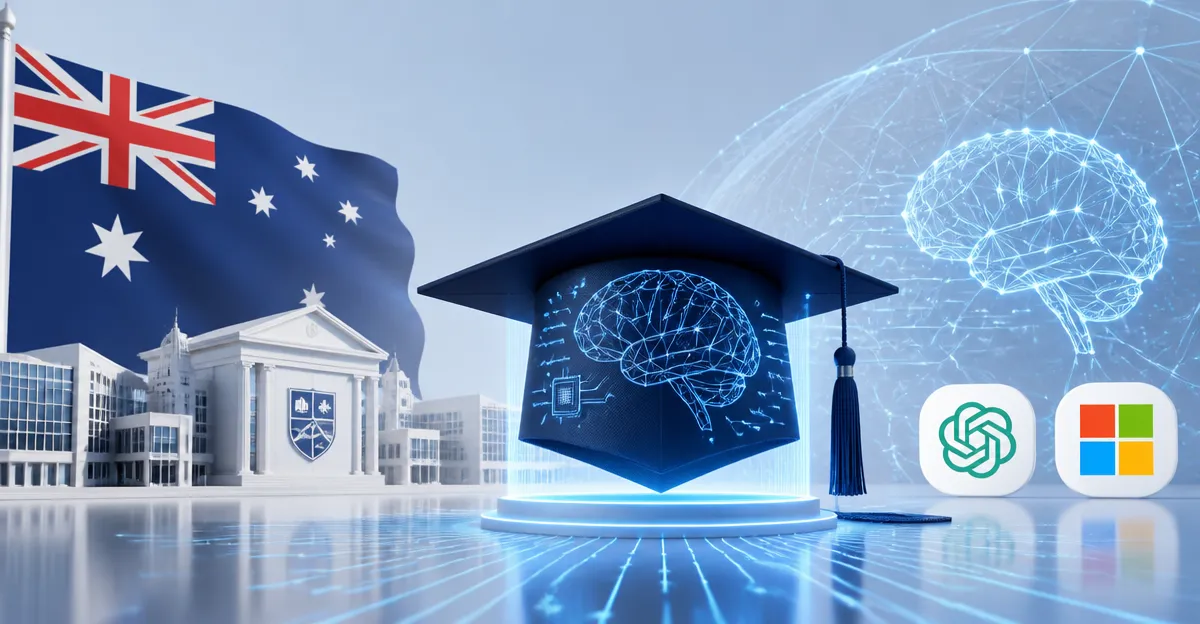
November 6, 2026, (Inside AI) — Australian universities are racing to embed artificial intelligence into the fabric of higher education, forging partnerships with OpenAI to equip students with frontier AI tools before they enter the workforce. Institutions including UNSW Sydney, the University of Sydney, La Trobe University, and Adelaide University are rolling out ChatGPT Edu at scale, redesigning curricula, and building assessment frameworks that acknowledge a new reality: most students already use AI daily.
The push reflects a broader shift in how universities view AI literacy. It is no longer an optional skill but a core competency for graduates entering an AI-enabled workplace. New research commissioned by OpenAI, based on a survey of more than 1,000 Australian university students, found that 81% use AI several times a week, with 33% using it multiple times a day. More than a quarter (28%) have already built an AI agent or assistant for their studies, work, or personal life.
Students want more. 79% said they want their university to offer opportunities to use advanced AI tools on real-world projects, and the same proportion expressed interest in applying AI to challenges in health, climate, science, or cybersecurity. 61% believe AI skills will be essential to career success, and 65% think those skills give Australian graduates an edge globally. Entrepreneurial ambition runs high: 76% are interested in starting a company or working for themselves, and 68% believe AI makes it easier to start a business.
The scale of these rollouts is significant. UNSW is bringing ChatGPT Edu to more than 80,000 students and staff, expanding access in stages. The university plans to integrate generative AI foundations and Codex into educational programs, with hackathons and industry projects. UNSW Master of IT student Nalin Iyer framed the workforce question directly: "It's important to understand what industry is looking for and how AI fits into that."
The University of Sydney is staging its rollout, with access for all students scheduled for Semester 1, 2027, following a trial. It is also establishing a $1 million AI Sustainability Research and Innovation Fund. La Trobe University has already given all 3,500 staff access to ChatGPT Edu, with universal access planned for its 45,000 students and staff in the first quarter of 2027. The university launched Australia's first Bachelor of AI Engineering (Honours) and an AI MBA program, both welcoming first cohorts in 2027.
La Trobe appointed Australia's first Pro Vice-Chancellor AI and Chief AI Officer, Phil Laufenberg, to lead its AI-first strategy. "ChatGPT and Codex have helped shorten early systems development and innovation from months to weeks, and importantly, enabled embedded co-design by staff and students," Laufenberg said.
Practical applications are emerging across disciplines. At La Trobe, Dr Cameron Anderson, Head of the Paramedicine program, uses ChatGPT to create simulations where students interpret ECGs, assess heart attacks, and triage patients after mass casualty incidents. Professor Therese Keane, Associate Dean for Research and Industry Engagement in La Trobe's School of Education, uses a social robot called Fletch to help future teachers practice giving feedback to parents. Powered by OpenAI large language models hosted through Microsoft Azure, Fletch responds with speech, facial expressions, and head movements. The team developed realistic scenarios from interviews with experienced educators, enabling trainees to practice confrontational conversations.
Adelaide University, created through a complex merger, is embedding AI from the outset. It is one of the first institutions to use OpenAI Daybreak Blue for authorised defensive security work, including vulnerability discovery, secure code review, malware analysis, incident response, and patch validation.
Assessment frameworks are evolving alongside access. UNSW introduced a Can, Can't, Must framework, allowing educators to specify whether AI use is permitted, prohibited, or required depending on the learning goal. The University of Sydney pairs its rollout with a responsible AI framework and supervised assessments to ensure students demonstrate their own capabilities. La Trobe's library developed free Responsible and Safe AI learning modules, and AI skills development is integrated into 50 priority first-year subjects for Semester 1, 2027.
The token economics of these rollouts are non-trivial. La Trobe reports dozens of live use cases, training for hundreds of people, and 10% month-on-month growth in active users. Managing safe access and cost as participation scales remains an operational challenge.
Read: Nasscom Chief Rajesh Nambiar Warns AI Could Sink Graduate Tech Jobs in India
These partnerships signal a deeper shift: universities are no longer debating whether to teach with AI but how to do so responsibly. The focus is on equipping graduates with both technical fluency and the judgment to apply it. As students enter a workforce increasingly shaped by AI, the institutions that get this balance right may define the next generation of Australian talent.

Shamil has a low tolerance for AI that only works in controlled demos. He covers agentic systems and generative AI with the skepticism of someone who has seen too many “revolutionary” tools quietly disappear six months after launch.