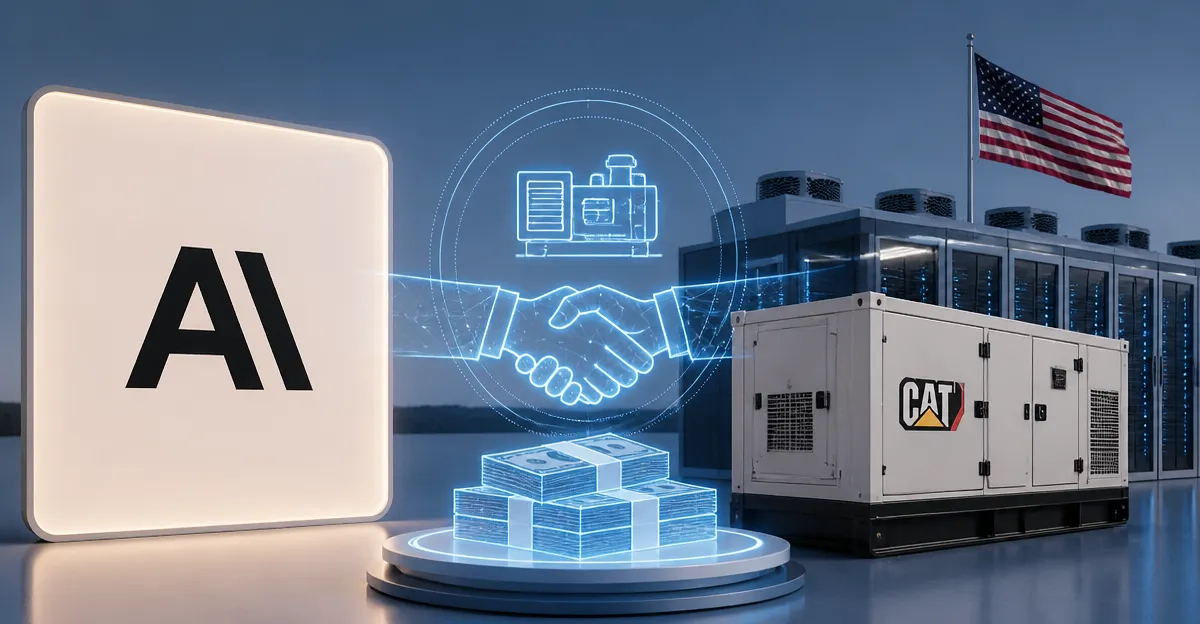
November 8, 2026, (Inside AI) — Anthropic has agreed to pay roughly $3.4 billion for gas-fired power generators to run its data centers, according to sources familiar with the transaction. The AI developer secured commitments for 1.7 gigawatts of heavy-duty generating equipment in late September from OnePWR Solutions, a San Antonio, Texas-based equipment supplier.
The arrangement stops short of an acquisition. Anthropic did not buy OnePWR itself, and no employees of the supplier moved to the AI company. The purchase instead bundled the generators with engineering and construction services required to install them, an official who spoke on condition of anonymity said. Anthropic and OnePWR did not respond to requests for comment, and Inside AI could not independently verify the deal terms.
The transaction lands as the company behind the Claude family of models races to convert record demand into physical capacity. Power, not silicon, has become the binding constraint for large AI operators. Anthropic has told investors it expects to spend more than $500 billion over the next decade on AI infrastructure, a figure that reframes the generator deal as a routine line item rather than an outlier.
One gigawatt is a useful yardstick here. It is roughly the output of a large nuclear reactor, and 1.7 gigawatts is comparable to the peak demand of a mid-sized city. Heavy-duty generators of this class are typically gas turbines used for continuous industrial load, not the diesel backup units common in server halls. Buying the installation capability alongside the hardware signals that Anthropic expects to energize sites quickly, without waiting on third-party construction schedules.
Why Gas Turbines Beat the Grid Queue
The choice of on-site gas generation is a bet on speed. Grid interconnection queues in major US data center markets now stretch years, and utilities in Texas and Virginia have grown cautious about reserving capacity for speculative AI campuses. Self-generation sidesteps that bottleneck, though it exposes the buyer to fuel prices, emissions rules, and local permitting fights.
The deal also carries a strategic edge that the headline figure obscures. By folding engineering and construction into the purchase, Anthropic gains control over the schedule from order to switch-on. That vertical integration is unusual for a software company and mirrors the playbook hyperscalers adopted during the last buildout cycle, when securing transformers and switchgear early became as important as securing chips.
Industry observers have long argued that AI infrastructure spending will eventually collide with energy reality. This transaction suggests the collision is already priced in. A $3.4 billion commitment to combustion equipment is a multi-decade signal, since turbines run for 20 to 30 years. It also raises questions about how Anthropic reconciles fossil-fuel dependence with its public posture on responsible development, a tension competitors such as Microsoft and Google have faced when their emissions targets slipped amid AI expansion.
OnePWR Solutions is a lesser-known name in a supply chain dominated by GE Vernova, Siemens Energy, and Mitsubishi Power. A single supplier absorbing a 1.7-gigawatt order would represent a substantial share of annual heavy-duty generator output, which makes the reported terms notable on their own. Whether OnePWR can deliver on that scale without subcontracting remains an open question, and the absence of confirmation from either party leaves the timeline unverified.
Anthropic's spending plans have drawn scrutiny since they surfaced in September. The company has expanded its compute footprint through cloud partnerships while simultaneously pursuing dedicated facilities. Power procurement of this size suggests the latter strategy is accelerating, and that Anthropic intends to own the energetic layer of its stack rather than rent it entirely from cloud providers.
The broader market is watching closely. If the generator deal closes as described, it would rank among the largest single power-equipment purchases attributed to an AI startup. Rivals are pursuing similar paths, with several firms signing long-term nuclear and geothermal agreements. Gas remains the fastest route to firm capacity, and speed is the currency of the current buildout.
For now, the transaction stands on reporting from sources rather than corporate confirmation. The key details to track are delivery dates, the split between equipment and construction costs, and whether regulators in the host states raise objections. Each will determine whether the $3.4 billion figure proves accurate or merely a starting point.

If a research paper dropped this week, Mahesh has already read it. He covers AI tools and vibe coding for builders who need to know what is worth their time and what is not.