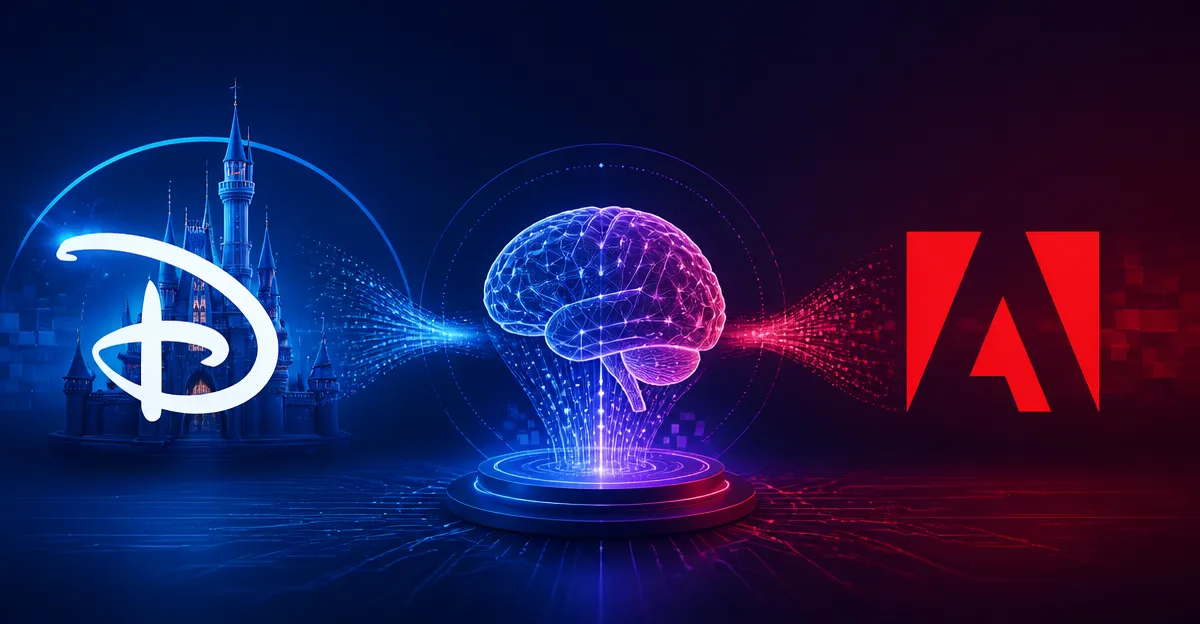
November 9, 2026, (Inside AI) — Disney and Adobe have signed a multi-year agreement to co-develop custom generative AI models trained on Disney's intellectual property. The deal, announced Monday, aims to scale AI tools across Disney's theme parks, film studios, and sports media operations. Financial terms were not disclosed.
The partnership will begin with Disney's Experiences division, which oversees global theme parks, resorts, and cruise lines, and with StudioLAB, the innovation hub inside Walt Disney Studios. Adobe will also work with ESPN to use AI tools to boost fan engagement and bring more of the network's content archive to audiences.
The core technology is Adobe's Firefly Foundry, a platform that lets enterprises build and deploy custom AI models. Disney's models will be private and proprietary, trained on its own intellectual properties to generate production-ready outputs.
Walt Disney Imagineering, the creative and R&D arm behind Disney Experiences, has already deployed a custom image generation model and a sketch-to-image model that turns hand-drawn sketches into fully rendered concept art. The tools are currently in use, according to the companies.
Read: Box AI Workflow Builder
Kyle Laughlin, senior vice president of R&D technology and engineering at Disney, said the tools have compressed development timelines from months to hours or days.
"We talk about the time frames in our projects in years -- it's years' worth of development. And what Adobe Foundry has allowed us to do is compress the creative process that would have taken months to now being able to do that in hours and days," Kyle Laughlin, senior vice president of R&D technology and engineering at Disney, said in an interview.
"We're able to run through multiple iterations quickly with these tools. And that helps us reduce costly changes in the field once we get into the construction of these experiences," Laughlin said, adding that the tools will help accelerate creative development at Disney and are "in no way meant to replace" roles at Imagineering.
The announcement comes as Disney faces financial pressure. Earlier this month, Bloomberg News reported that Disney was considering cutting thousands of jobs and has asked some managers to target 20% in annual cost savings. The company has not confirmed those figures.
Why Private Models Matter For Media Giants
The Disney-Adobe deal reflects a broader shift in how large enterprises approach generative AI. Rather than relying on public models from OpenAI, Google, or Midjourney, companies with valuable intellectual property are increasingly building private models trained on their own data. This approach keeps proprietary characters and storylines out of public training sets and reduces the risk of copyright disputes.
Read: Amazon SageMaker AI Studio
Adobe's Firefly Foundry competes with similar enterprise offerings from Nvidia, Microsoft, and Amazon Web Services. Disney's choice of Adobe suggests the company values integration with its existing creative workflows, which already rely heavily on Adobe's Creative Cloud suite.
The partnership also extends to ESPN, where AI tools could personalize highlights, generate automated game recaps, or surface archival content for specific fan segments. Disney has not detailed how those tools will work or when they will launch.
Disney's Imagineering team has used AI for concept art before, but the new models are the first to be co-developed with a major software vendor and deployed at production scale. The sketch-to-image tool, for example, allows artists to iterate on ride designs or character concepts without building physical models or commissioning full renderings.
Laughlin's comments about job replacement are notable given the broader labor tensions around AI in creative industries. Hollywood writers and actors struck for months in 2023 partly over AI protections. Disney's framing of the tools as assistive rather than substitutive may be an attempt to preempt similar concerns from its own workforce.
The deal does not specify which Disney characters or franchises will be used to train the models. Disney has not said whether the models will be used for consumer-facing content or only internal development.
Adobe and Disney have collaborated before on creative software and marketing tools, but this is their first joint effort on custom generative AI models. The companies did not disclose the length of the multi-year agreement or the expected rollout timeline for ESPN and StudioLAB.

Shamil has a low tolerance for AI that only works in controlled demos. He covers agentic systems and generative AI with the skepticism of someone who has seen too many “revolutionary” tools quietly disappear six months after launch.