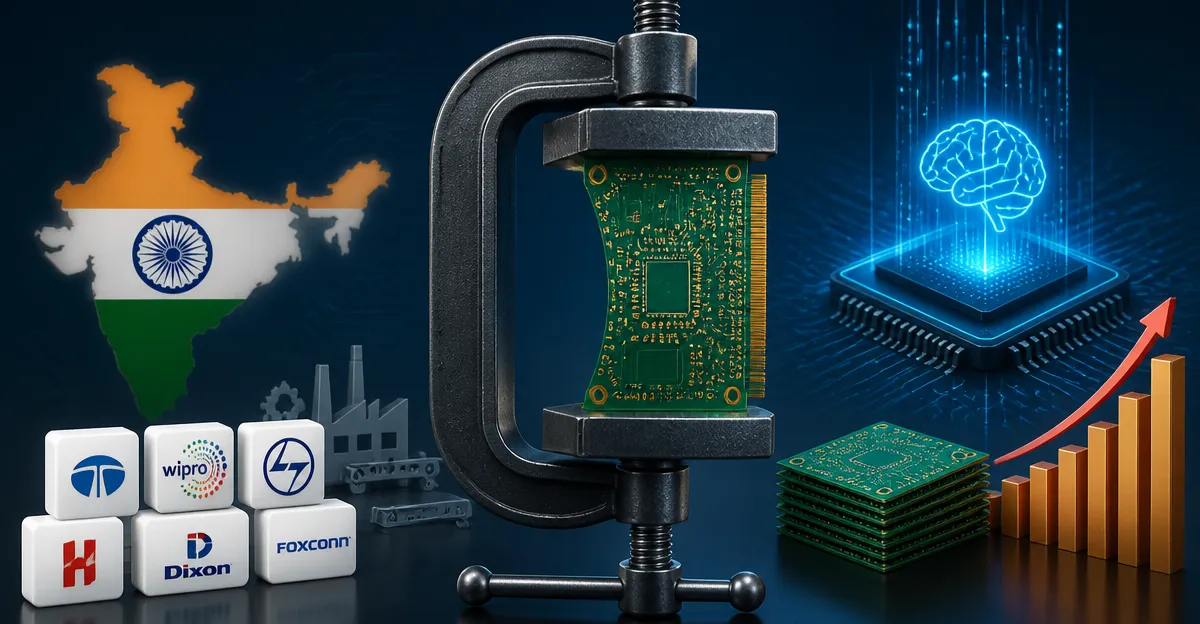
November 10, 2026, (Inside AI) — India's electronics manufacturers are grappling with soaring costs and supply constraints for printed circuit boards (PCBs), as global capacity increasingly shifts toward AI hardware. The squeeze threatens to inflate prices for smartphones, laptops, and other consumer electronics just as demand rebounds.
PCBs are the backbone of nearly every electronic device, and India's domestic production is limited. The country imports the majority of its PCBs, primarily from China and Taiwan. Now, AI data centers and high-performance computing are absorbing a growing share of global PCB output, leaving less for traditional electronics.
The timing is precarious. India's electronics manufacturing sector is expanding rapidly under the Production Linked Incentive (PLI) scheme, aiming to reduce import dependence. But the PCB shortage could undermine those ambitions, forcing companies to pay premiums or delay production.
Industry sources say lead times for PCBs have stretched from weeks to months, and prices have risen by double digits over the past year. Smaller manufacturers are hit hardest, as they lack the bargaining power of large players like Dixon Technologies or Foxconn.
Read: DRAM Prices Double 2026
"The AI boom is real, but it's creating unintended consequences for the broader electronics ecosystem," said an executive at a mid-sized Indian electronics firm, who requested anonymity to speak candidly. "We are now competing with AI server makers for the same PCB capacity, and we simply cannot match their volumes."
India's government has been pushing for self-reliance in electronics, but PCB manufacturing remains a weak link. Domestic PCB production is estimated at less than 10% of demand, according to industry estimates. Setting up a PCB plant requires significant capital and environmental clearances, which has deterred investment.
The global PCB market is dominated by companies in Taiwan, China, and South Korea. These manufacturers are reallocating lines to produce high-layer-count boards used in AI accelerators, which command higher margins. That shift is reducing supply for simpler boards used in consumer devices.
Meanwhile, India's electronics exports have been growing, but the PCB crunch could slow that momentum. The government's $10 billion PLI scheme for electronics has attracted major investments, but without a stable PCB supply chain, those investments may not translate into output.
Some companies are exploring alternatives, such as sourcing from Southeast Asia or investing in domestic PCB capabilities. But these are long-term solutions. In the short term, manufacturers may have to absorb higher costs or pass them on to consumers.
The situation is reminiscent of the 2021 semiconductor shortage, which exposed the vulnerabilities of global supply chains. That crisis prompted India to launch a semiconductor mission, but PCB manufacturing has received less attention.
Read: AI Chip Packaging Battleground
Analysts warn that if the PCB shortage persists, it could dent India's ambitions to become a global electronics manufacturing hub. The government needs to address the issue urgently, perhaps by offering incentives for PCB manufacturing or negotiating with supplier countries.
"We need a strategic approach to PCB supply," said a second industry official, who also spoke on condition of anonymity. "This is not just about costs; it's about ensuring that India's electronics manufacturing story remains on track."
Inside AI could not independently verify the specific price increases cited by industry sources.
The AI-driven demand for PCBs is part of a broader trend. As AI models grow larger, they require more powerful hardware, which in turn demands more sophisticated PCBs. This is straining global supply chains that were already tight due to pandemic-related disruptions and geopolitical tensions.
India's electronics industry is at a crossroads. The country has the potential to become a major player, but it must overcome infrastructure and supply chain challenges. The PCB squeeze is a wake-up call.

If a research paper dropped this week, Mahesh has already read it. He covers AI tools and vibe coding for builders who need to know what is worth their time and what is not.