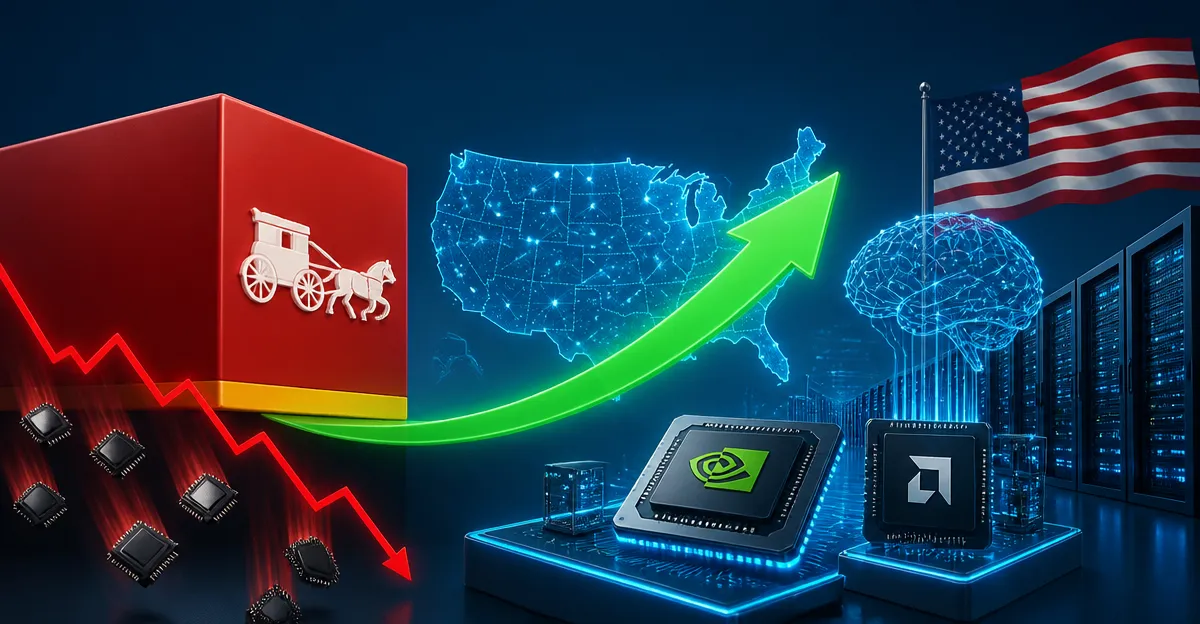
November 10, 2026, (Inside AI) — Wells Fargo has raised its rating on US AI infrastructure companies to "neutral" from "negative", arguing that the recent selloff in semiconductor stocks has created a more balanced risk-reward setup. The brokerage said chip shares have dropped about 38% from their June highs, and valuation multiples have compressed enough that much of the expected slowdown in AI-related earnings growth is now priced in.
The upgrade comes after months of turbulence in AI-linked equities, as investors have grown wary of stretched valuations and signs of moderating spending on AI hardware. Wells Fargo's shift signals a view that the worst of the derating may be over, even if growth is set to cool.
Semiconductor stocks have been under pressure since mid-2025, when several major cloud providers signaled they would slow the pace of data center expansion. That guidance, combined with export controls and supply chain adjustments, weighed heavily on chipmakers tied to AI accelerators. By June 2026, the sector had already begun to retreat from record levels, and the subsequent decline has been sharp.
Wells Fargo's analysts noted that the 38% decline has brought forward price-to-earnings ratios closer to historical averages. They argue that the market has already absorbed the expected moderation in AI earnings growth, leaving less room for further downside surprises. The upgrade applies to US AI infrastructure companies broadly, including those involved in semiconductors, networking, and data center equipment.
The brokerage's move is notable because it follows a period of widespread pessimism. Several Wall Street firms had downgraded AI hardware names in late 2025 and early 2026, citing oversupply concerns and a potential pause in hyperscaler capital expenditures. Wells Fargo itself had held a negative view, making the shift to neutral a signal that the risk-reward calculus has changed.
Still, the upgrade is not a full-throated endorsement. The neutral rating implies that while the downside may be limited, catalysts for a strong rebound are not yet visible. Wells Fargo's report pointed to persistent uncertainty around AI spending, particularly as enterprises assess the return on investment from generative AI projects. That caution is echoed by other analysts who note that the selloff may have been driven as much by sentiment as by fundamentals.
The broader context is a maturing AI investment cycle. After two years of explosive growth in demand for AI chips, the market is entering a phase where execution and profitability matter more than top-line expansion. Companies that can demonstrate efficient scaling and real customer traction may outperform, while those reliant on hype could struggle. Wells Fargo's upgrade suggests that the sector's valuation now better reflects this new reality.
Investors will watch upcoming earnings reports for signs of stabilization. Key suppliers of AI infrastructure are expected to report in the coming weeks, and any indication of resilient demand could validate Wells Fargo's call. Conversely, further guidance cuts could test the brokerage's thesis. For now, the upgrade offers a measure of relief to a sector that has been under sustained pressure.

Shamil has a low tolerance for AI that only works in controlled demos. He covers agentic systems and generative AI with the skepticism of someone who has seen too many “revolutionary” tools quietly disappear six months after launch.