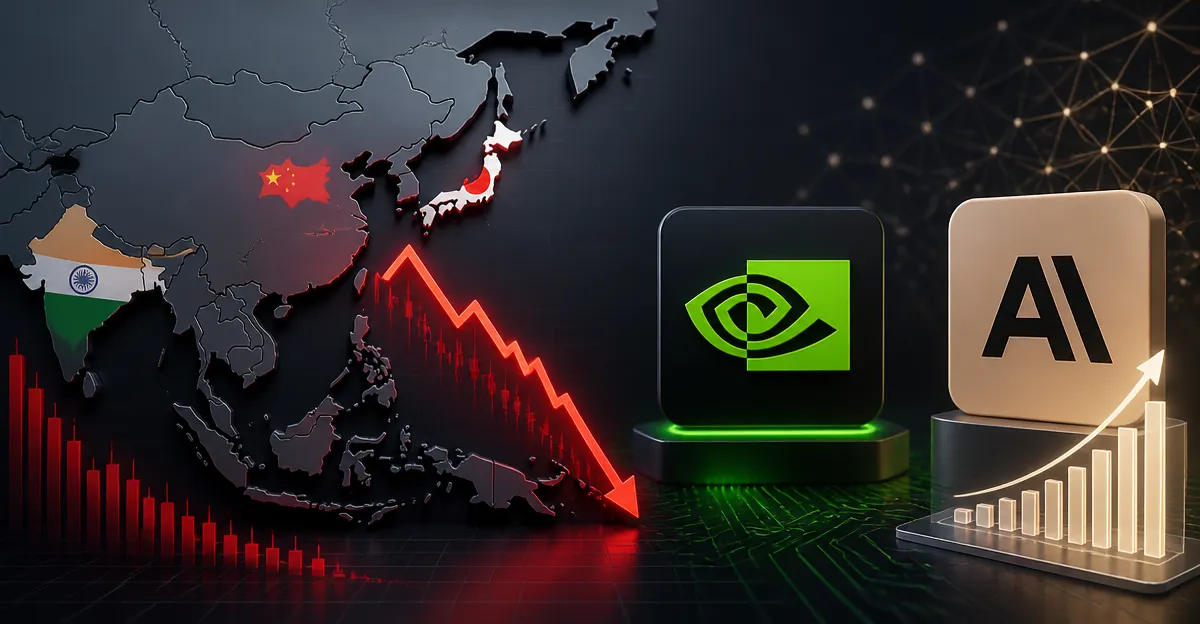
November 16, 2026, (Inside AI) — Asian equity markets opened the week lower on Monday as investors braced for two pivotal events that could determine whether the artificial intelligence-driven bull market retains its momentum. Japan's Nikkei fell 0.6%, South Korea's KOSPI slipped 0.2%, and the MSCI Asia-Pacific ex-Japan index eased 0.1%. The declines follow a turbulent week capped by the sudden departure of Jensen Huang as chief executive of Nvidia, the chipmaker whose meteoric rise became the defining symbol of the AI investment boom.
Nvidia's earnings report, scheduled for Tuesday, and the initial public offering of AI startup Anthropic two days later now serve as twin stress tests for a market that has poured trillions into AI-related assets over the past four years. The chipmaker's market capitalization has collapsed from roughly $5.8 trillion in early October to $3.9 trillion as of Friday, according to LSEG data, as investors fled following Huang's exit.
The stakes extend well beyond a single company. Nvidia's valuation has anchored the broader AI trade, influencing everything from semiconductor supply chains to data center construction forecasts. Anthropic's IPO, meanwhile, will provide the first real-time public market valuation for a leading large language model developer, offering a benchmark that private AI startups have lacked. The company's offering has reportedly attracted more institutional interest than SpaceX, according to people familiar with the matter.
Can Nvidia Beat Estimates Without Its Architect?
Analysts expect Nvidia to report earnings growth of 90% on revenue of $109 billion for its fiscal third quarter, according to LSEG data. The question is whether the company will maintain its bullish outlook for the coming year under new leadership. Options markets imply an earnings-day price swing of approximately 7% in either direction.
"Options markets imply an earnings-day move of approximately +/-7%, yet I question whether the quarterly numbers will carry their usual significance," said Chris Weston, head of research at foreign exchange brokerage Pepperstone. "Nvidia may well deliver another exceptional beat and raise at tomorrow's earnings, but investors are increasingly trying to value a business in FY2028 and FY2029 potentially without the individual who architected its competitive advantage."
The leadership vacuum has prompted speculation about Huang's potential return. The Financial Times reported that Huang has discussed with confidants the possibility of returning as CEO. US Treasury Secretary Scott Bessent said Nvidia needs to "go outside the company" for a new chief executive, signaling that the Trump administration favors fresh leadership.
Huang's departure raises uncomfortable questions about key-person risk at companies whose strategic vision is tightly bound to a single founder. Nvidia's competitive moat rests not only on its hardware but on its CUDA software ecosystem and long-term supply agreements, both of which were shaped by Huang's relationships across the semiconductor industry. Whether those ties transfer to a successor remains uncertain, and the market's sharp repricing suggests investors are not waiting for clarity.
Rate Fears Compound Tech Sector Anxiety
Macroeconomic pressures are adding to the unease. US producer price data released Friday showed inflation pressures broadening, while a hotter-than-expected consumer price index report earlier in the week led analysts to estimate a 0.3% rise in core personal consumption expenditure for October. That would mark the third consecutive monthly increase at that pace. The PCE index is the Federal Reserve's preferred inflation gauge.
Fed funds futures now imply a quarter-point rate hike next month is essentially locked in, with odds of a 50-basis-point move falling to 6% from 12% a day earlier. Markets have priced in a total tightening of 90 basis points by late next year. US Treasury yields surged last week, with two-year yields jumping 35 basis points and ten-year yields rising 29 basis points to reclaim the 5% threshold.
The dollar index held steady at 103.42 after rising 1.1% last week against major peers, reaching its highest level since April last year. Higher borrowing costs typically weigh on growth stocks, and the AI sector's valuations have been particularly sensitive to rate expectations.
Fed Chair Kevin Warsh is scheduled to speak Monday in San Francisco, where he will address how artificial intelligence may reshape the US economy. His comments will be scrutinized for any signal on how the central bank weighs AI-driven productivity gains against inflationary pressures.
Beyond earnings and rates, geopolitical risks loom. President Donald Trump is set to meet Chinese President Xi Jinping and Russian President Vladimir Putin on the sidelines of the Asia-Pacific Economic Cooperation forum in Shenzhen this week. Discussions are expected to cover nuclear arms reduction and the US-Israeli war with Iran. The Fed's October policy meeting minutes are due Wednesday.
In commodities, Brent crude fell 0.2% to $95.69 a barrel, while US crude edged 0.1% higher to $88.68. Gold bounced 0.3% to $3,891 an ounce after falling 4.6% last week.
S&P 500 futures edged up 0.3%, and Nasdaq futures bounced 0.5%, suggesting US markets may open higher despite the uncertainty abroad. Whether that optimism survives Nvidia's earnings and Anthropic's trading debut remains the week's central question.

Shamil has a low tolerance for AI that only works in controlled demos. He covers agentic systems and generative AI with the skepticism of someone who has seen too many “revolutionary” tools quietly disappear six months after launch.