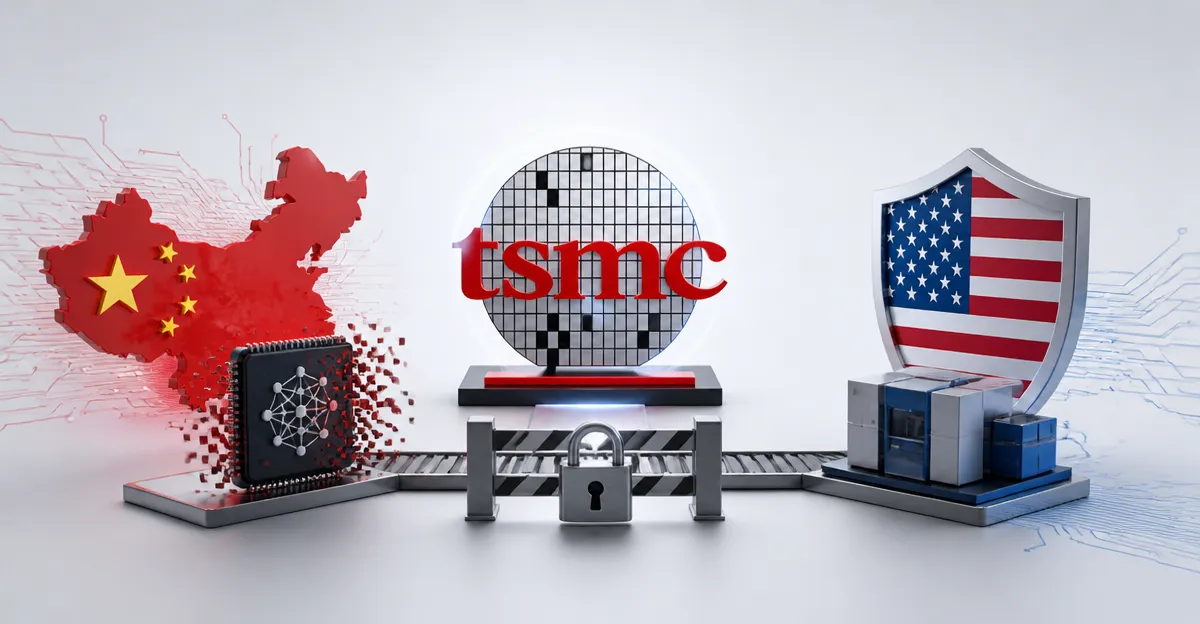
November 19, 2026, (Inside AI) — Taiwan Semiconductor Manufacturing Company has begun suspending advanced chip orders from Chinese designers and will generally limit them to older 28-nanometre and 40-nanometre processes, according to two people familiar with the matter. The move follows new U.S. Commerce Department rules that took effect on Thursday and closes one of the last routes Chinese firms had for producing powerful AI processors.
TSMC, the world's largest contract chipmaker, has instructed that affected orders using 16-nanometre processes and below be halted unless customers obtain U.S. export licences. The guidance also restricts older-node orders if the chips use high-bandwidth memory or require advanced packaging, the people said. Most leading AI chips rely on 7-nanometre processes or smaller, where HBM and advanced packaging are standard.
The restrictions matter because they strike at the heart of Beijing's push to build domestic alternatives to Nvidia-designed chips. Without access to TSMC's leading-edge capacity, Chinese designers must either secure U.S. licences or fall back to mature nodes that cannot match the performance of cutting-edge AI accelerators. The new rules shift the burden of proof: Chinese advanced chips are now presumed to be covered by U.S. controls unless an exception applies.
Washington Removes The Verification Route
Until this week, TSMC could check the computing power and other technical characteristics of certain Chinese chip designs to determine whether they fell outside U.S. export controls. The new Commerce Department rules remove that compliance route for affected Chinese customers. TSMC can no longer use the verification process, and advanced chips from those customers now require export licences by default.
The U.S. government maintains a list of approved chip designers that includes Nvidia, AMD, Apple, and Taiwanese firms MediaTek and Realtek. No mainland Chinese companies appear on that list. Some Chinese AI chip designers still had access to TSMC's 7-nanometre technology before Thursday, according to a separate source with direct knowledge of the matter. Inside AI could not independently verify the arrangements under which those chips were manufactured.
TSMC's guidance also requires closer scrutiny of customers' operating locations, parent companies, major shareholders, packaging providers, and shipping routes. The checks extend to orders placed through overseas subsidiaries or intermediaries, including entities in Taiwan, the U.S., Europe, Japan, and Southeast Asia. The Financial Times first reported that TSMC and South Korea's Samsung Electronics had suspended some chip shipments to Chinese customers following the new restrictions.
The timing is notable. The rules took effect on Thursday, the same day the guidance circulated, leaving Chinese designers with little room to adjust. For years, the verification process functioned as a release valve. It allowed TSMC to serve Chinese customers whose chips fell below control thresholds, even as Washington tightened broader restrictions. That valve is now shut.
Industry analysts have long noted that China's AI chip ambitions depend heavily on access to advanced foundry capacity. SMIC, the mainland's largest foundry, has struggled to scale 7-nanometre production at competitive yields. Without TSMC, Chinese designers face a stark choice: stockpile what they can, redesign for older nodes, or wait for domestic capacity that remains years behind.
The broader semiconductor supply chain is already adjusting. Packaging providers and memory suppliers that serve Chinese customers face new scrutiny under TSMC's guidance. Shipping routes and intermediary entities in Southeast Asia, long used to route orders around restrictions, are now explicitly covered by the checks. The rules leave little ambiguity about intent.
For Nvidia, the immediate effect is limited. The company's advanced chips are designed in the U.S. and manufactured by TSMC under approved arrangements. But the long-term picture is more complicated. If Chinese alternatives cannot be manufactured at leading nodes, Beijing's push for self-sufficiency slows. That could entrench Nvidia's dominance in the near term while accelerating China's investment in domestic foundry and packaging capacity over the next decade.
TSMC has not publicly commented on the guidance. Samsung, which faces similar U.S. restrictions, has also remained silent. The Commerce Department has not issued additional guidance beyond the rules that took effect Thursday. Chinese officials have not responded to requests for comment.
The restrictions arrive as Chinese technology giants including Huawei and Baidu continue to develop in-house AI chips. Those efforts now face a manufacturing bottleneck that no amount of design talent can easily overcome. The question is whether China's domestic foundries can close the gap before the restrictions bite into commercial deployments.
For now, the message from Washington is clear: advanced AI chips designed in China will not be manufactured with U.S.-aligned technology without explicit permission. TSMC's guidance simply enforces that message at the factory floor.

Sofia spent years studying how machines parse human language before pivoting to cover the systems now rewriting it. She reads technical papers the way others read news and looking for what the numbers are actually saying beneath the headlines.