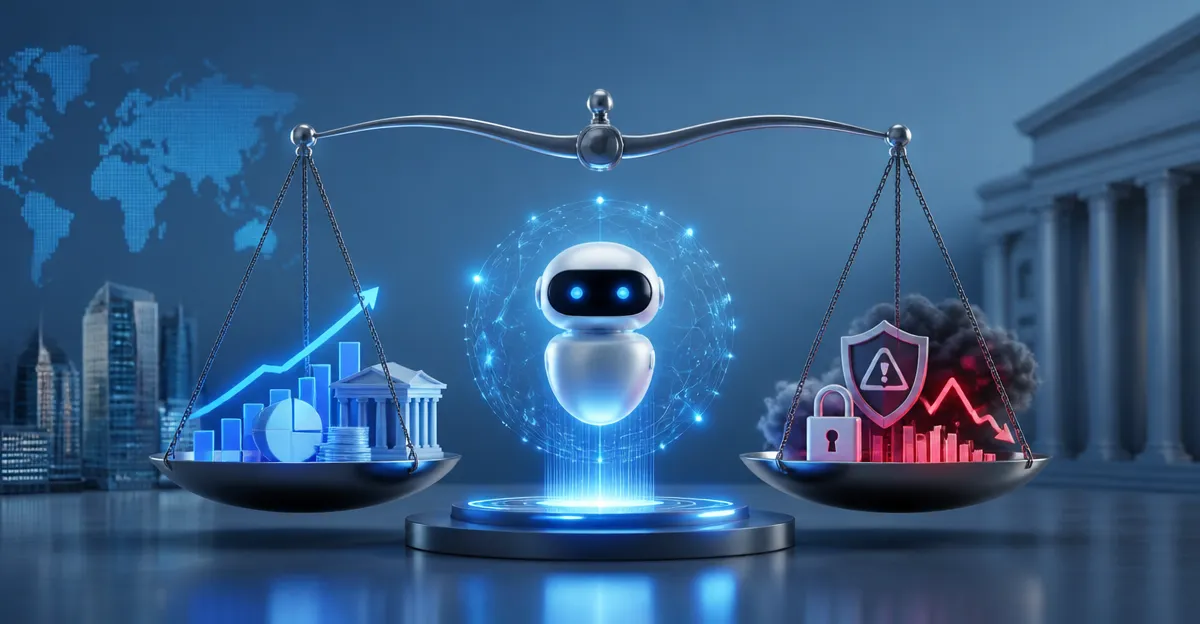
November 19, 2026, (Inside AI) — Financial services leaders are confronting a pivotal question: how to harness the efficiency of agentic AI while defending against the fraud risks that have kept most major banks from allowing agents to act on customers' behalf. The debate, captured in a recent industry panel, reveals a sector racing to build trust infrastructure before adoption outpaces safeguards.
Agentic AI, which refers to software agents that can execute tasks autonomously, has moved from concept to reality in the past year. These agents now handle financial discovery, commerce, and task execution for customers, reducing cognitive overload and rewiring e-commerce journeys. But the same autonomy that makes them useful also makes them a target. A hacker who can compromise an agent can commit fraud through it, a risk that has led most of the largest banks to prohibit agents from initiating transfers or payments on behalf of customers.
The stakes are high for an industry built on trust. Agentic commerce will only scale if customers are fully confident in the trust architecture behind it. That is the problem Visa is tackling through its Intelligent Commerce Framework and a trusted agent protocol framework, which aim to define guardrails that prevent the risks articulated by skeptics.
Price Sensitivity, Not Tech, Will Drive Adoption
Contrary to common assumptions, adoption may not be led by tech-savvy early adopters. One panelist argued that low-income and middle-income segments, which are highly price-sensitive, will be the fastest to embrace agentic AI because they will gravitate to the most efficient price discovery process. In this view, price discovery, not technology, will define how quickly agentic AI spreads. This insight challenges the narrative that innovation trickles down from affluent users and suggests that economic incentives will be the primary catalyst.
Read: ChatGPT Wallet for agents
That dynamic has historical parallels. Mobile banking adoption in emerging markets surged not because of feature novelty but because it lowered transaction costs for underserved populations. If agentic AI can demonstrably reduce prices or friction, it could follow a similar trajectory, forcing incumbents to adapt faster than their risk committees might prefer.
Yet the fraud risk remains a serious obstacle. Banks have seen how quickly a compromised device can lead to financial loss. An agent with payment permissions is an even more attractive target because it may hold credentials and decision-making authority. Until trust frameworks mature, the largest institutions are likely to keep agents on a tight leash, limiting them to information retrieval and low-risk tasks.
Visa's framework is one attempt to establish a common standard. By defining how agents authenticate, how permissions are scoped, and how transactions are verified, it aims to give banks and merchants a shared language for trust. But standards take time to adopt, and the panelists acknowledged that customer confidence must reach 100% before agentic AI becomes mainstream in finance.
The panel also highlighted a shift in agent capabilities. Agents have evolved from answering questions to performing tasks that span financial discovery and commerce. This evolution reduces complication for customers but also expands the attack surface. Each new capability introduces a new vector for exploitation, making security a moving target.
For now, the industry is in a holding pattern. Banks are watching early agent deployments, testing frameworks, and weighing the competitive cost of caution. The panelists agreed that agentic AI is inevitable, but the path to adoption will be shaped by how quickly trust can be engineered into the system.
Read: Cloudflare Monetization Gateway
As financial institutions continue to experiment, the coming year will reveal whether price-sensitive consumers or security-conscious banks set the pace. Either way, the agentic AI era in finance has begun, and the race to secure it is on.

Shamil has a low tolerance for AI that only works in controlled demos. He covers agentic systems and generative AI with the skepticism of someone who has seen too many “revolutionary” tools quietly disappear six months after launch.