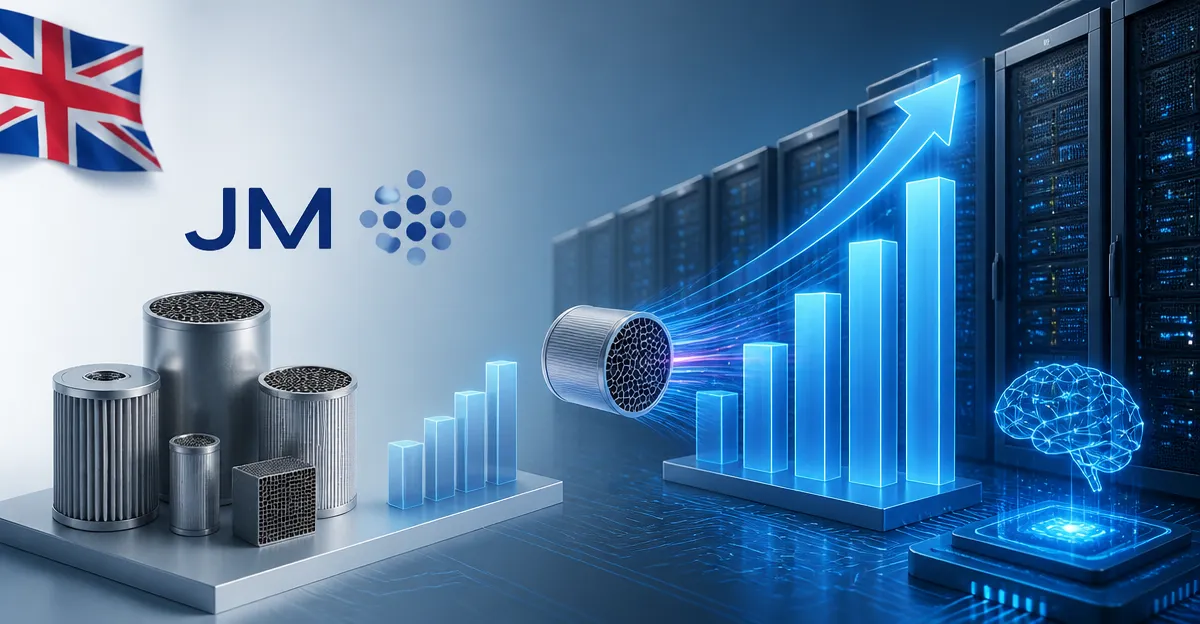
November 20, 2026, (Inside AI) — Demand for the pollution filters that keep gas turbines running at AI data centers is now far outstripping supply, according to Johnson Matthey CEO Liam Condon, who said the company has been turning away potential customers. The London-listed chemicals and sustainable technologies firm made the disclosure on Thursday while raising its annual sales expectations for its stationary emissions control businesses.
The bottleneck matters because data center construction is surging, particularly in the United States, as large technology companies pour capital into AI computing. Grid constraints are pushing many operators toward on-site gas turbines, and those turbines require emission controls to meet regulations. Johnson Matthey sits directly on that supply chain through its July acquisition of Cormetech, a US-based maker of catalysts that strip nitrogen oxides from gas-turbine exhaust.
Johnson Matthey now expects annual sales for Cormetech and its Clean Air Solutions business, which serves marine, industrial and utilities customers, to exceed £250 million ($328 million), up from a previous forecast of more than £200 million. The two businesses will be reported as the company's Clean Power segment from full year 2026/27. The upgrade came as Johnson Matthey reported higher first-half operating profit.
"For some time, we've had to turn away potential customers because demand far outstrips supply at this stage of the market," Condon told Reuters after the company reported higher first-half operating profit.
Read: US Power Demand to Hit Record Highs in 2026 and 2027 as AI Surges, EIA Says
Condon said on an analyst call that Johnson Matthey has the manufacturing capacity to boost production, but would need to buy more machines and dryers to make more products. The constraint is therefore equipment and capital deployment, not plant space. That distinction matters for how quickly the company can convert the demand surge into revenue.
The market for selective catalytic reduction (SCR) systems, which reduce emissions from gas-turbine exhaust, is worth about $1 billion and is expected to grow 10% to 15% annually over the next five to seven years, mainly driven by data centers, Condon said in June after announcing the Cormetech deal. Other players in the SCR market include Belgium's Umicore, Austria's CERAM and parts of German chemicals group BASF.
The supply shortfall is a reminder that the AI buildout's physical dependencies extend well beyond chips and power. Gas turbines need catalysts, and those catalysts need specialized manufacturing equipment with long lead times. A company that has to buy more machines and dryers to meet demand is describing a capacity expansion measured in quarters, not weeks. That lag could delay turbine commissioning schedules at data center sites and push operators toward alternative power arrangements or higher-cost suppliers.
Why Gas Turbines Became the Default
Data center operators have increasingly turned to gas turbines because grid interconnection queues in major US markets can stretch for years. On-site generation lets operators bypass those queues, but it also triggers air-quality permitting requirements. SCR systems inject a reagent into exhaust and pass it over a catalyst to convert nitrogen oxides into nitrogen and water. Cormetech's catalysts sit at the center of that process.
Johnson Matthey's traditional business is pollution filters for cars and trucks, a market tied to internal combustion vehicle production. The Cormetech acquisition moves the company into stationary emissions control, where demand is tied to data center construction rather than auto sales. The raised guidance suggests that shift is already paying off, at least at the order-book level.
The company's disclosure also offers a rare public data point on the AI infrastructure supply chain. Most attention focuses on GPUs, memory and electricity. Emission control catalysts rarely appear in AI capex discussions, yet they are a regulatory prerequisite for the gas turbines that many data centers now depend on. A shortage here can slow projects just as effectively as a chip shortage.
Read: Venture Global Raises Profit Forecast, Targets AI Data Center Power
Johnson Matthey did not disclose how many customers it has turned away or the size of its order backlog. Inside AI could not independently verify the scale of the supply shortfall. The company also did not specify how much capital it would need to spend on additional machines and dryers, or how long delivery of that equipment would take.
The raised guidance covers the stationary emissions businesses only. Johnson Matthey's larger automotive catalyst division faces separate pressures as electric vehicle adoption reshapes demand for conventional pollution filters. The Clean Power segment, once separated in reporting from 2026/27, will give investors a clearer view of how much of the company's growth now depends on AI-driven data center construction.
For now, the signal is straightforward. A niche industrial supplier says demand from AI data centers exceeds what it can produce, and it has raised its sales forecast accordingly. Whether competitors such as Umicore, CERAM and BASF can fill the gap, and how fast Johnson Matthey adds manufacturing equipment, will determine whether the shortage eases or becomes another schedule risk for the AI buildout.

If a research paper dropped this week, Mahesh has already read it. He covers AI tools and vibe coding for builders who need to know what is worth their time and what is not.