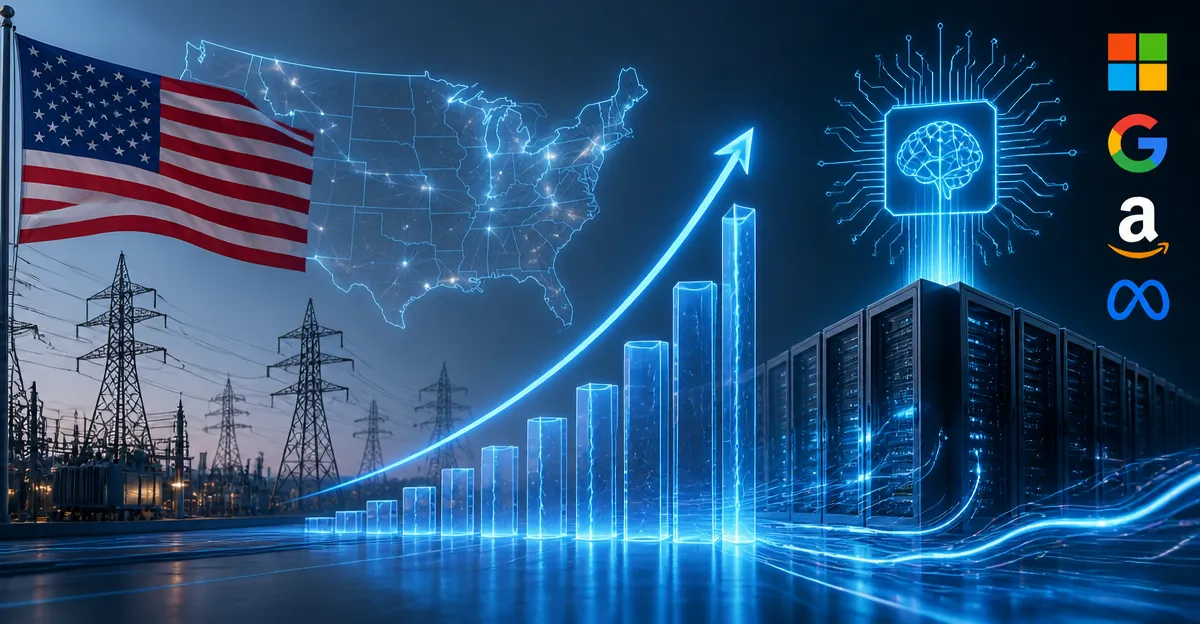
November 11, 2026, (Inside AI) — U.S. electricity consumption will climb to record highs in 2026 and 2027, driven by power-intensive artificial intelligence data centers and broader electrification, the U.S. Energy Information Administration (EIA) said in its Short-Term Energy Outlook released Tuesday. The agency projects demand will rise from a record 4,216 billion kilowatt-hours (kWh) in 2025 to 4,306 billion kWh in 2026 and 4,370 billion kWh in 2027. If accurate, 2026 would mark the third consecutive year of record demand.
The forecast underscores how AI’s rapid buildout is reshaping the U.S. power system. Data centers dedicated to AI are the largest new source of demand, while homes and businesses increasingly rely on electricity for heating and transportation instead of fossil fuels. The EIA’s numbers suggest the grid will strain to keep pace, with implications for utilities, regulators, and technology companies racing to secure power for their AI ambitions.
The EIA expects residential power sales to reach 1,546 billion kWh in 2026, commercial sales 1,557 billion kWh, and industrial sales 1,061 billion kWh. The all-time highs stand at 1,519 billion kWh for residential and 1,503 billion kWh for commercial customers in 2025, and 1,064 billion kWh for industrial customers in 2000. The industrial figure would remain below its 2000 peak, reflecting a shift in the U.S. economy away from energy-intensive manufacturing.
Coal Slips As Renewables And Gas Dominate
The generation mix will shift modestly. Coal’s share of power generation will slide from 17% in 2025 to 15% in 2026 and 2027, while natural gas holds steady at 40% in 2026 before easing to 39% in 2027. Renewables will rise from about 24% in 2025 to 25% in 2026 and 28% in 2027. Nuclear power’s share will remain at 18% through the forecast period.
Read: Anthropic Buys $3.4 Billion in Gas Generators for AI Data Centers
Natural gas sales for power generation will rise to 37.4 billion cubic feet per day (bcfd) in 2026, up from the previous record of 36.8 bcfd in 2024. Industrial gas sales will reach 23.8 bcfd, matching the all-time high set in 1973. Residential gas sales will slide to 12.2 bcfd, well below the 14.3 bcfd record from 1996, while commercial sales will dip to 9.4 bcfd from the 9.9 bcfd record in 2025.
The EIA’s outlook lands as technology giants including Microsoft, Google, and Amazon pour billions into AI infrastructure. Those companies have signed long-term power purchase agreements and, in some cases, are exploring nuclear power to secure reliable, carbon-free electricity. The demand surge is already prompting utilities to revise load forecasts upward and delay coal plant retirements. Grid operators in several regions have warned of tightening reserve margins.
Analysts note that the EIA’s projections have historically underestimated the pace of data center growth. A 2024 report from Lawrence Berkeley National Laboratory found that U.S. data centers consumed about 176 billion kWh in 2023, or 4.4% of total U.S. electricity. That share could reach 6.7% to 12% by 2028, according to the lab. The EIA’s forecast implies data centers will account for a growing slice of the projected increase, though the agency does not break out data center demand separately.
“The EIA’s forecast is a wake-up call for grid planners,” said John Moura, director of reliability assessment at the North American Electric Reliability Corporation (NERC), in a statement. “We are seeing demand growth that we have not witnessed in two decades, and it is happening faster than new generation and transmission can be built.”
The push for more power is also reviving interest in natural gas pipelines and nuclear plants. Several utilities have announced plans to extend the lives of existing reactors, and startups are developing small modular reactors (SMRs) aimed at data center campuses. However, those projects face long lead times and regulatory hurdles. In the near term, gas and coal will fill the gap, even as renewables expand.
The EIA’s projection assumes continued economic growth and no major policy shifts. A recession or stricter efficiency standards could temper demand. Conversely, a faster AI rollout could push consumption higher. The agency will update its forecast monthly, but the direction is clear: U.S. power demand is on an upward trajectory not seen in a generation.
For the AI industry, the report highlights a growing constraint. Access to affordable, reliable electricity is becoming as critical as access to chips. Companies that lock in power supplies early may gain an edge. Those that wait could face higher costs and delays. The grid, once an afterthought, is now a strategic battleground.

If a research paper dropped this week, Mahesh has already read it. He covers AI tools and vibe coding for builders who need to know what is worth their time and what is not.