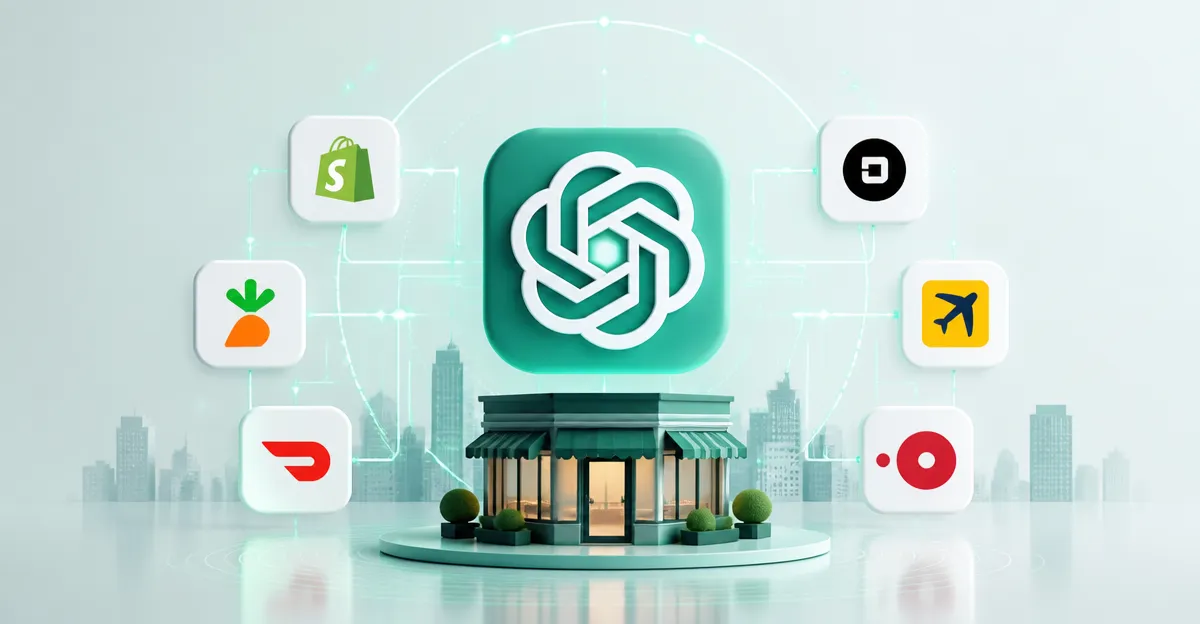
November 11, 2026, (Inside AI) — OpenAI has launched a beta program called Businesses in ChatGPT, allowing companies to claim their profiles, manage their information, and view engagement insights through a new Business Hub. The company also introduced Business Agents, which let eligible ecommerce and online service businesses in the U.S. interact directly with ChatGPT users. The announcement, made today, positions ChatGPT as a platform for business discovery and transactions, not just conversation.
The move matters because ChatGPT now reaches 1.2 billion people each week, according to OpenAI. That scale creates a new front in the battle for consumer attention, placing OpenAI in direct competition with search engines and marketplaces. For businesses, it offers a way to shape how they appear in AI-generated answers. For OpenAI, it opens a revenue stream beyond subscriptions and advertising.
How Verification And Insights Work
Businesses can claim their organization through Business Hub, where they verify ownership and then update key details. They can add self-service product feeds with pricing and availability, giving ChatGPT more accurate data to draw from. Any eligible business in a region where ChatGPT operates can participate. Existing OpenAI Enterprise customers and advertisers can work with their OpenAI representative to claim their business. Shopify merchants can connect their store from Business Hub or the Shopify admin to streamline verification. Eligible products from Shopify merchants are already integrated into ChatGPT through Shopify Catalog.
Business Hub also provides aggregated insights. Companies can see the number of mentions and website clicks they receive, and explore discovery topics, which are common themes across conversations where their website is cited. OpenAI says these insights are designed to protect user privacy. The company does not share users' conversations or Business Agent chats with businesses. Insights are aggregated and only available when enough conversations or interactions meet certain thresholds.
Read: OpenAI Launches Free ChatGPT Workshops for Caregivers in Five U.S. Cities
Business Agents represent a more significant shift. After claiming a business, eligible organizations can build, test, and launch an agent that answers questions and helps people explore offerings. When a business appears in a model response, users can click to see its ChatGPT profile. If a Business Agent is available, customers can start a conversation with the business to ask follow-up questions. For example, someone comparing products could ask about differences between two options and which features fit their needs. The agent uses the business's information to help.
OpenAI emphasizes that Business Agent conversations are clearly labeled, separate from the customer's original ChatGPT conversation, and distinct from ChatGPT's independent answers. Businesses can also sponsor their Business Agent and use it as the destination for ChatGPT Ads. Sponsored placements are clearly labeled and separate from ChatGPT responses.
This development mirrors earlier efforts to monetize AI assistants, such as Microsoft's Bing Chat ads and Google's Search Generative Experience experiments. However, OpenAI's approach goes further by allowing direct, branded interactions within ChatGPT. It also raises questions about how AI-generated answers will balance organic business information with sponsored placements. The line between helpful assistance and advertising may blur, even with labels.
Business Agents are now available to eligible ecommerce and online service businesses in the United States. OpenAI plans to expand Businesses in ChatGPT and Business Agents to more markets and business categories over time, and to build tools for organizations with more complex needs.
“We're starting with the foundations: accurate business information, useful insights, and conversations that help people make informed decisions,” OpenAI said in its announcement. The company did not provide a timeline for broader expansion.
For businesses, the beta offers a chance to influence how they appear in AI-generated recommendations. For users, it introduces a new way to connect with companies without leaving ChatGPT. The success of this initiative will depend on adoption, trust, and whether businesses find the insights valuable enough to invest in maintaining their profiles.
Read: Northern Trust, Microsoft Deploy AI Agent to Cut Client Onboarding Time by 83%
As ChatGPT evolves from a conversational tool into a platform for commerce and discovery, OpenAI's latest move signals its ambition to become a central hub for online interactions. The beta launch is an early step, but it sets the stage for a more integrated experience where AI assistants facilitate transactions and customer service. How regulators and competitors respond remains to be seen.

Shamil has a low tolerance for AI that only works in controlled demos. He covers agentic systems and generative AI with the skepticism of someone who has seen too many “revolutionary” tools quietly disappear six months after launch.