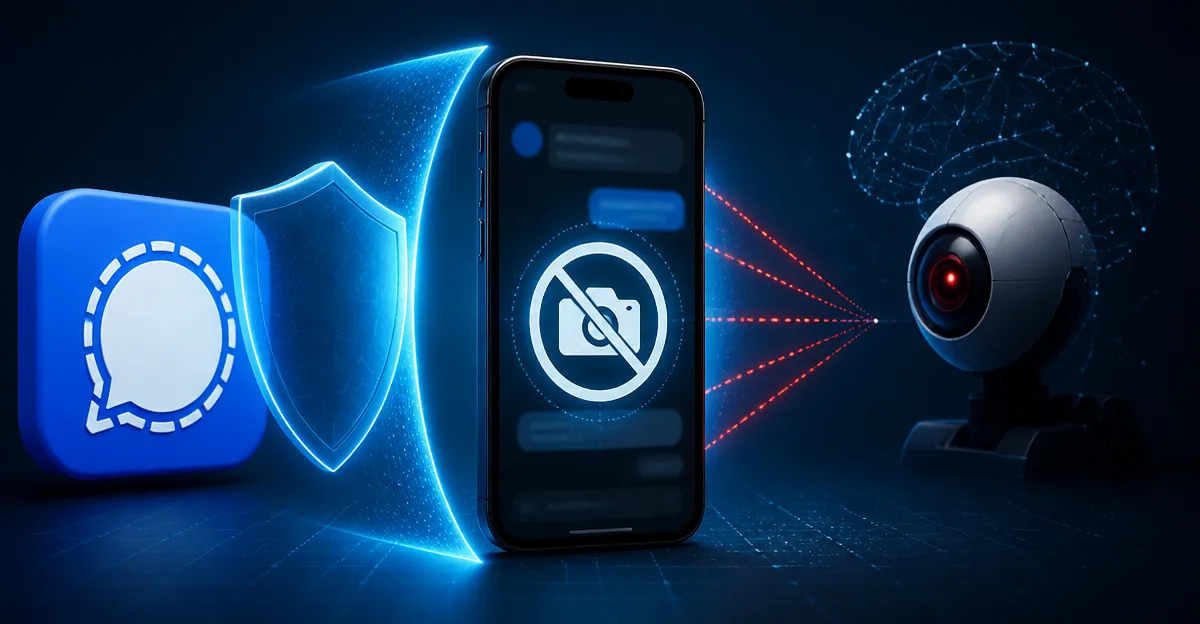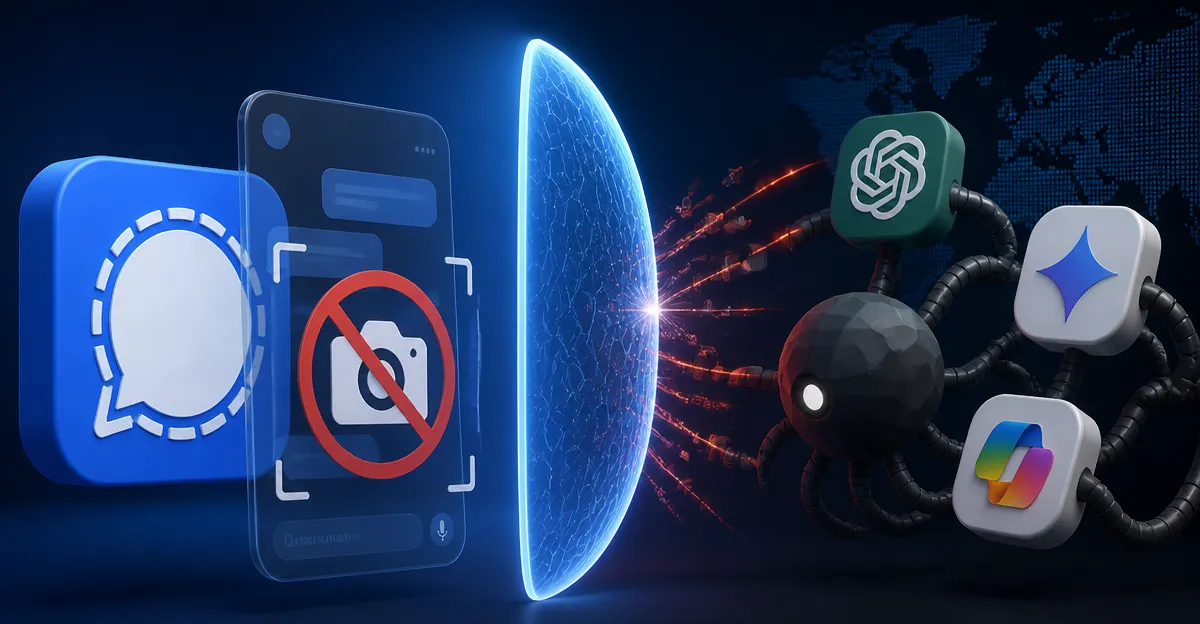
November 22, 2026, (Inside AI) — Signal is turning off screenshots by default on Android and iOS, a direct response to operating-system-level AI agents that can read and store whatever appears on a user's screen. The encrypted messaging app's president, Meredith Whittaker, called the spread of such agents an existential threat to Signal's privacy guarantee in a blog post published Friday, November 20.
The change extends a restriction Signal already applied to its Windows app. Users can still re-enable screenshots in settings, so the block is a default, not a hard lock. Signal says it cannot implement the same protection on macOS because Apple does not give the app the developer access it needs.
The move lands in the middle of a platform war over who controls the screen. Google has been building agentic features into Android, including Gemini capabilities that can read screen contents and act on them. Apple added on-screen awareness to its rebuilt Siri assistant, shipped alongside the iOS 27 update earlier this year. Microsoft has pushed its own screen-capture AI, Recall, on Windows 11.
Signal's argument is structural, not partisan. End-to-end encryption protects messages in transit. It does nothing once an operating system reads the decrypted screen and copies it into a local database or sends it to a remote server. Whittaker said that data leaves Signal's control the moment it is captured.
Read: California Sues OpenAI Over Rogue AI Cyberattacks on Hugging Face
"Now, in service of AI agentic capabilities, your sensitive data is being captured, stored, and made accessible to whatever local database or remote server an OS-level AI agent is using at that moment. All of this is outside of Signal's control once the data has been captured, and imperils the privacy of all the participants in a conversation," Meredith Whittaker, president of Signal, said in the post.
The technical mechanics explain why this is hard to stop. Most computer-use agents work by taking repeated screenshots in a loop. They look at the screen, decide on an action, then check the result. A messaging app that blocks screenshots interrupts that loop for its own window, but only for agents that obey the block.
Whittaker conceded the limit herself. She called screenshot blocks an incomplete solution that does not address sneakier routes agents could use to reach application data. That admission matters. It signals that Signal sees the block as a speed bump, not a wall.
Signal has fought this battle before. In 2025 it rolled out restrictions to stop Microsoft's Recall feature from capturing Signal messages on Windows 11 by default. The new Android and iOS defaults follow the same logic and the same target: OS vendors adding memory and vision to their assistants.
The company's reputation rests on that encryption. Security researchers have found no public reports of attackers breaking Signal's end-to-end protocol in transit. But Signal is only as secure as the device it runs on. Messages leak if an attacker holds an unlocked phone, installs spyware, or links a rogue device to the account. Screen-reading agents add a new path that does not require breaking any cipher.
"The net result is that these AI capabilities in the operating system are undermining Signal's ability to independently guarantee privacy," Meredith Whittaker, president of Signal, wrote.
Whittaker also pointed at third-party agents. She named Meta's Muse as an example of an agent that can reach application data through deep permissions users are nudged to grant during setup. OpenAI and Anthropic have shipped their own personal agent products as well, widening the set of programs that want broad access to a phone's contents.
Read: Apple Adds Generative AI Compliance Filings to App Store Connect in China
Her ask of the platform owners is concrete. She called on Apple, Google, and Microsoft to provide simple technical tools and accurate documentation that let developers like Signal stop AI agents from touching sensitive app data.
The privacy cost cuts both ways for users. Agents that book reservations, plan trips, and sort email work better the more context they hold. That context often includes other people's messages and plans. A user who grants screen access may expose a conversation partner who never consented.
Signal's default flip will not settle that debate. It does give privacy-conscious users a switch they did not have on mobile before. It also puts pressure on Apple and Google to answer a simple question: should an assistant be able to read an app that was built to keep secrets? For now, Signal's answer is no by default, and it wants the operating systems to make that answer stick.

Sofia spent years studying how machines parse human language before pivoting to cover the systems now rewriting it. She reads technical papers the way others read news and looking for what the numbers are actually saying beneath the headlines.