November 23, 2026, (Inside AI) — Indian equities are poised to extend a four-week winning streak on Monday as foreign investors keep pouring money into the country's stock market, even while a global selloff in AI-linked shares deepens across Asia.
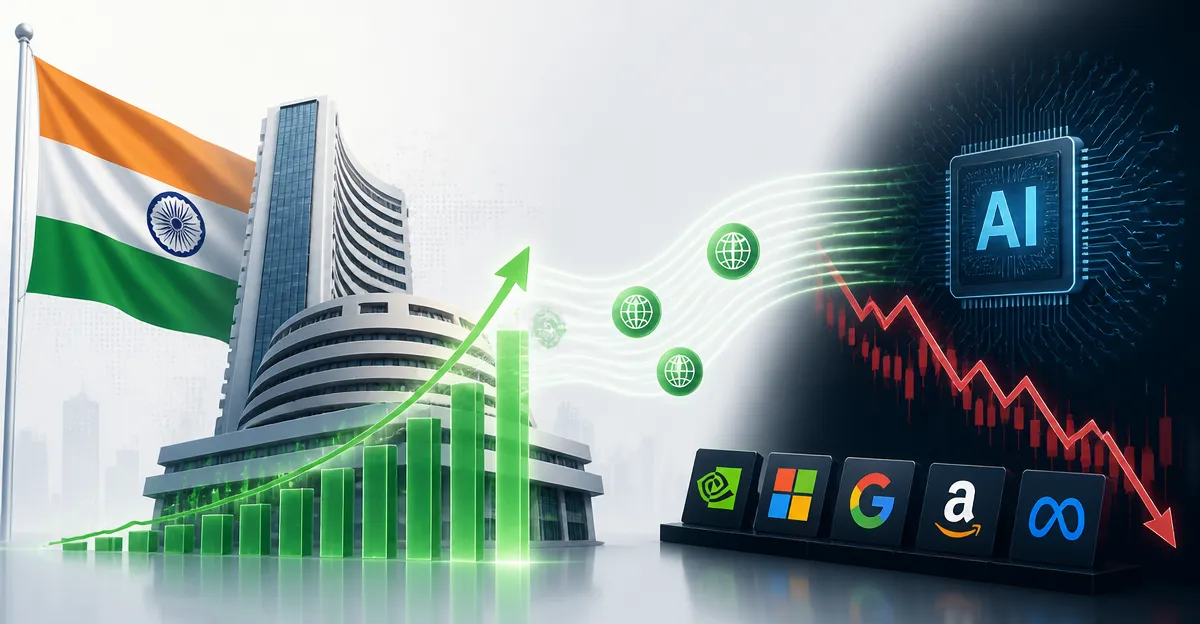
GIFT Nifty futures traded at 25,912 points early Monday, pointing to a higher open for the benchmark Nifty 50, which closed at 25,800.6 on Friday. The setup caps an extraordinary month: the Nifty has climbed nearly 12% in November, while MSCI's broadest Asia Pacific index outside Japan has fallen 10% over the same period.
The divergence is the story. Foreign investors net bought Indian shares worth 103.08 billion rupees ($1.11 billion) on Friday alone, according to provisional data. November inflows now stand at a record $13 billion, cutting year-to-date outflows to $18.4 billion. That reversal follows two years of sustained selling by overseas funds.
The money is not arriving because India's corporate earnings have suddenly accelerated. It is arriving because global capital is rotating out of the AI trade. South Korean equities fell 3% on Monday, and the wider regional gauge dropped 1%, as investors questioned the scale of debt-funded spending on data centers built to power AI models.
Read: Anthropic Stock Falls 8.5% as AI Sell-Off Deepens, Nvidia Plunges 14%
That skepticism has a concrete basis. Hyperscaler capital expenditure commitments have grown faster than the revenue streams meant to justify them, and credit markets have started pricing in more risk on AI-related borrowing. When the most crowded trade in global markets wobbles, fund managers look for markets that were left behind. India, after two years of outflows, fit that description.
Two brokerage upgrades reinforced the shift. HSBC and Goldman Sachs both raised Indian equities to "outperform," giving institutional allocators a research justification for rebalancing away from AI-heavy portfolios.
Oil has added a second tailwind. Brent crude futures slipped 0.2% to $92.3 per barrel and have fallen 21.6% this month on expectations of easing Middle East tensions and recovering regional supplies. Cheaper crude directly improves India's inflation outlook, current account position, and the margin prospects of import-heavy sectors.
Can The Nifty Defend Its Gains?
The rally now faces its first real test. A market that rises on foreign flows can fall just as quickly when those flows reverse, and the global risk backdrop is deteriorating rather than stabilizing.
"Following the sharp, largely uninterrupted rally in recent sessions, the market's ability to withstand deteriorating global risk appetite and defend key support levels will be critical in determining whether the uptrend retains momentum or gives way to profit-booking," said Ponmudi R, CEO of Enrich Money.
The AI selloff itself deserves scrutiny. The concern is not that AI demand has disappeared. It is that the financing structure behind data center buildouts relies heavily on debt, and equity markets are now demanding evidence that the spending converts into durable earnings. South Korea's 3% slide reflects its heavy exposure to memory chip suppliers tied to AI infrastructure. India's benchmark carries far less of that exposure, which is precisely why it has become a destination for rotated capital.
Corporate news adds idiosyncratic catalysts. Tata Steel will acquire a 26.4% stake in APL Apollo Tubes for 155.1 billion rupees in cash and launch an open offer for a further 26%. Maruti Suzuki India raised prices on select models by an average 0.31% from November 22, citing sustained cost pressures. IndusInd Bank terminated former top executive Sumant Kathpalia and is seeking to recover pay across his entire tenure following a disciplinary inquiry.
The rupee reference rate sits at 92.67 per dollar, a level that makes foreign inflows more valuable in local currency terms but also reflects persistent pressure on the currency.
For AI watchers, the Indian rally is a useful barometer. It measures how aggressively global investors are willing to abandon the AI infrastructure trade, and whether that rotation lasts beyond a few weeks. If the data center debt debate intensifies, India's relative appeal grows. If AI earnings surprise to the upside, the flows could reverse just as fast.

Shamil has a low tolerance for AI that only works in controlled demos. He covers agentic systems and generative AI with the skepticism of someone who has seen too many “revolutionary” tools quietly disappear six months after launch.