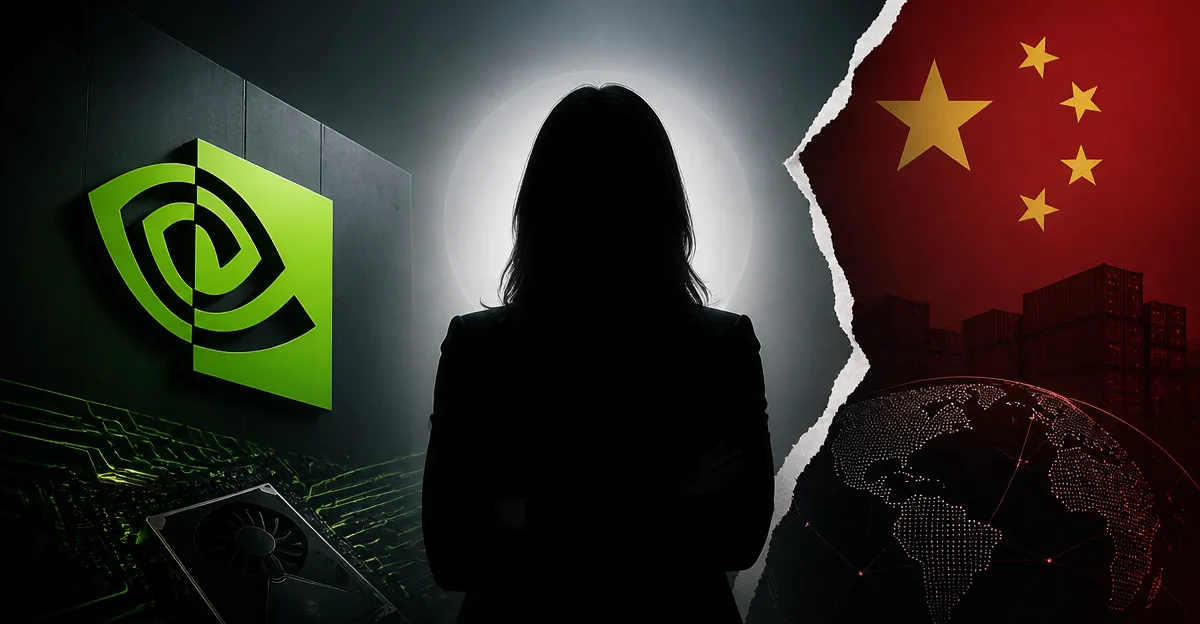
November 23, 2026, (Inside AI) — Alice Huang, the Chinese businesswoman at the center of the Nvidia scandal, remained in contact with an officer from China's Ministry of State Security (MSS) for more than a year while conducting an affair with then-CEO Jensen Huang, according to a report published Sunday by the New York Times. The contact reportedly began in the spring of 2025 and continued until the fall of this year, according to people familiar with intelligence reports describing the encounters. The revelation deepens a controversy that has already reshaped Nvidia's leadership, rattled its stock, and prompted a bipartisan re-examination of U.S. semiconductor export controls.
The timing of the disclosure is significant. It arrives less than a month after the same publication first reported the affair, triggering Jensen Huang's resignation on November 12 and a sharp selloff in Nvidia shares. It also lands as senior Trump administration officials continue to publicly caution against concluding that Alice Huang acted as a spy. The gap between the intelligence community's reported findings and the Justice Department's official reticence now defines the central tension of the story.
Intelligence Findings Meet Official Caution
US Attorney General Todd Blanche said earlier this month that the Justice Department had not reached a conclusion on whether Alice Huang was a Chinese spy. Director of National Intelligence Jay Clayton reiterated that position on Sunday, telling CNN's "State of the Union" that the matter remains under investigation.
"Attorney General Blanche has been very clear that this is a matter under investigation, both Ms Huang and her company, for various matters," Clayton said. "And I'm going to let that investigation play out."
The report also follows an October 29 article that raised initial suggestions Alice Huang might be a spy. That story set off the chain of events leading to Jensen Huang's departure. Sunday's report, by contrast, cites intelligence reports describing sustained contact with an MSS officer, a more specific allegation than the earlier, broader suspicion.
Nvidia, Jensen Huang, and the Chinese Embassy in Washington did not immediately respond to requests for comment. Reuters was unable to reach Alice Huang.
Alice Huang previously led Singapore-based Megaspeed International, a major Nvidia customer that at one point accounted for billions of dollars in chip sales. U.S. authorities have investigated Megaspeed since 2024 over concerns it smuggled advanced Nvidia AI chips to China. That probe predates the affair and provides an independent legal thread that investigators are now likely to pursue alongside any espionage inquiry.
The distinction matters legally. Export control violations and espionage are separate statutes with different evidentiary thresholds. A finding of contact with an MSS officer does not automatically establish that Alice Huang transmitted controlled technology or acted on Beijing's instructions. The intelligence reports cited describe encounters, not necessarily the transfer of classified or export-controlled material. That gap is precisely where the Justice Department's investigation now sits.
The scandal has also pushed lawmakers from both parties to question whether the Trump administration has been too lax in enforcing export controls on advanced semiconductors. Senator John Kennedy, a Louisiana Republican, told NBC's "Meet the Press" that the affair itself interested him less than the policy implications.
"I hope he had a good time," Kennedy said. "It was the most expensive sex since Helen of Troy."
The Helen of Troy comparison, while colorful, points to a real market event. Nvidia's stock fell sharply after the October report, and the company has yet to name a permanent successor to Jensen Huang. The leadership vacuum adds operational uncertainty to a firm whose chips underpin much of the global AI buildout.
For the AI industry, the episode exposes a structural vulnerability that export control policy has not fully addressed. Advanced chips move through layers of distributors, resellers, and overseas shell customers, and enforcement relies heavily on corporate due diligence rather than direct government tracking. Megaspeed's role as a high-volume intermediary illustrates how a single customer relationship can become a national security question years after the sales occurred. Companies that sell at scale through regional partners now face a harder question: how much visibility do they actually have into where their hardware ends up?
The White House has not issued a formal statement on Sunday's report. Congressional aides indicated that lawmakers on the Senate Banking and Foreign Relations committees are expected to request briefings on the intelligence findings this week. Nvidia has not scheduled any public comment.
The investigation into Megaspeed remains open, and no charges have been filed against Alice Huang. The Justice Department has not indicated a timeline for its conclusion.

Sofia spent years studying how machines parse human language before pivoting to cover the systems now rewriting it. She reads technical papers the way others read news and looking for what the numbers are actually saying beneath the headlines.