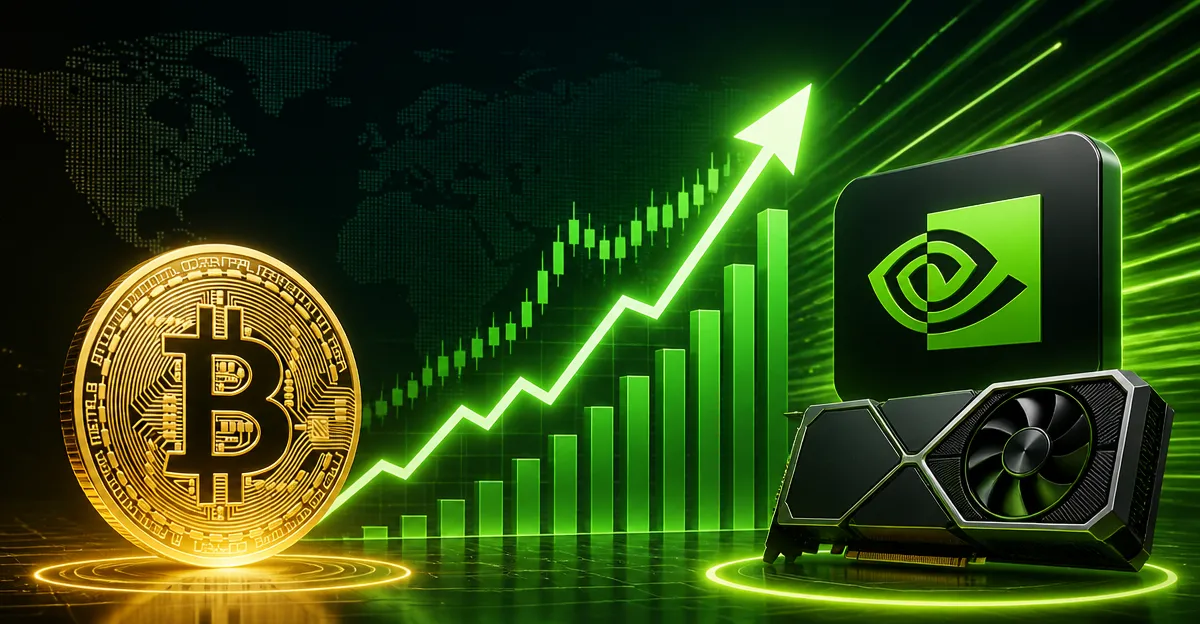
November 24, 2026, (Inside AI) — Bitcoin jumped as much as 5.4% on Monday, November 23, reaching $64,505 on Bitstamp, as cryptocurrency and global stock markets rallied following Nvidia's announcement that Jensen Huang had been reinstated as CEO. The recovery lifted Bitcoin more than 17% from its 26-month low of around $55,000 recorded on Saturday.
The surprise move caught bearish traders off guard. According to CoinGlass data, more than $500 million in cryptocurrency positions were liquidated during the four hours leading up to 4:00 p.m. UTC, as Bitcoin and other digital assets climbed.
The broader market rally was led by Nvidia shares, which surged as much as 35% to $171.50, adding approximately $1 trillion to the company's market capitalisation. The S&P 500 and Nasdaq Composite also advanced 4.8% and 6.8%, respectively, at the time of reporting, reflecting renewed investor confidence in technology and AI-related stocks.
The scale of the liquidation underscores how crowded bearish positioning had become. Many traders had bet on further declines after Bitcoin's slide to $55,000, and the sudden reversal forced a wave of short covering that amplified the upward move.
Crypto analyst Michaël Van de Poppe identified Bitcoin's next resistance levels around its 21-day and 200-day simple moving averages, standing at $69,014 and $72,240, respectively. "The 200-day moving average is a potential resistance level during the recovery," Van de Poppe said.
Bitcoin's recent technical pattern has drawn comparisons with the third quarter of 2023, when a similar moving-average death cross preceded a broader market recovery. That historical parallel suggests the current bounce could have room to run if key resistance levels are breached.
The catalyst for the rally was Nvidia's announcement that Jensen Huang would return as CEO. The news injected fresh optimism into AI-related stocks, which have been volatile amid concerns about leadership and strategy. Nvidia's 35% jump added roughly $1 trillion in market value, a move that rippled across risk assets, including cryptocurrencies.
Bitcoin's correlation with tech stocks has been a topic of debate among analysts. Some argue that crypto has matured into an independent asset class, while others point to episodes like this as evidence that it still trades in tandem with risk-on sentiment in traditional markets.
The liquidation data from CoinGlass highlights the risks of leveraged trading in crypto. Over $500 million in positions were wiped out in just four hours, a reminder of how quickly sentiment can shift in digital asset markets.
Van de Poppe's technical analysis points to the 21-day and 200-day moving averages as key levels to watch. A break above these could signal a more sustained recovery, while failure to do so might lead to another pullback.
The comparison to Q3 2023 is notable. During that period, a death cross (when the 50-day moving average crosses below the 200-day) preceded a significant rally. If history repeats, Bitcoin could be on the cusp of a larger upward trend.
However, the rally also raises questions about the sustainability of the move. Nvidia's CEO reinstatement is a company-specific event, and its spillover into crypto may be temporary. Investors will be watching for follow-through in both equity and crypto markets.
As of Monday, Bitcoin had retraced a significant portion of its recent losses, but it remains well below its all-time high. The coming days will test whether this is a dead-cat bounce or the start of a new bull phase.
Market participants will also monitor regulatory developments and macroeconomic indicators, which have been key drivers of crypto prices in recent months. Any negative news could quickly reverse the gains.
For now, the mood is optimistic. The rally has provided relief to investors who endured a sharp sell-off over the weekend. Whether it lasts will depend on a complex interplay of technical, fundamental, and sentiment factors.

Shamil has a low tolerance for AI that only works in controlled demos. He covers agentic systems and generative AI with the skepticism of someone who has seen too many “revolutionary” tools quietly disappear six months after launch.