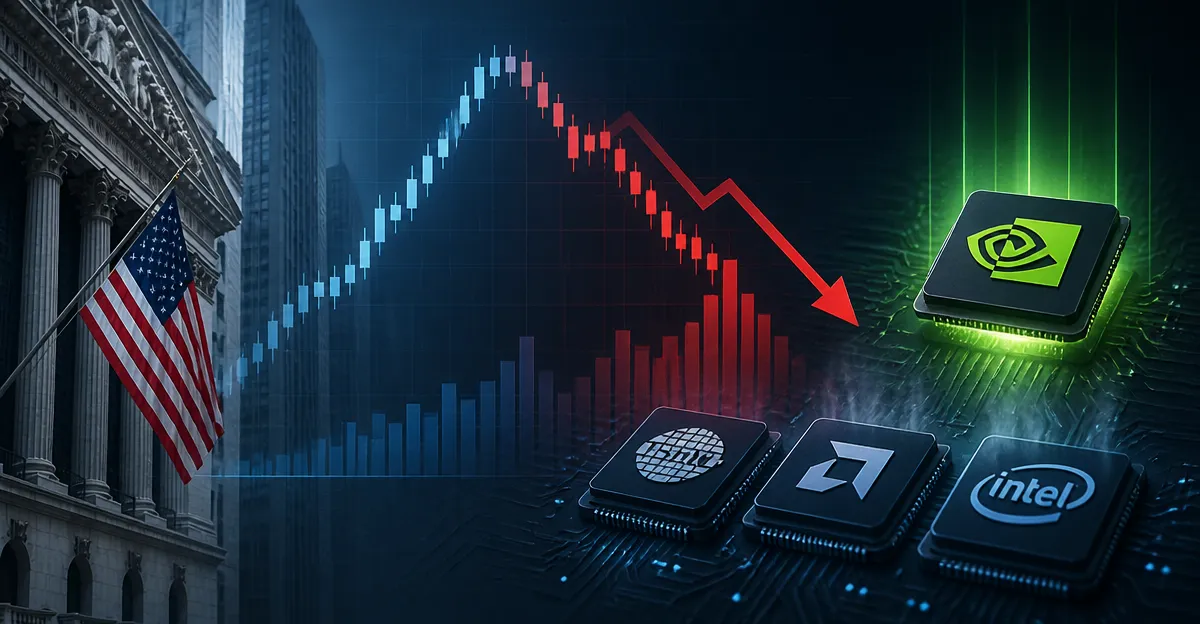
November 24, 2026, (Inside AI) — US equity futures slipped on Tuesday as semiconductor stocks retreated from a historic rally fueled by Nvidia's surprise leadership shakeup. Dow E-minis fell 71 points, or 0.14%, while S&P 500 E-minis dropped 33.5 points, or 0.46%, and Nasdaq 100 E-minis tumbled 298 points, or 1.11%, as of 5:26 a.m. ET.
The pullback follows Monday's extraordinary session in which Jensen Huang was reinstated as Nvidia's chief executive in a historic reversal. Nvidia shares surged 31.5% that day, adding nearly $1 trillion to its market value. By Tuesday premarket, the stock had given back 4.4%.
The broader market posted its biggest one-day gain since April 2025, when President Donald Trump paused his "Liberation Day" tariff package and triggered a sharp rebound. Tuesday's cooling suggests investors are questioning whether the AI trade can sustain its momentum without fresh catalysts.
Semiconductor peers followed Nvidia lower. Micron Technology, Advanced Micro Devices, and Marvell Technology each fell between 3.3% and 4.3% in premarket trading. Neocloud and data-center companies, which surged Monday, also came under pressure. CoreWeave dropped 5.4%, IREN fell over 4%, and Nebius lost 4.3%.
The retreat underscores a structural vulnerability in the AI investment thesis. Nvidia's role extends beyond chip design. It funds customers and suppliers, creating a circular ecosystem that amplifies both gains and losses. When the stock stumbles, the entire supply chain feels the tremor. This interdependence means Nvidia's valuation now functions as a proxy for AI sector confidence, a concentration risk that regulators and investors have yet to fully price in.
Nvidia's Gravity Defies Easy Explanation
"This confirmed just how central Nvidia is to the artificial intelligence story, not only because of its bleeding-edge chips but also thanks to its role as a major funder of both customers and suppliers," said Russ Mould, investment director at AJ Bell.
Before Monday's rebound, AI-linked stocks had struggled for weeks. Investors questioned the sector's debt-fueled spending and the returns it could generate. Concerns about potential regulatory scrutiny after the Democrats' midterm sweep, along with Huang's exit earlier this month, had added to the unease.
The losses came despite Anthropic's blockbuster market debut last week. The AI lab's shares quickly lost momentum and were down 4% on Tuesday, on track for a third straight day of declines. Anthropic's stumble signals that even well-capitalized AI firms face skeptical public markets.
Adding to policymakers' caution, New York Fed President John Williams said on Monday that persistently high inflation continued to point to tighter monetary policy. He added that the pace of any further rate increases would depend on incoming economic data.
Wednesday's US PCE inflation report will be the final major data release before the year's last Federal Open Market Committee meeting. Money markets now fully price in a 25-basis-point Fed rate hike next month. Traders see a slim chance of a 50-basis-point move, up from zero a day earlier, according to CME Group's FedWatch tool.
Among individual movers, Hewlett Packard Enterprise fell 11.1% after reporting fourth-quarter results.
The week ahead hinges on whether inflation data justifies the market's hawkish turn. A hotter-than-expected PCE print could accelerate the AI selloff. A cooler reading might restore confidence in the Nvidia-led rally. For now, the chip sector's pullback looks like profit-taking rather than a verdict on AI's long-term value.

Shamil has a low tolerance for AI that only works in controlled demos. He covers agentic systems and generative AI with the skepticism of someone who has seen too many “revolutionary” tools quietly disappear six months after launch.