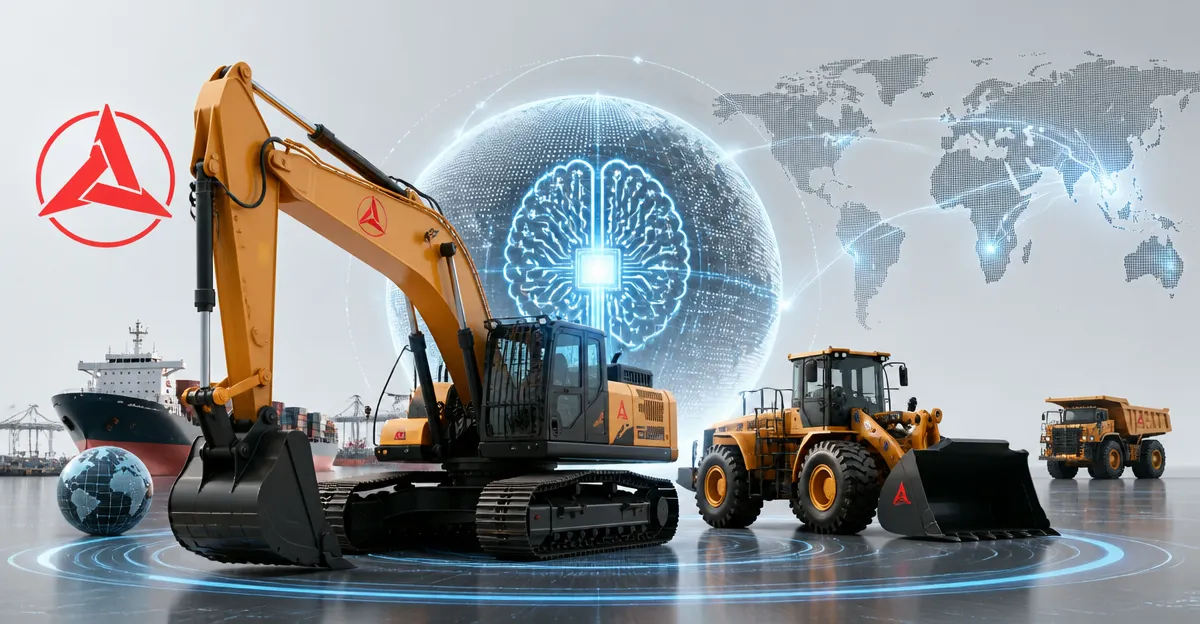
November 27, 2026, (Inside AI) — Sany Heavy Industry will launch autonomous mining equipment and artificial intelligence agents designed to coordinate entire fleets, the Chinese machinery manufacturer announced at the Bauma China trade fair in Shanghai. The move puts Sany in direct competition with Japan's Komatsu and U.S.-based Caterpillar, both of which have invested heavily in automated construction and mining solutions.
Sany's push comes as overseas sales continue to grow, though the company did not disclose specific revenue figures for its international business. The new AI agents are intended to manage multiple machines simultaneously, handling tasks such as route planning, load distribution, and real-time adjustments based on site conditions. Autonomous mining equipment, including haul trucks and excavators, will operate with minimal human oversight.
The announcement signals a broader shift in the heavy machinery sector, where automation is becoming a key differentiator. Mining companies increasingly seek to reduce labor costs and improve safety by deploying self-driving fleets. Sany's entry intensifies a race that Komatsu and Caterpillar have led for years, with both firms already offering commercial autonomous haulage systems.
Can Sany's AI Agents Outperform Established Rivals?
Sany's AI agents represent a step beyond simple automation. Unlike individual self-driving machines, these agents coordinate fleets, potentially optimizing fuel use and reducing idle time. The company has not released technical details or performance benchmarks, leaving questions about scalability and reliability unanswered.
Read: AI Tunnel Boring Machine
Industry analysts note that Sany's advantage lies in its large installed base in China and emerging markets, where mining activity is growing. However, Komatsu and Caterpillar have decades of operational data from autonomous systems deployed in Australia, Chile, and Canada. That data advantage could prove difficult to overcome.
Sany's overseas expansion has been steady, with sales growing in Southeast Asia, Africa, and Latin America. The company's ability to offer cost-competitive autonomous solutions could appeal to smaller mining operators who find Western systems too expensive. Yet, trust in autonomous technology remains a hurdle, especially in regions with weak regulatory frameworks.
The global autonomous mining equipment market is projected to reach $8.5 billion by 2030, according to industry estimates. Sany's move could accelerate price competition and drive further adoption. However, the company must demonstrate that its AI agents can handle complex, unpredictable environments without costly errors.
Sany's announcement did not include a timeline for commercial deployment or pricing. The company also declined to name technology partners or specify which AI models power its agents. Such omissions are common at trade shows, where hype often outpaces reality.
For now, Sany's challenge is clear: convince mining companies that its AI is ready for the rough, remote conditions where autonomous equipment must operate. The company's success will depend on pilot projects and real-world validation, not trade show promises.
Read: Global Industrial Robot Fleet
Competitors are watching closely. Komatsu and Caterpillar have both expanded their autonomous offerings in recent years, and neither is likely to cede market share without a fight. Sany's move ensures that the battle for the world's mines will be fought with algorithms as much as iron.

Tobias is less interested in what a robot or a prompt can do today than in what it means for tomorrow. He writes about prompt engineering and robotics for readers who want context, not just specs.