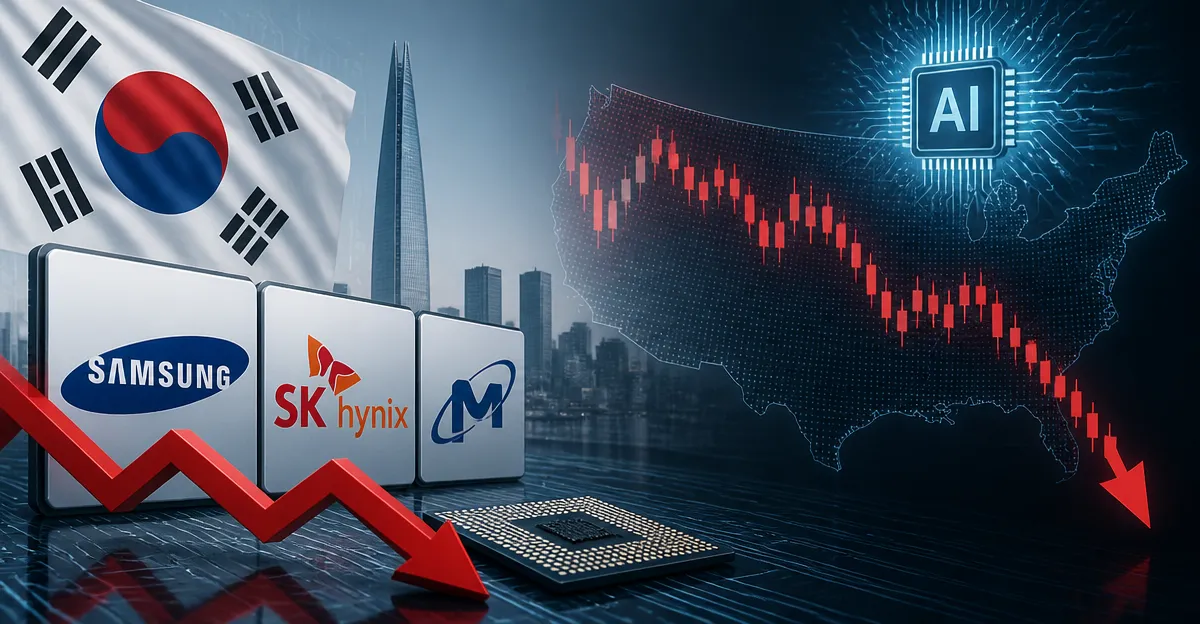
July 8, 2026, (Inside AI) — South Korean chip stocks tumbled sharply Wednesday morning after a brutal overnight selloff on Wall Street. Samsung Electronics shares dropped as much as 4.4%, while SK Hynix slid 5%. The declines tracked a broad rout in U.S. semiconductor stocks driven by mounting fears over the AI boom's durability.
The Philadelphia Semiconductor Index plunged 4.7% overnight. Intel cratered 9.7%, AMD lost 6.5%, and Micron fell 4.7%. The carnage reflected a sudden shift in investor sentiment. For months, AI euphoria had propelled chip valuations to dizzying heights. Now, the question is whether that spending spree can last.
South Korea's memory titans are uniquely exposed. Samsung and SK Hynix supply the high-bandwidth memory (HBM) chips essential for AI accelerators like Nvidia's GPUs. Their fortunes are tightly coupled to AI infrastructure buildout. When U.S. investors panic, Seoul often feels the aftershocks within hours.
“The selloff is a direct reflection of the market's reassessment of AI capex sustainability,” said Heekyong Yang, reporting from Seoul for Reuters. The trigger wasn't a single news event. Rather, it was a cumulative anxiety that hyperscalers might soon curb their voracious appetite for chips.
The Capex Conundrum and Memory Market Realities
AI-driven demand has been a bonanza for memory makers. HBM chips command premium prices and fat margins. But the same boom has lured massive capacity expansions. Analysts at TrendForce warn that HBM supply could outstrip demand as early as 2027. That timeline may be accelerating.
Historical patterns are instructive. The memory chip industry is notoriously cyclical. Booms inevitably lead to gluts. In 2018, a similar capex surge preceded a brutal downturn that crushed Samsung's profits. Today's AI narrative feels different, but the physics of supply and demand remain unchanged.
Competing viewpoints add complexity. Goldman Sachs recently argued that AI server spending will grow 40% annually through 2028. But Morgan Stanley cautioned that cloud providers are already optimizing workloads, potentially reducing chip intensity per query. The truth likely lies in between.
What's missing from the panic is nuance. AI inference, as opposed to training, is more memory-efficient. New architectures like Google's TPU v6 use less HBM per flop. If inference scales faster than training, memory demand could plateau sooner than expected. Investors are pricing in worst-case scenarios without fully understanding the technical shifts.
Geopolitical Undercurrents and What Comes Next
The selloff also has a geopolitical dimension. South Korean chipmakers face export controls to China, their largest market. Recent U.S. Commerce Department rules have tightened restrictions on advanced memory exports. Samsung and SK Hynix are walking a tightrope, investing in both China and the U.S. to hedge risks.
“We are monitoring the situation closely, but no fundamental changes have occurred in our order books,” a Samsung Electronics spokesperson told Inside AI. The statement aims to calm nerves, yet markets often move faster than corporate realities.
Looking ahead, earnings season will be pivotal. Samsung reports Q2 results in late July. Any hint of slowing AI-related revenue could deepen the rout. Conversely, strong numbers might restore confidence. The Philadelphia Semiconductor Index's 4.7% drop suggests the market is bracing for disappointment.
For context, the AI chip boom has been the defining trade of the decade. Nvidia's market cap surpassed $4 trillion earlier this year. Memory makers rode the coattails. Now, the first real test of that thesis is underway. Whether this is a blip or a turning point depends on data we don't yet have.