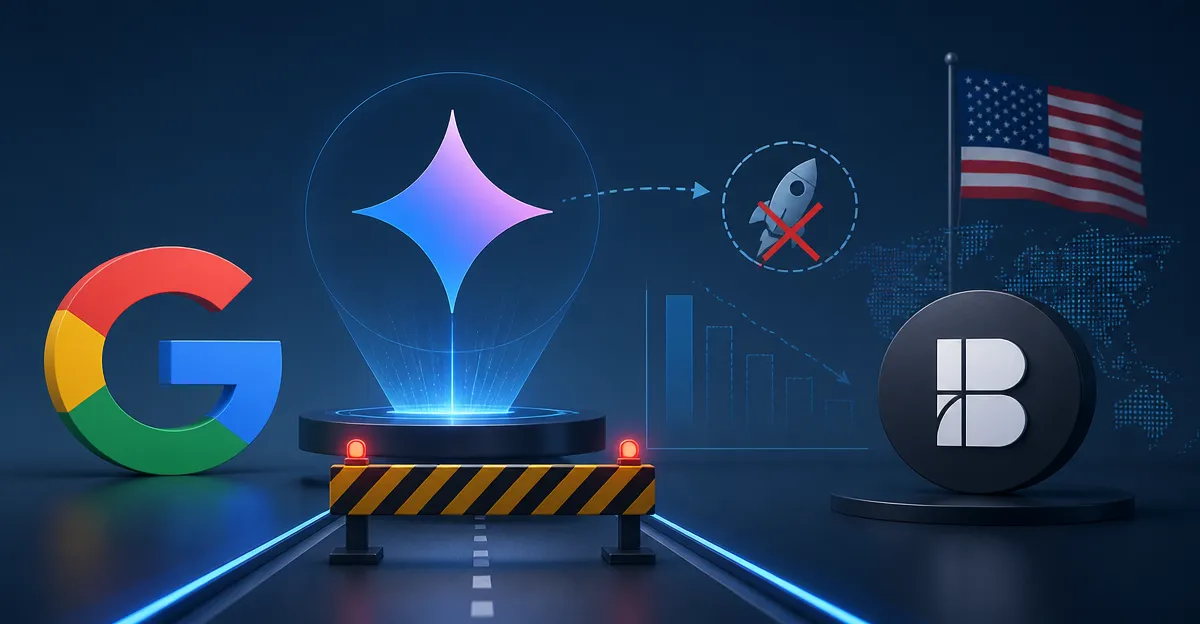
July 17, 2026, (Inside AI) — Alphabet Inc.’s Google has postponed the launch of its next-generation flagship AI model, Gemini 3.5 Pro, by several months after internal testing revealed performance shortfalls, particularly in coding tasks, according to a Bloomberg News report citing people familiar with the matter.
The delay underscores the intensifying pressure on AI labs to deliver transformative capabilities while maintaining reliability. Gemini 3.5 Pro was expected to be a cornerstone of Google’s enterprise AI push, but the model’s inability to meet internal benchmarks forced leadership to push back the release timeline, the sources said.
The setback comes as rivals like OpenAI, Anthropic, and Meta accelerate their own model rollouts, often prioritizing speed over perfection. Google’s cautious approach reflects a strategic bet that enterprise customers will value robustness over rapid iteration.
Google has not publicly commented on the delay, but the company has historically emphasized safety and responsibility in AI deployment. A spokesperson declined to comment when reached by Reuters.
Industry analysts note that coding capabilities have become a critical battleground for AI models, with developers increasingly relying on AI assistants for software engineering. A model that underperforms in code generation could lose significant market share to competitors like GitHub Copilot, powered by OpenAI’s Codex, or Anthropic’s Claude, which has gained traction for its coding accuracy.
“The coding benchmark is the new Turing test for enterprise AI,” said Dr. Sarah Chen, an AI researcher at Stanford University, who is not involved with Google’s project. “If you can’t write production-grade code, you’re not ready for the boardroom.”
The delay also highlights the immense computational and data challenges in scaling large language models. Training runs for frontier models now cost hundreds of millions of dollars, and diminishing returns on scale have forced companies to rethink architectures. Google’s Gemini team is reportedly exploring novel training techniques, including reinforcement learning from human feedback (RLHF) and constitutional AI, to close the gap.
Google’s previous model, Gemini 2.0 Ultra, launched in early 2025, received mixed reviews for its reasoning abilities, though it excelled in multimodal tasks. The company had hoped Gemini 3.5 Pro would leapfrog competitors, but internal benchmarks showed only marginal improvements in key areas, Bloomberg reported.
The competitive landscape has shifted dramatically since Google first unveiled its Gemini family in late 2023. OpenAI’s GPT-5, released in mid-2025, set a new standard for coding and problem-solving, while Anthropic’s Claude 4 introduced advanced agentic workflows. Meanwhile, open-source models like Meta’s Llama 4 have eroded the performance gap, putting pressure on proprietary systems.
Google’s cloud division, which relies on AI to differentiate its services, may feel the impact. Enterprise clients often commit to platforms based on the promise of upcoming models, and delays can erode trust. However, some analysts argue that a flawed launch would be more damaging.
“Google learned from the Bard fiasco that rushing to market can backfire spectacularly,” said Mark Sullivan, an analyst at Forrester Research. “They’d rather take the hit now than face a recall later.”
The delay also raises questions about Google’s internal AI governance. Sources told Bloomberg that the decision to postpone was made by DeepMind CEO Demis Hassabis after a review of the model’s safety and performance metrics. Hassabis has previously emphasized the importance of rigorous testing before public release.
Google’s AI efforts have been under scrutiny since the company restructured its research arms, merging Google Brain and DeepMind in 2024. While the merger aimed to streamline development, some insiders say cultural clashes and duplicated efforts have slowed progress.
Despite the setback, Google continues to invest heavily in AI infrastructure. The company recently announced a $30 billion expansion of its data center network, including custom TPU v6 chips designed for next-generation models. This hardware could give Google a long-term edge, even if software timelines slip.
The broader AI industry faces a reckoning as the low-hanging fruit of scaling laws diminishes. Researchers are increasingly turning to inference-time compute and agentic architectures to boost performance, but these methods introduce new complexity and cost.
Google’s delay may signal a shift toward more measured, quality-focused development cycles—a contrast to the “move fast and break things” ethos that has dominated Silicon Valley. For enterprise customers, that patience could pay off, but only if the final product delivers on its promise.