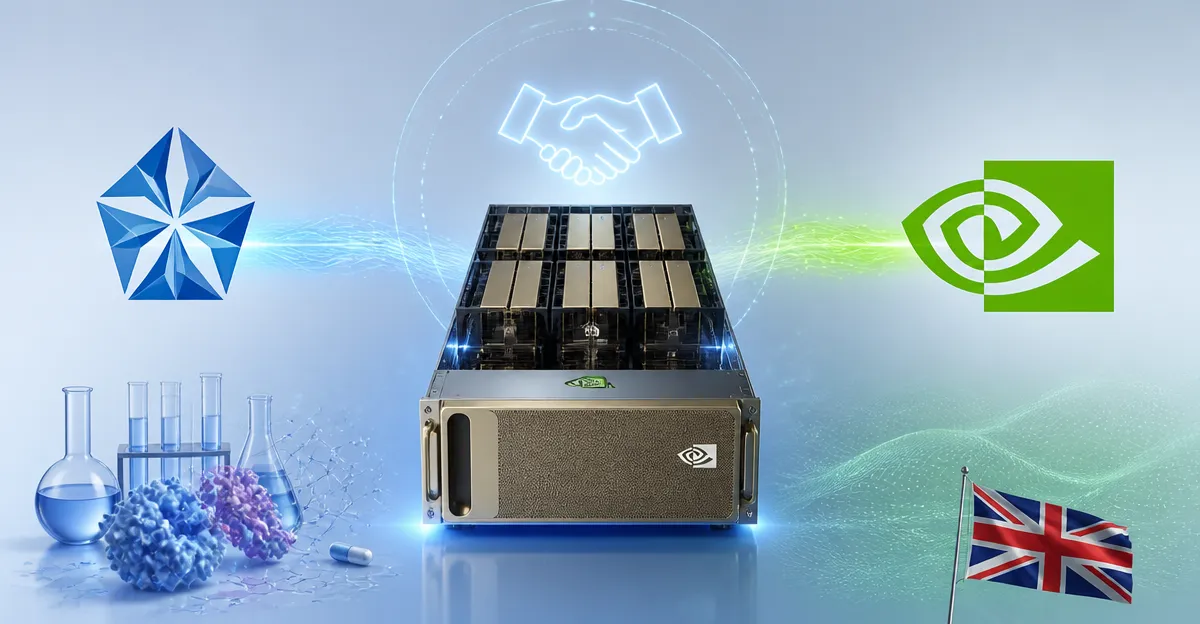
July 20, 2026, (Inside AI) — Bristol Myers Squibb will become the first life sciences company to purchase Nvidia’s latest DGX SuperPOD, powered by the newly unveiled Vera Rubin architecture. The deal, announced Monday, marks a significant escalation in the pharmaceutical industry’s race to harness artificial intelligence for drug discovery.
The financial terms remain undisclosed. However, BMS executives confirmed the investment builds on a smaller SuperPOD system already in use, one they described as two or three generations behind Vera Rubin. This leapfrog upgrade signals the company’s intent to dominate computationally intensive research.
Nvidia revealed the Vera Rubin architecture earlier this year as the successor to its current AI computing platform. The SuperPOD configuration integrates multiple systems for massive parallel processing, tailored for training large-scale AI models. For BMS, this means exponentially faster simulations of molecular interactions.
Robert Plenge, chief research officer at Bristol Myers, quantified the impact. “Maybe before we could do 10 and now we can do dozens,” he said, referring to the number of drug candidates the company can evaluate early in development. The statement underscores a shift from incremental to multiplicative gains in screening capacity.
Read: Can AI Collaborations Power China’s Next Wave of Blockbuster Drug Deals?
Plenge also disclosed that AI tools have already slashed the time to produce medicines for clinical trials by 20% to 30%. He projected that figure could reach 50% in coming years. Such acceleration could compress traditional decade-long timelines, potentially saving billions in R&D costs.
The company attributes one experimental sickle cell disease treatment, currently in early clinical development, directly to AI-enabled research. Without these tools, Plenge said, the candidate would likely not have been discovered. This rare admission highlights the technology’s role in uncovering novel biological targets.
Greg Meyers, chief digital and technology officer at BMS, tied the investment to surging computational demands. The company now uses AI across all its small-molecule programs and most large-molecule programs. As models grow larger and datasets expand, legacy infrastructure becomes a bottleneck.
Energy efficiency also factored into the decision. “When you host these things, you have to pay an electric bill,” Meyers said. “Think of it as 10 times more compute capacity per watt spent … Electricity is not getting cheaper.” The Vera Rubin architecture’s performance-per-watt advantage addresses both cost and sustainability pressures.
This purchase reflects a broader trend. Pharmaceutical giants including Roche, AstraZeneca, and Moderna have struck partnerships with Nvidia or built in-house AI clusters. The goal is uniform: identify drug targets faster and improve the dismal 10% success rate of experimental drugs entering clinical trials.
Yet the BMS deal stands out for its scale and timing. By adopting Vera Rubin so early, the company gains a competitive edge in generative chemistry and protein folding predictions. Competitors may face a widening gap if they delay similar upgrades.
Read: Anthropic Offers $50,000 AI Credits for Rare Disease Research Grants
However, raw computing power alone does not guarantee breakthroughs. Data quality, algorithmic innovation, and integration with wet-lab workflows remain critical. Skeptics note that AI-discovered drugs have yet to consistently outperform traditionally developed ones in late-stage trials.
Nvidia’s push into life sciences mirrors its strategy in autonomous vehicles and climate modeling. The company provides not just hardware but also software frameworks like BioNeMo, a generative AI platform for drug discovery. BMS is likely leveraging such tools alongside the SuperPOD.
The Vera Rubin architecture introduces new tensor core designs and faster interconnects, crucial for the massive parallelism required in molecular dynamics. Industry analysts estimate a single SuperPOD could exceed 1 exaflop of AI performance, though Nvidia has not confirmed specifications.
Bristol Myers Squibb’s move may pressure other pharma firms to accelerate their AI infrastructure roadmaps. The industry’s compute needs are doubling every few months, according to some estimates, making such investments almost mandatory for remaining competitive.
While the immediate focus is drug discovery, the system could later support clinical trial optimization, patient stratification, and real-world evidence analysis. BMS has not detailed these plans, but the versatility of the platform suggests broad applicability.
The deal also highlights the growing symbiosis between Silicon Valley and the pharmaceutical sector. As AI becomes embedded in R&D, the lines between tech and biotech continue to blur, raising questions about data privacy, regulatory oversight, and intellectual property.