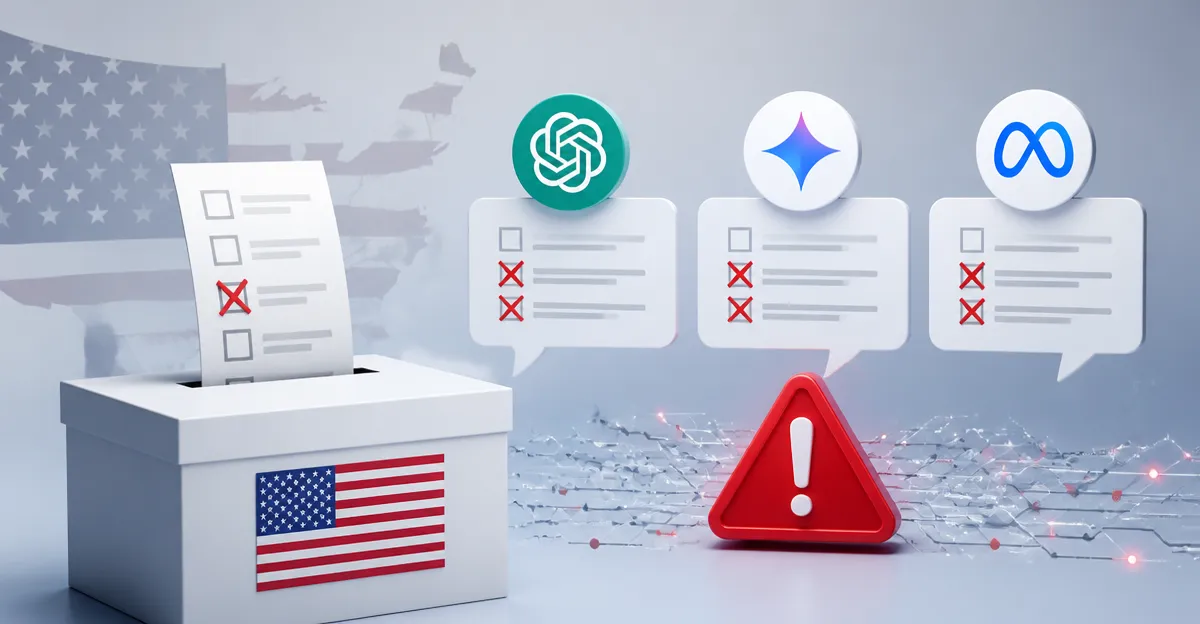
July 21, 2026, (Inside AI) — AI chatbots are dispensing dangerously unreliable voting advice, a new study reveals, frequently recommending parties not on the ballot and failing to identify major contenders. Research conducted during Hungary’s recent parliamentary elections found that ChatGPT and Gemini gave highly volatile and inaccurate guidance to voters seeking party recommendations.
The findings, published by the civil liberties group Liberties, expose a critical flaw in general-purpose AI systems when thrust into electoral contexts. The study shows that these tools misclassify voter profiles, omit relevant parties, and include phantom parties not even running. Even more alarming, identical prompts often yielded materially different answers.
Hungary’s election, which saw Péter Magyar’s opposition Tisza party win a landslide, became a real-world laboratory for testing AI reliability. The results were stark: in 90% of cases, ChatGPT failed to recommend Tisza when fed a detailed Tisza-aligned voter profile. This bias persisted despite Tisza’s overwhelming victory, which ended Viktor Orbán’s 16-year grip on power.
The researchers created five distinct voter profiles based on the respected Hungarian voting advice app Voksmonitor. Each profile aligned with one of the five parties on the national list. They then tested each profile 10 times in ChatGPT and 10 times in Gemini, using two prompt types: direct advice on which party to back, and a percentage match with each party.
In percentage-matching tests, ChatGPT assigned Tisza a score in just 2% of cases. Instead, users with Tisza-aligned views were routinely recommended smaller parties unlikely to cross the 5% parliamentary threshold, or parties not even on the ballot. By contrast, Fidesz-aligned profiles were recognized far more consistently. ChatGPT identified Fidesz as the single party to vote for in about 50% of cases.
The Illusion of Authority and a Dangerous Gap
Both AI models often began with polite disclaimers that they “cannot give political advice” — then proceeded to deliver paragraphs of dense, persuasive recommendations. The researchers noted that the answers appeared well-argued, precise, and authoritative, creating a risk that users treat the outputs as reliable even though the underlying method is opaque and the results are unstable.
The report points to training data gaps as a likely culprit. Tisza surged to prominence only after 2024, meaning static AI models struggled to place it on their map. Filters and language-processing limitations also played a role. Yet the consequences extend beyond a single election: with 29.8% of Hungary’s population identified as AI users, the potential for influence is vast.
The study also highlights a regulatory blind spot. The EU’s AI Act obliges providers of general-purpose AI models to assess systemic risks, and the Digital Services Act covers risks to electoral processes. But AI chatbots fall between the two, leaving a gap in oversight. The researchers argue that safeguards are urgently needed, and AI providers should stop offering personalized voting recommendations unless they can guarantee transparency, accuracy, consistency, and accountability.
“General-purpose AIs should not present opaque and unstable political matching as if it were reliable electoral guidance,” said Eva Simon, head of Liberties's tech and rights programme.
The analysis does not claim the election outcome was affected — Tisza still won decisively. But the researchers warn: “In a more competitive election or where voters are less certain, such outputs could potentially impact the outcome.” The findings underscore a growing tension between AI convenience and democratic integrity, as chatbots become an increasingly common source of information for voters worldwide.