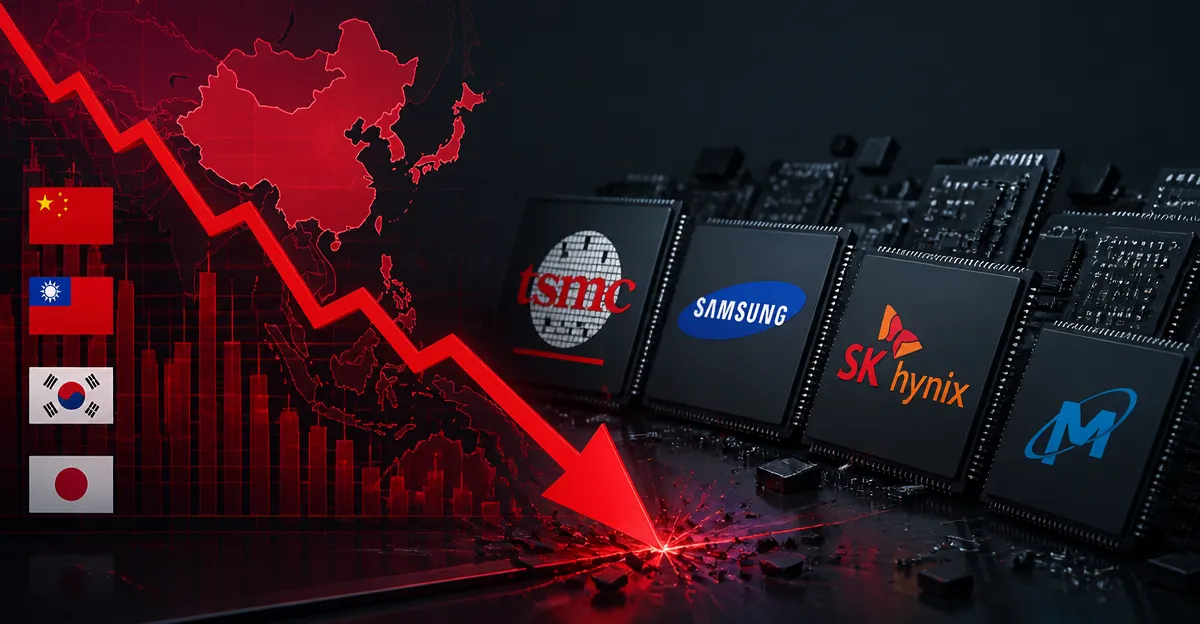
July 29, 2026, (Inside AI) — Asian semiconductor stocks cratered for a second straight day on Wednesday, with Seoul’s Kospi index plunging 12.6% at one point after SK Hynix reported record profits that still missed investor expectations. The sell-off, which has wiped out over 40% of the Kospi’s value from its peak just over a month ago, marks the worst two-day rout in the index’s history. Japan’s Nikkei slid 1.5%, and shares of TSMC fell 3% in Taipei, as the AI-driven chip rally unraveled across the region.
The rout was triggered by SK Hynix’s second-quarter earnings, which showed record profits but fell short of the sky-high benchmarks set by investors betting on the AI boom. The company’s shares tumbled as much as 16%, dragging down Samsung Electronics, which dropped nearly 10%. Together, the two firms account for more than half of the Kospi’s market capitalization, amplifying the index’s moves.
Analysts say the earnings miss exposed deeper anxieties about the sustainability of AI infrastructure spending. Gary Tan, a portfolio manager at Allspring Global Investments in Singapore, captured the mood: “SK Hynix delivered strong results, but in today’s AI market, strong is no longer enough. Investors were looking for additional catalysts, particularly around long-term agreements and shareholder returns, to support a memory sector that has become the epicentre of the AI trade.”
The sell-off extended to U.S. markets on Tuesday, where Intel, Advanced Micro Devices, Sandisk, Western Digital Corp, and Seagate Technology all declined. In a notable rotation, Apple briefly surpassed a $5 trillion valuation as investors sought safety, becoming only the second company ever to hit that mark.
Behind the panic lies a structural vulnerability: retail investors, many using borrowed money, had piled into chip stocks during the recent rally. When the tide turned, margin calls forced a cascade of selling. Han Ji-young, an analyst at Kiwoom Securities, noted: “Hopes of the market rebounding today after a 10% plunge yesterday faded, triggering panic selling and forcing most stock investors to book losses.”
The turmoil underscores a broader reckoning around AI chip valuations. While demand for high-bandwidth memory remains robust, driven by data center expansion, the market is now questioning whether the capital expenditure boom can persist. SK Hynix’s results, though record-breaking, lacked the forward-looking guidance and shareholder return policies that investors craved, according to Tan.
This episode echoes past semiconductor cycles, where periods of frantic capacity building were followed by sharp corrections. The current sell-off, however, is uniquely tied to AI hype, which had propelled SK Hynix and Samsung to stratospheric heights on expectations of insatiable AI chip demand.
Meanwhile, geopolitical tensions added to market jitters. Oil prices climbed after the U.S. military intercepted an Iranian missile barrage and conducted strikes in Iraq, pushing Brent crude to $87.14 a barrel, a 3.6% rise. The convergence of tech stock turmoil and energy supply fears created a risk-off environment that punished overextended positions.
South Korea’s finance minister, Koo Yun-cheol, told the national assembly the government is reviewing market stabilization measures, signaling official concern over the speed of the decline. For now, the AI trade’s epicenter is experiencing a seismic shift, and the aftershocks are being felt from Seoul to Silicon Valley.