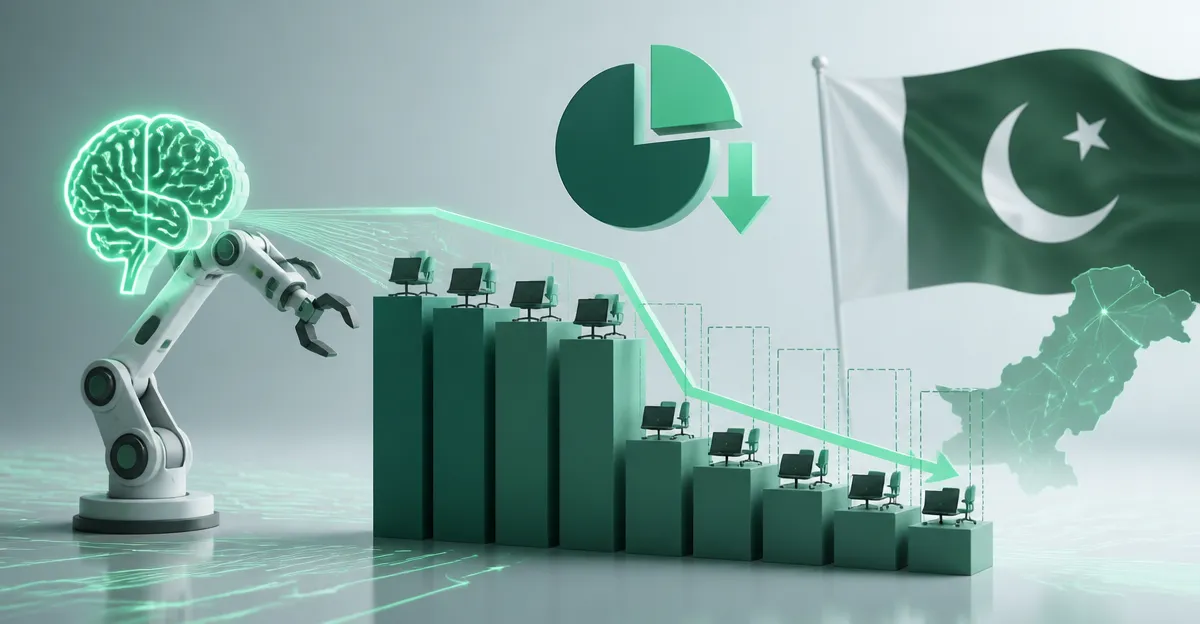
August 7, 2026, (Inside AI) — Pakistan’s technology job market is undergoing a significant transformation as artificial intelligence reshapes hiring patterns, with entry-level positions for junior software developers declining by approximately 25% over the past year, according to industry data from the Pakistan Software Houses Association (P@SHA). The shift is particularly acute among developers aged 22 to 25, whose employment has dropped by nearly 20% since 2024, signaling a structural change in how tech companies build their workforces.
This contraction in junior hiring comes despite robust growth in Pakistan’s IT sector. IT and telecom export remittances surged to a record Rs. 1.2 trillion in fiscal year 2025-26, a 20.6% increase from the previous year. The paradox of a booming industry shedding entry-level roles underscores the dual-edged impact of AI: automating routine tasks while creating demand for higher-level expertise.
AI tools are now proficient in handling many of the repetitive digital tasks traditionally assigned to junior workers. Basic website development, app creation, graphic design, content generation, and manual software testing are increasingly performed by AI systems. As a result, companies report a reduced need for delivery-focused and junior coding roles, allowing existing employees to complete more projects with AI assistance.
The freelance market mirrors this trend. Entry-level freelance projects have fallen from around 15% of total listings to below 9%, while basic writing and translation work declined by 32% year-on-year as businesses adopt AI-powered tools. This shift is pressuring young professionals who traditionally entered the industry through freelance gateways.
Federal Minister for Information Technology Shaza Fatima Khawaja characterized the change as a transition rather than a threat to employment.
“The government’s National AI Policy 2025 aims to create 3 million AI-related jobs by 2030, supported by investment, training programmes and scholarships.” Shaza Fatima Khawaja, Federal Minister for Information Technology
Her statement frames the government’s response as proactive, focusing on upskilling workers to use AI tools and adapt to evolving workplace requirements. The policy targets a net gain in employment through AI-driven roles, though the immediate challenge is bridging the gap for displaced junior workers.
Demand is pivoting sharply toward professionals with advanced skills. Companies are increasingly seeking expertise in AI engineering, cybersecurity, cloud computing, AI integration, and advanced software development. This realignment means that while some traditional entry points are narrowing, new opportunities are emerging for those with specialized training.
The trend aligns with global patterns observed in the IT industry. Pakistan’s experience reflects this dynamic, with the shift occurring rapidly due to the country’s large freelance economy and young workforce.
Several technology firms have already adjusted recruitment strategies. Some report that AI has reduced their need for junior coding roles, enabling leaner teams to handle more projects. Others prioritize experienced professionals who can work effectively alongside AI systems, avoiding large intakes of entry-level developers. This recalibration suggests a long-term restructuring rather than a cyclical downturn.
Critics note that the government’s projection of 3 million AI jobs by 2030 may be optimistic given current infrastructure and education gaps. Pakistan’s higher education system faces challenges in producing graduates with cutting-edge AI skills, and the rapid pace of technological change could outstrip training programs. However, the IT sector’s export growth provides a financial base for investment in upskilling initiatives.
The development also raises questions about income inequality and access to opportunity. As entry-level roles diminish, aspiring tech workers without resources for advanced education may find it harder to break into the industry. This could widen the gap between a highly skilled elite and a larger pool of underemployed graduates, unless targeted interventions are implemented.
Pakistan’s experience may serve as a bellwether for other emerging economies with large IT sectors. The combination of a growing digital economy and rapid AI adoption creates both risks and opportunities, demanding agile policy responses and industry collaboration to ensure that the benefits of AI are broadly shared.