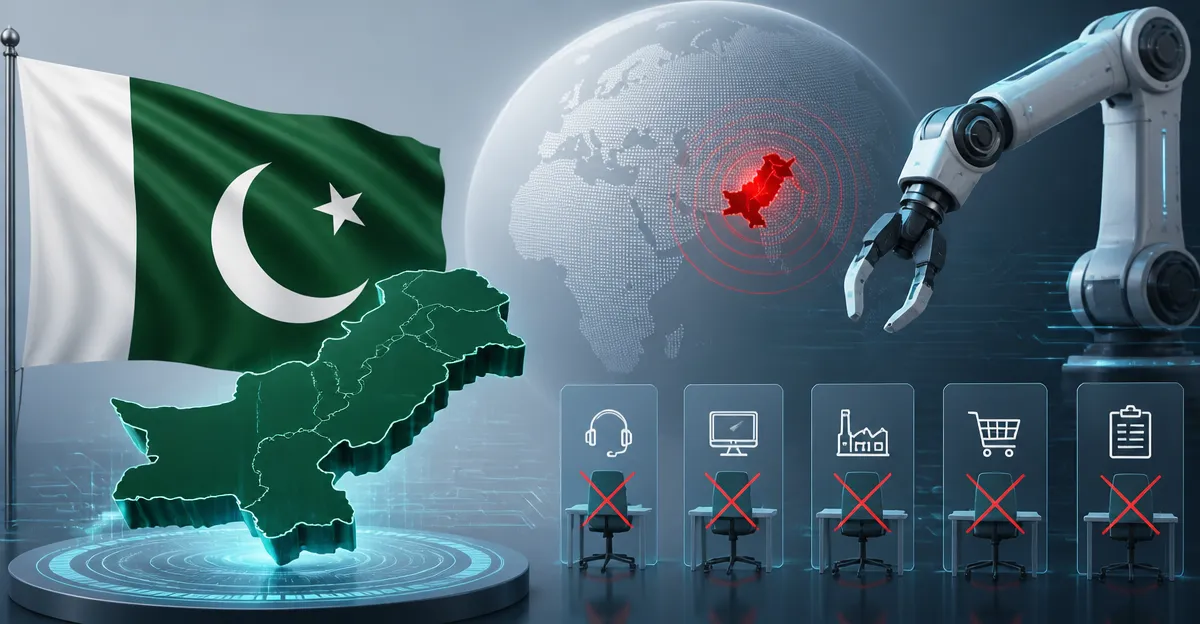
August 5, 2026, (Inside AI) — Pakistan has been identified as one of the nations most vulnerable to job displacement from artificial intelligence, according to the World Bank’s newly released World Development Report 2026: The Promise of AI. The report highlights that educated, skilled workers in the country face the greatest risk as AI automates knowledge-based tasks, exacerbating an already weak formal job market.
The analysis places Pakistan among the most exposed countries in the Middle East, North Africa, Afghanistan and Pakistan (MENAAP) region. Persistent youth unemployment and sluggish private sector job growth amplify the threat, the report states. Economies that have relied on high-skilled services for employment growth, like Pakistan, are likely to feel a particularly severe impact unless AI adoption is paired with robust policies on job creation, re-skilling, and digital competitiveness.
The scale of global AI investment underscores the challenge. The report notes that projected 2026 capital spending by five U.S. AI hyperscalers—Alphabet, Amazon, Meta, Microsoft, and Oracle—will reach $775 billion. This figure dwarfs Pakistan’s nominal GDP of $408 billion and exceeds the combined economies of Argentina, Singapore, Thailand, the UAE, Vietnam, the Philippines, Malaysia, Bangladesh, Colombia, South Africa, and Iran.
Globally, jobs in high-income countries face more than three times the automation risk of those in developing economies, at 14.2% compared with 4.5%. However, 16.2% of jobs in developing economies could see meaningful productivity gains from AI, close to the 18.7% projected for high-income countries. This duality creates a precarious path for nations like Pakistan, where the benefits may not automatically offset the losses.
Skilled Graduates in the Crosshairs
The report’s emphasis on skilled graduates as the most at-risk group challenges the common narrative that automation primarily threatens low-skill labor. In Pakistan, where a growing number of young people hold degrees but face limited opportunities, AI’s ability to perform tasks once reserved for trained professionals could deepen unemployment. The World Bank’s findings align with broader research on AI’s impact on labor markets.
World Bank Chief Economist Indermit Gill offered a nuanced perspective, suggesting that developing countries need not replicate the massive infrastructure investments of tech giants to benefit from AI.
“Developing countries do not need large models or data centres to benefit, and could instead rely on low cost, adapted AI tools to expand access to healthcare, education and agricultural services,” Indermit Gill, Chief Economist, World Bank.
This approach could help Pakistan mitigate job losses by leveraging AI for public good, but it requires strategic investment in digital literacy and infrastructure. The report recommends a three-step approach for developing nations: adopt existing AI tools, adapt them to local needs, and gradually build toward frontier AI development.
The Investment Gulf Widens
The staggering $775 billion in projected hyperscaler spending for 2026 illustrates a growing divide. While these investments drive innovation, they also concentrate AI capabilities in a few nations, potentially leaving countries like Pakistan further behind. The World Bank’s data echoes concerns raised in a 2023 OECD Employment Outlook, which warned that without proactive policies, AI could widen global inequalities. Pakistan’s situation is particularly acute given its demographic profile, with a large youth population entering a job market unable to absorb them.
The report’s recommendations are not a panacea. Adopting and adapting AI tools demands a baseline of digital infrastructure, regulatory frameworks, and educational reform that many developing nations lack. For Pakistan, the path forward may involve international cooperation and targeted investment in sectors where AI can complement rather than replace human labor. The World Bank’s call to action is clear, but the window for preparation is narrowing as AI capabilities accelerate.