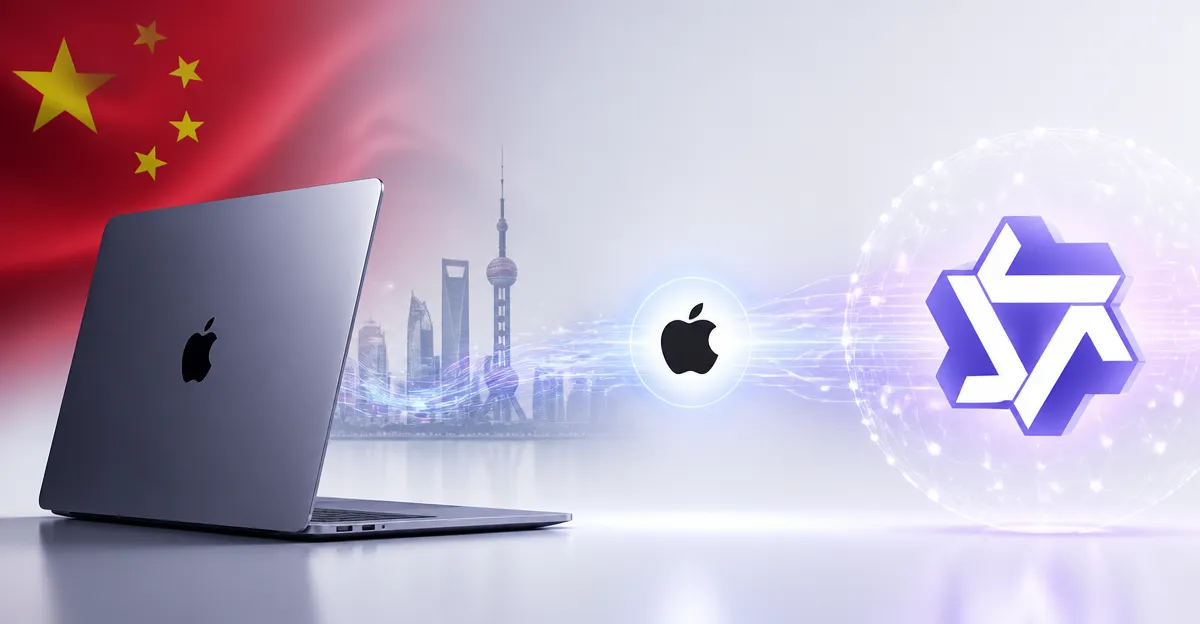
August 8, 2026, (Inside AI) — Apple has published a guide for Mac users in mainland China detailing how to connect Alibaba’s Qwen AI service to Siri and the Writing Tools feature. The move marks a rare integration of a third-party Chinese AI model into Apple’s operating system and signals a tactical shift in the company’s China strategy.
The arrangement is Mac-specific and does not extend to iPhones or iPads. It allows eligible users to route certain AI requests through Qwen, Alibaba’s flagship large language model, rather than relying solely on Apple’s on-device intelligence or Western cloud services. Apple’s support documentation, published in Simplified Chinese, walks users through enabling the Qwen connection in system settings.
This integration comes as Apple faces mounting pressure in China’s AI PC market. Domestic rivals like Lenovo have aggressively marketed locally developed AI features, eroding Apple’s share. By offering Qwen as an option, Apple may appeal to Chinese consumers and enterprises that prefer or are required to use domestic AI services due to regulatory or performance considerations.
Apple has not announced plans to bring Qwen integration to iOS or iPadOS. The Mac-focused rollout suggests a cautious approach, possibly to test user adoption and regulatory feedback before expanding to higher-volume devices. In China, AI services must comply with strict content and security regulations, and partnering with an approved local provider like Alibaba reduces compliance risks.
Alibaba’s Qwen models have gained traction as open-source alternatives to Western LLMs, with strong performance on Chinese-language benchmarks. The Qwen series includes models of varying sizes, from lightweight versions suitable for on-device use to large-scale cloud models. It is unclear which specific Qwen model Apple is integrating, but the setup process implies a cloud-based connection.
The integration may also reflect Apple’s broader AI strategy of offering users choice while maintaining privacy. Apple typically processes AI requests on-device or through its Private Cloud Compute infrastructure. Allowing a third-party model like Qwen introduces new privacy considerations, and Apple’s guide likely includes disclosures about data handling when using Alibaba’s service.
Neither Apple nor Alibaba immediately responded to requests for comment on the scope or duration of the arrangement. The move could set a precedent for other regional AI integrations, especially in markets where local models dominate or where regulatory barriers limit access to Western AI services.
Qwen’s Ascent and China’s AI Ecosystem
Alibaba launched its first Qwen model in 2023 and has since released multiple iterations, including multimodal and coding-specialized variants. Qwen models have been adopted by enterprises across finance, healthcare, and logistics in China. Alibaba has also made Qwen available through its cloud platform, positioning it as a competitor to models from Baidu and Tencent.
China’s AI PC market has become a battleground for ecosystem lock-in. Lenovo’s AI PCs, for example, integrate its proprietary Xiaotian assistant, while Huawei promotes its Pangu models. Apple’s Mac market share in China slipped to 7.5% in Q2 2026, down from 9.2% a year earlier, according to IDC data. The Qwen integration could help reverse that trend by making Macs more attractive to users who want native Chinese AI capabilities.
Apple’s support document reportedly outlines step-by-step instructions for enabling Qwen, including signing in with an Alibaba account and granting necessary permissions. The feature appears to be optional, meaning users can continue using Siri without Qwen if they prefer. This opt-in design aligns with Apple’s typical privacy-first approach.
The integration may also be a response to China’s evolving AI regulations, which increasingly require that AI services used by the public be provided by licensed domestic entities. By partnering with Alibaba, Apple ensures compliance without building its own China-specific AI stack from scratch.
The long-term implications for Apple’s AI roadmap remain uncertain. If the Mac integration proves successful, Apple could expand Qwen access to other devices or even negotiate similar deals with other regional AI providers. For now, the move represents a pragmatic adaptation to China’s unique market conditions.