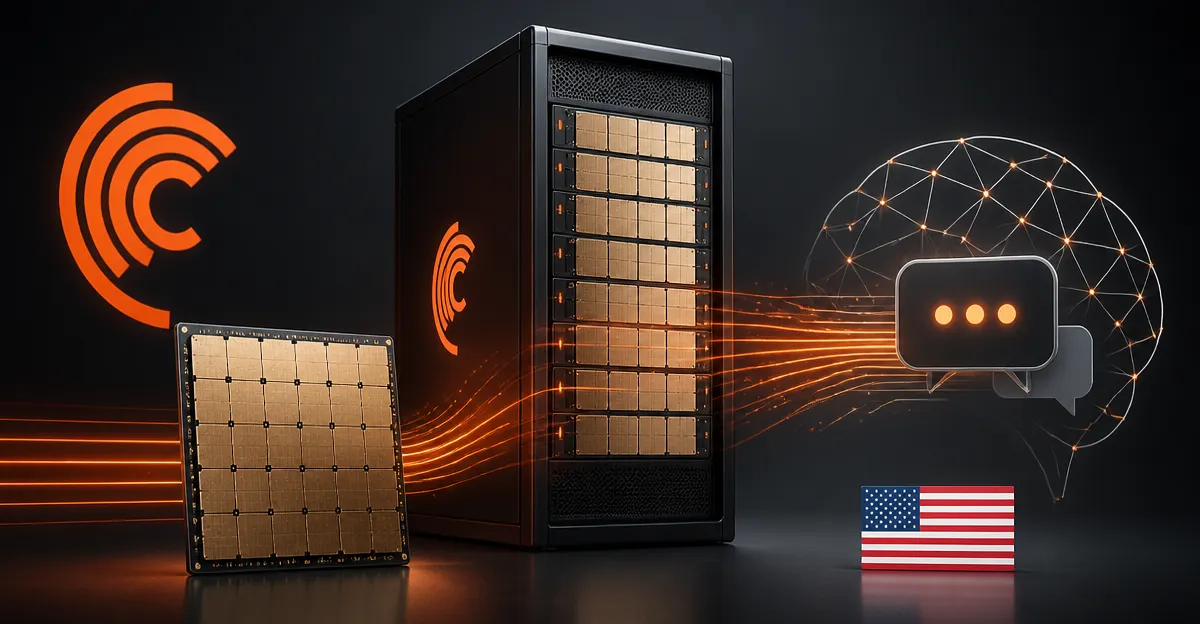
August 19, 2026, (Inside AI) — Cerebras Systems has introduced the CS-4, a new server rack built around three dinner-plate-sized chips. The company says the hardware will accelerate AI chatbot responses by targeting inference, the stage where models generate answers.
The announcement, made Tuesday in San Francisco, positions Cerebras directly against Nvidia in the market for AI inference hardware. The CS-4 relies on the company’s Nexus server architecture, which uses pluggable modules to house the chips and reduce setup complexity.
Chief Technology Officer Sean Lie said the new system has 50% fewer components than prior designs. That reduction, he explained at a media briefing, would speed data center construction. The rack includes a chip called WSE-3 Turbo and new networking components to improve data movement between chips.
Availability is set for the third quarter. The chips are fabricated using TSMC’s 5-nanometer manufacturing process. Cerebras says its large chips avoid the energy and slowdown of moving data from one chip to another, a key bottleneck in conventional AI servers.
Why Wafer-Scale Chips Change the Inference Math
Cerebras has long argued that physically larger chips reduce communication overhead. In standard AI clusters, data must travel between many smaller GPUs, consuming power and adding latency. A single wafer-scale chip keeps more data on one piece of silicon.
That design matters most for inference, where users expect near-instant responses. Chatbots like Anthropic’s Claude process tokens sequentially, and any delay in moving activations between chips slows the entire response. Cerebras claims its approach avoids that penalty.
The company’s roadmap includes another generation of the chip and server in 2027. CEO Andrew Feldman said the company expects to deliver 600 megawatts’ worth of computing power by the end of that year. He framed the engineering goal around throughput, not just raw speed.
“We’re going to get four times as fast between now and the end of the year, end of 2027, and we’re going to get 20 times more throughput,” Feldman said at the briefing.
The Financial Reality Behind the Hardware Push
The launch follows Cerebras’ latest earnings report. Last week, the company posted an adjusted loss of $6.9 million on sales of $180.1 million. The narrow loss relative to revenue suggests the company is investing heavily in engineering while trying to scale commercial deployments.
Cerebras remains a small player compared to Nvidia, which dominates AI data center spending. But the inference market is growing faster than training as models move into production. That shift creates an opening for specialized hardware vendors.
The CS-4’s pluggable module design also addresses a practical concern for data center operators. Faster installation and fewer components can reduce labor costs and time to deployment, which matters when capacity is constrained.
Cerebras did not disclose pricing or specific customer commitments for the CS-4. The company has previously supplied systems to research labs and government clients, but commercial cloud adoption remains an open question.