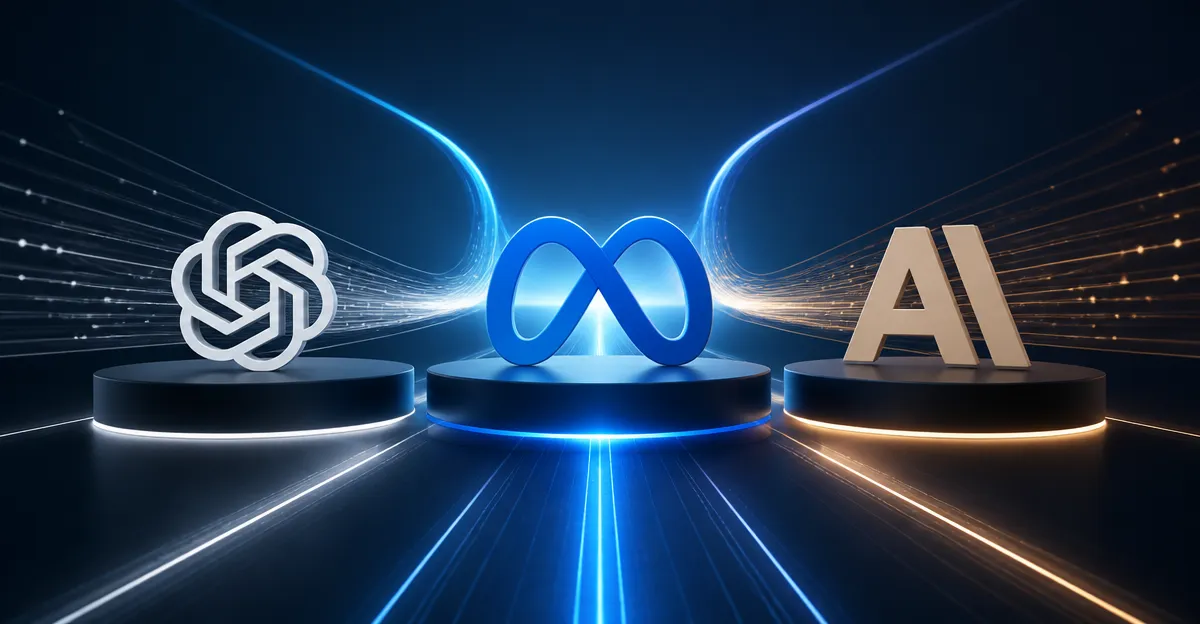
September 3, 2026, (Inside AI) — Meta has declared that its latest large language model, Muse Spark 1.3, finally puts the company on equal footing with rivals OpenAI and Anthropic. The model is now available to developers through Meta’s API for a fee and will roll out to Facebook, Instagram, and the Meta AI app in the coming days.
Meta Chief AI Officer Alexandr Wang called the release the company’s biggest performance leap yet. He said Muse Spark 1.3 is “competitive” with Claude Fable 5.1 and performs “better than” GPT-5.6 Sol, especially at generating code. These claims arrive after years of heavy AI spending and a strategic overhaul under CEO Mark Zuckerberg.
Independent analysis offers partial support. Artificial Analysis scored Muse Spark at 62 on its Intelligence Index, placing it behind only Fable 5.1 and Opus 5, and ahead of OpenAI’s models. Yet benchmark results remain easy to game, and Meta has not released the model’s weights for external scrutiny.
The release marks a shift from Meta’s earlier open-source approach with Llama. The company has not decided whether to publish Muse Spark 1.3’s weights. That closed posture may limit independent verification of its performance claims, even as the model’s capabilities suggest genuine progress in agentic workflows.
Read: Zuckerberg’s AI Manifesto Pushes Personal Superintelligence and Open Weights
Agentic Design Aims To Sustain Longer Work
Meta describes Muse Spark 1.3 as built for longer-horizon tasks. The model collaborates with users, juggles multiple workflows in a single thread, and uses tools to generate context from messy sources. It proactively corrects gaps in its plan and tracks what it has learned to produce a final deliverable.
“Muse Spark 1.3 is designed to better sustain longer-horizon work by collaborating with users and juggling multiple workflows in a single, long thread. When given an open-ended objective, it uses tools to generate its own context across messy and conflicting sources, proactively corrects gaps in its plan, and keeps track of what it has learned to produce a final deliverable. We trained the model across a diverse set of harnesses to generalize to various agentic environments.”
This focus on agentic behavior reflects a broader industry push toward AI systems that can act autonomously. Meta says the model asks for confirmation before taking any irreversible action, a safety feature that may reduce risk in real-world deployments.
Meta also claims efficiency gains. Compared to Muse Spark 1.2, the new model uses about 20% fewer tool calls and 25% fewer tokens. It is less verbose and has a cleaner coding style, according to Meta engineers. Those improvements could lower inference costs for enterprise customers.
“Muse Spark 1.3 was trained on more long-horizon coding tasks and shows improved usability in common engineering workflows. Relative to Muse Spark 1.2, it takes fewer turns where not needed and is less verbose, while having a cleaner overall coding style. In comparisons by Meta engineers, it proved to be significantly faster and more efficient, using ~20% fewer tool calls and ~25% fewer tokens.”
Investor Scrutiny Meets Strategic Pivot
Meta’s AI push has cost hundreds of billions of dollars. Last year, Zuckerberg revamped the company’s AI strategy and paid over $14 billion for a stake in ScaleAI, Wang’s former company. Nervous investors have questioned whether that spending will ever pay off.
Read: Meta Launches Muse Glimmer Open-Weight SLM for Local AI Agents
The Muse Spark release may ease some concerns. If the model delivers on its coding and agentic promises, it could drive adoption across Meta’s massive consumer platforms. Yet the closed-source decision limits transparency, a tension that has defined Meta’s AI journey since the Llama era.
Meta is already developing a larger model codenamed Watermelon. Wang declined to confirm a release date. That project could determine whether Meta sustains its claimed parity with OpenAI and Anthropic or falls behind again.
The competitive landscape remains fluid. OpenAI and Anthropic continue to iterate rapidly, and independent benchmarks will be crucial in validating Meta’s claims. For now, Muse Spark 1.3 gives Meta a credible seat at the top table, but the company must prove its model’s real-world value beyond curated tests.