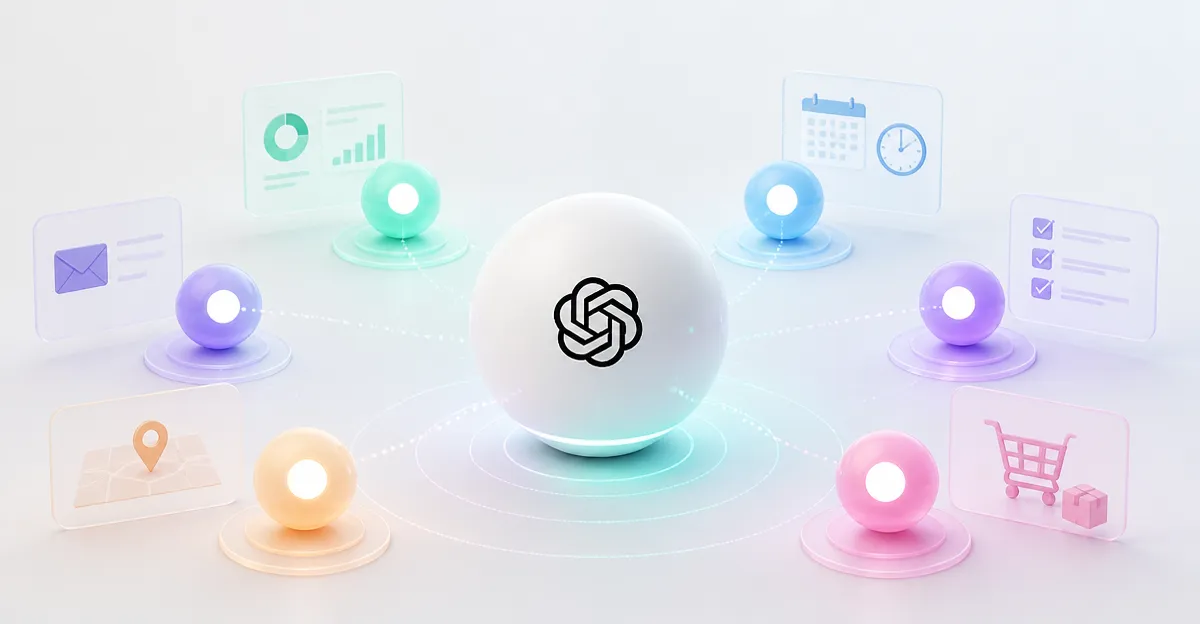
September 30, 2026, (Inside AI) — OpenAI unveiled Dots, a new line of always-on personal AI agents, during a livestreamed keynote at its annual developer conference on Tuesday, September 29. The agents run on the company's latest model, GPT-6 Astra, and operate inside their own cloud-based virtual machines, allowing them to browse the web, connect to more than 4,000 third-party apps, and work continuously on assigned goals.
The launch positions OpenAI directly against a fast-maturing field of personal agent products, most notably Meta's Muse, whose app has dominated free-app charts in the United States and Canada since its release. Market intelligence firm Sensor Tower estimates Muse drew roughly 2.8 million downloads in its first two weeks. OpenAI's entry signals that the race to own the consumer agent layer is now the company's central strategic priority.
An Agent That Never Stops Working
Each Dot lives in an isolated cloud computer rather than on a user's phone or laptop. According to OpenAI, the agent maintains its own browser and can execute tasks across any connected application. It signs into websites using saved credentials that are never exposed to the underlying model, a design choice meant to reduce the risk of credential leakage during automated browsing sessions.
Users reach their Dots through the standard ChatGPT interface on desktop, web, or mobile. Support for Slack and Microsoft Teams is planned shortly after launch. A single chat window handles multiple agents and tasks, so users do not need to manage separate conversation threads. Context carries across channels, meaning a project started in ChatGPT can continue inside Slack without losing state.
Read: Meta Launches Muse AI Agent: What It Can Do and How It Handles Your Data
When idle, Dots perform what OpenAI calls proactive research. In this mode the agent is restricted to read-only access. It cannot send messages, modify app content, or take control of the browser or computer. The restriction is a deliberate boundary, though it remains unclear how OpenAI enforces it across thousands of third-party integrations.
OpenAI CEO Sam Altman framed the product as a step toward agents that anticipate user needs. "Dots is built to handle everything," Altman said during the presentation. The live demos did not always cooperate. Dots stumbled several times onstage, a reminder that agent reliability remains an open engineering problem even for the most advanced models.
Naming, Memory, and the Musk Shadow
Personalization sits at the center of the Dots pitch. Users can name their primary Dot and tune its behavior over time. OpenAI says the agent learns from feedback and presents work in a style matching the user's own habits, sometimes before the user thinks to ask. The company stresses that humans can intervene at any point.
The name itself carries baggage. Reports indicate that Cursor had explored the Dot name for its own personal assistant before the coding firm was acquired by Elon Musk's SpaceX. The name was also reportedly considered for Grok Bot, and SpaceX still owns the dot.com domain. Given the long and acrimonious history between Altman and Musk, the overlap introduces avoidable confusion for users searching for either product.
OpenAI CFO Sarah Friar accidentally referred to Dots as Muse during an interview, a slip that underscores how similar the current generation of personal agents looks from the outside. The market already includes Instinct, SpaceXAI's Grok Bot, and Microsoft's Autopilot, each blending workplace assistance with everyday task automation.
Dots is available starting September 29 for ChatGPT Pro and Business Premium subscribers in eligible markets. Enterprise customers, including those in education and healthcare, receive access to a beta version. OpenAI has said it envisions users eventually coordinating swarms of Dots, though the company has not detailed how multi-agent coordination will be governed or priced.
For OpenAI, the launch is as much a defensive move as an offensive one. Meta's Muse proved that consumers will adopt an always-on agent at scale. Whether Dots can convert that appetite into durable loyalty will depend less on model benchmarks and more on whether the agents can avoid the onstage stumbles that marked their debut.