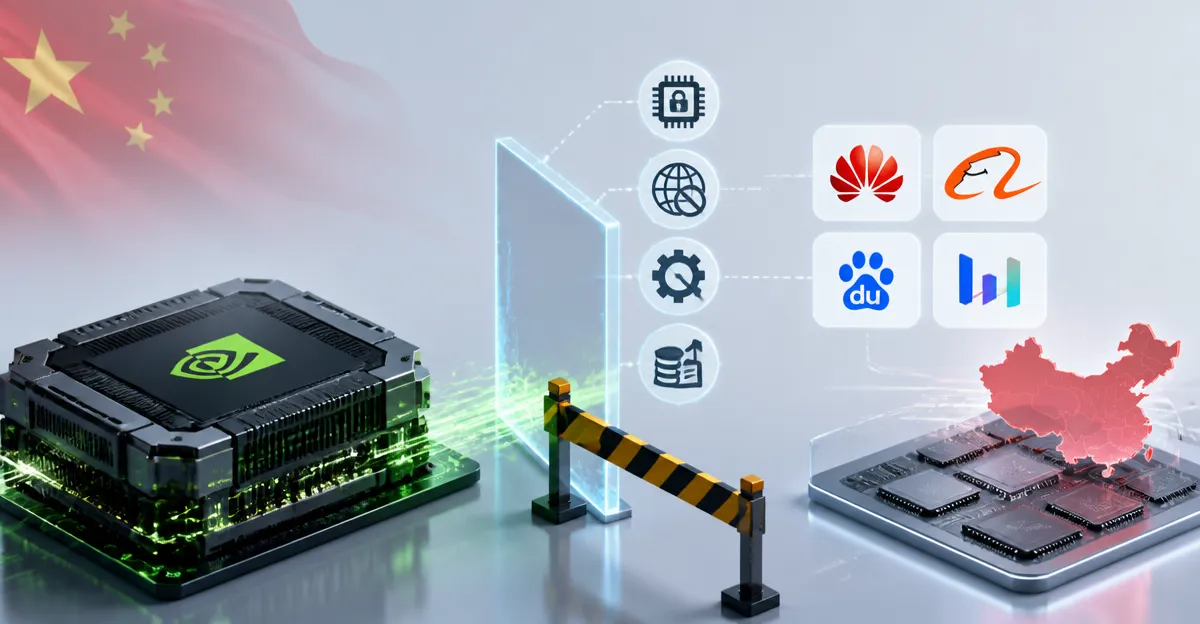
August 10, 2026, (Inside AI) — China’s most advanced AI models are still being trained on Nvidia chips, despite Beijing’s push for semiconductor self-sufficiency. The high cost and complexity of switching to domestic alternatives like Huawei‘s Ascend processors remain a major barrier, industry insiders say.
The core issue is software. Nvidia’s CUDA platform has become the de facto standard for AI development, with a vast ecosystem of libraries and tools. Huawei’s alternative, CANN, requires developers to rewrite and optimize massive codebases, a process that is both time-consuming and expensive.
“Our existing training pipelines are reliant on CUDA,” said James Wang, who develops AI models at a research institute affiliated with a Shanghai-based university. “CUDA code cannot run directly on Ascend and requires extensive rewriting.”
Wang estimated that migrating existing workflows to Huawei’s Ascend chips could add at least 50 per cent in time and costs for his team. This engineering bottleneck is echoed across the industry.
“Training LLMs on Nvidia chips for now remains the norm among Chinese AI developers,” said a person familiar with the industry.
Despite U.S. export controls limiting access to Nvidia’s most advanced chips, Chinese firms have stockpiled older models and accessed them via cloud services. The immediate pain of migration outweighs the long-term strategic goal of self-reliance.
CUDA’s Moat Is Deeper Than Silicon
Nvidia’s dominance isn’t just about hardware performance. Over a decade, CUDA has accumulated a rich set of optimized libraries for deep learning, such as cuDNN and TensorRT. These libraries are deeply integrated into popular frameworks like PyTorch and TensorFlow, which power most LLM training.
Huawei’s CANN, while improving, lacks this mature ecosystem. Developers must port or recreate these optimizations, a process prone to bugs and performance regressions. For cutting-edge models with billions of parameters, even small inefficiencies can balloon into days of extra training time and millions in compute costs.
This lock-in effect is well-known in the semiconductor industry. Intel faced similar challenges with its x86 architecture, which maintained dominance for decades due to software compatibility, even as rival chips offered better performance-per-watt.
Beijing’s Dilemma: Speed vs Sovereignty
The Chinese government has poured billions into domestic chip initiatives, but the AI sector’s reliance on Nvidia exposes a critical vulnerability. While companies like Biren Technology and Moore Threads are developing GPUs, they too struggle with software maturity.
Some firms are exploring hybrid approaches: using Nvidia for training and domestic chips for inference, where software demands are less stringent. However, for training frontier models, the path of least resistance remains Nvidia, even if it means navigating export restrictions.
The timeline for a viable switch remains uncertain. Huawei’s latest Ascend 910B chip shows promise, but industry analysts estimate it could take 3 to 5 years for the software ecosystem to reach parity, assuming sustained investment and developer adoption.
In the meantime, Chinese AI labs continue to push boundaries on Nvidia hardware, a quiet acknowledgment that in the near term, performance trumps politics.