September 15, 2026, (Inside AI) — The United Kingdom and the United States have signed a Joint Declaration of Intent to link two fusion energy supercomputers, creating a federated AI system designed to accelerate the development of practical fusion power. The agreement, inked on September 14 at the Global Fusion Policy Summit in London, connects the UK Atomic Energy Authority's (UKAEA) SUNRISE supercomputer with Princeton Plasma Physics Laboratory's (PPPL) STELLAR-AI platform. The collaboration, known as the SUNRISE-STELLAR-AI Federation, aims to train shared AI models on experimental data from two separate fusion machines, potentially speeding up the design of future power plants.
The announcement follows a joint workshop held online on September 9 and 10, where scientists from both nations transformed a shared vision into a concrete plan. While the project remains at an early exploratory stage, it represents a significant step toward using artificial intelligence to overcome longstanding barriers in fusion research. The two facilities involved, the UK's MAST Upgrade in Oxfordshire and the US's NSTX-U in New Jersey, are compact spherical tokamaks with notably similar designs. This similarity makes combining their datasets particularly valuable, as models trained on just one machine often struggle to generalize to others.
Digital Twins To Bridge Data Gaps
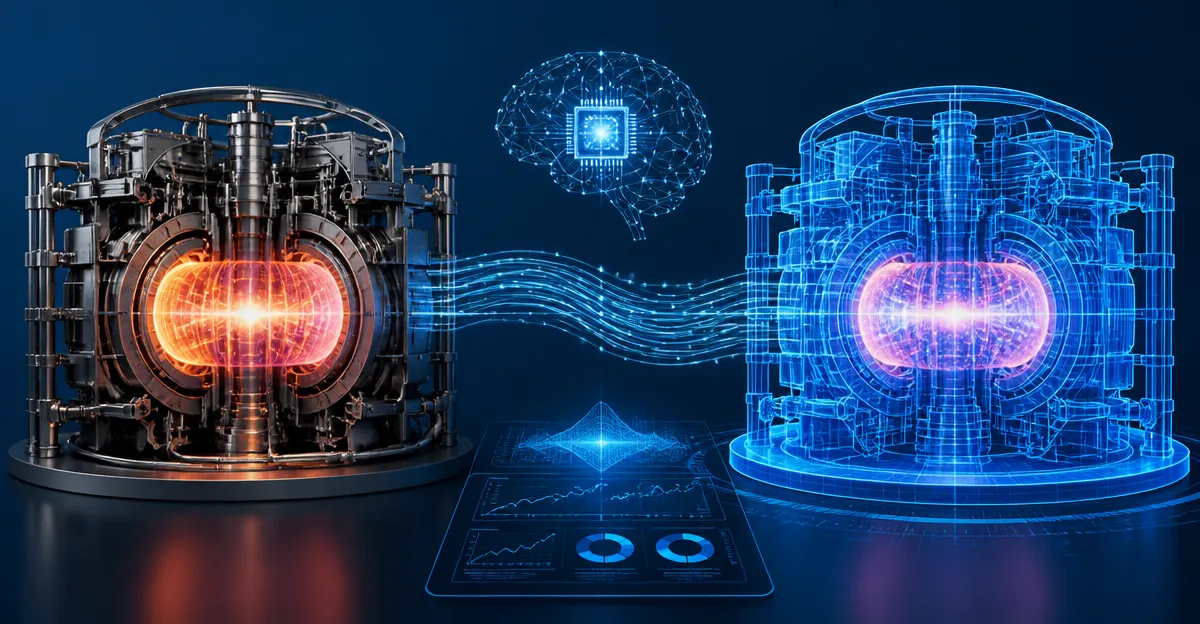
At the heart of the collaboration is the creation of detailed digital twins for both fusion machines. These virtual replicas allow researchers to test design changes in software before implementing them on physical hardware. Rob Akers, a senior fellow at UKAEA, explained how simulation would extend their datasets. "We will use simulation to extend our datasets," Akers said, according to sources familiar with the plan. This approach enables exploration of regimes that have not yet been tested physically, filling gaps in experimental data and providing a more comprehensive understanding of plasma behavior.
The SUNRISE supercomputer is backed by £45 million in government funding and anchors the UK's first AI Growth Zone at Culham Campus. Meanwhile, STELLAR-AI is PPPL's $13 million computing platform, supported by Princeton University. The federation aims to let models and experiments move freely between the two systems, according to Shantenu Jha of PPPL. "Our goal is to let models and experiments move freely between the two systems," Jha said. This fluid exchange could significantly enhance the predictive power of AI models, making them more reliable for designing future reactors.
Read: Nvidia Teams Up With Australian Partners to Build 2 GW AI Factory Capacity
The core benefit lies in merging two separate datasets. By pooling data from MAST Upgrade and NSTX-U, researchers hope to capture more underlying physics than either dataset alone could provide. This is crucial because fusion reactions involve complex, turbulent plasma dynamics that are difficult to model accurately. AI models trained on a single machine's data often fail when applied to different conditions. The federation seeks to overcome this limitation by exposing models to a wider range of plasma scenarios.
Officials framed the collaboration as essential for solving fusion's toughest challenges. "Fusion needs partnerships," said Joe Milnes of UKAEA. The sentiment reflects a growing recognition that no single country or institution can tackle fusion's complexities alone. International collaboration, combined with advanced AI, could accelerate progress toward commercial fusion energy, which promises virtually limitless clean power.
While the project is still in its early stages, it builds on decades of fusion research and recent advances in AI. The UK's MAST Upgrade and the US's NSTX-U are both spherical tokamaks, a design that is more compact and potentially cheaper than traditional tokamaks. Their similar geometry allows for direct comparisons and data sharing, which is not always possible with dissimilar machines. This compatibility is a key reason why the two labs are pursuing a federated approach.
The federation could also help address one of fusion's biggest hurdles: the scarcity of experimental data. Fusion experiments are expensive and time-consuming, limiting the amount of data available for training AI models. By using simulations to generate additional data, researchers can augment real-world observations and improve model robustness. This hybrid approach, combining simulation with experimental data, is increasingly seen as a pathway to more capable AI in scientific domains.
Looking ahead, the SUNRISE-STELLAR-AI Federation could aid major future reactor projects, such as ITER and the UK's STEP prototype. If successful, it might demonstrate how AI can accelerate the design and operation of complex energy systems. However, challenges remain, including data standardization, computational interoperability, and the need for robust validation. The partners have not yet announced a timeline for when the federation will be fully operational, but the Joint Declaration signals a strong commitment to proceed.
Read: NVIDIA Secures Exclusive AI Compute Rights at Ohio’s PORTS-Pike Campus
The collaboration also underscores the growing role of AI in scientific discovery. From climate modeling to drug discovery, AI is transforming how researchers tackle grand challenges. Fusion energy, with its immense potential and daunting technical barriers, is a natural fit for AI-driven innovation. As the UK and US join forces, they may set a precedent for international AI collaborations in other fields.