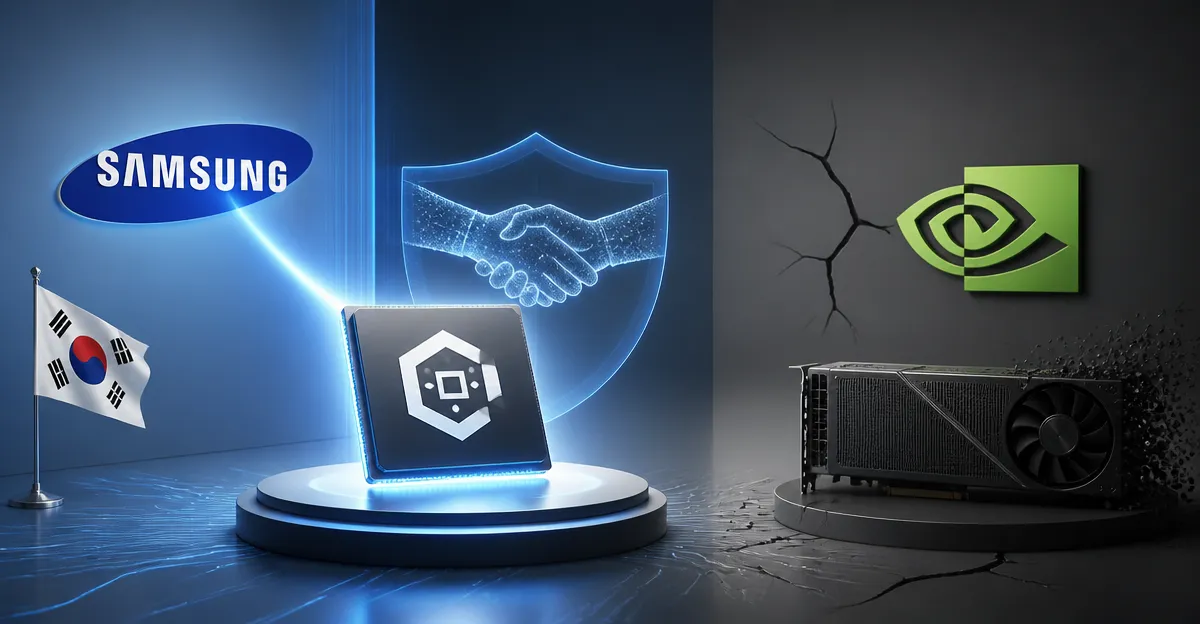
July 20, 2026, (Inside AI) — Samsung SDS launched a cloud service on Monday powered by chips from South Korean startup FuriosaAI, marking the country’s first deep learning service running on a domestically designed processor. The move directly targets the ballooning costs of AI inference, offering businesses a cheaper alternative to traditional GPU infrastructure.
The service, called NPUaaS (Neural Processing Unit as a Service), is built on FuriosaAI’s second-generation RNGD chip. Unlike GPUs that excel at training massive models, NPUs are optimized for inference — the phase where a trained model generates text, analyzes images, or serves predictions. Samsung is not challenging NVIDIA on raw training power; instead, it is betting on the higher-volume, lower-cost inference market.
Cost reduction is the central pitch. The RNGD chip promises drastically lower power consumption than traditional GPUs, a critical advantage as energy bills surge across the AI industry. Clients lease computing through the cloud, scaling across one, two, four, or eight chips as needed. This flexibility appeals to companies wary of huge upfront hardware spending.
The Sovereignty Angle in a Splintering Chip Landscape
Beyond cost, the service carries a strategic motive: digital sovereignty. NPUaaS runs inside a sovereign cloud environment aimed at public-sector and defense-adjacent clients who demand strict data security. The setup keeps sensitive Korean workloads off foreign hardware entirely, addressing both privacy and geopolitical concerns.
This launch fits a global pattern of nations seeking alternatives to NVIDIA’s dominance. China is building chips like the DF1000 to escape U.S. export controls. The UAE recently won license-free NVIDIA access through diplomacy. Now South Korea backs a domestic challenger for inference. Each represents a different route around the same dependency.
Samsung SDS executive Lee Ho-jun framed the offering as a flexibility play:
“Customers can now deploy high-performance AI with greater flexibility and lower cost.”
The statement underscores a shift in enterprise AI strategy, where inference workloads are becoming the pragmatic entry point for affordable, localized AI.
Inference Economics and the Startup’s Bet
FuriosaAI’s RNGD chip is fabricated on a 5nm process and uses HBM3 memory, delivering competitive performance per watt. While exact benchmarks remain undisclosed, the startup claims it outperforms NVIDIA’s A100 on certain inference tasks at a fraction of the power. This aligns with industry trends: inference is forecast to account for over 60% of AI computing costs by 2028, according to McKinsey.
Samsung SDS is not alone in this pivot. Global cloud providers are increasingly integrating custom silicon for inference. Amazon has Inferentia, Google has TPU v5e, and Microsoft is rumored to be developing its own inference chips. FuriosaAI’s advantage lies in its sovereign cloud packaging, which could resonate with regulated industries in Asia.
However, the startup faces an uphill battle. NVIDIA’s CUDA ecosystem locks in developers, and its upcoming Blackwell architecture promises even greater inference efficiency. FuriosaAI must prove its software stack is mature enough for enterprise adoption, not just a hardware novelty.
The service also highlights a broader recalibration in AI infrastructure. Training grabs headlines, but inference is where the money flows. As models move into production, the demand for cheap, secure, and energy-efficient inference will only intensify. Samsung’s bet on a homegrown NPU may be a bellwether for how nations and corporations navigate the next phase of AI deployment.