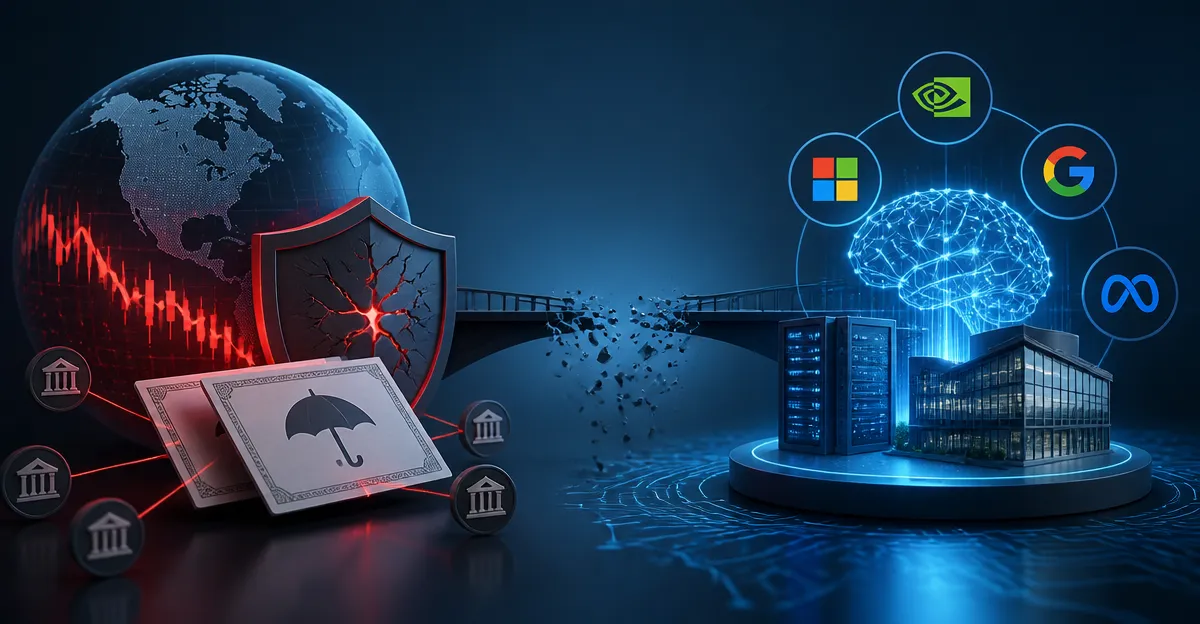
July 29, 2026, (Inside AI) — The AI sector’s financial foundations are showing cracks beyond equity sell-offs. Credit default swaps (CDS) on bonds from tech giants like Oracle, Nvidia, and Apple are surging in cost, signaling deepening investor anxiety about when massive AI investments will yield returns.
This derivatives market, a relic of the 2008 crisis, is now pricing in default risk for companies that have borrowed billions to fund AI infrastructure. Oracle’s CDS trades around 200 basis points, far above peers, while Nvidia’s has spiked to 78 bps and Meta’s hovers near 93 bps. The investment-grade CDS index sits at just 53 bps.
The move reflects a stark shift: even record earnings cannot mask the uncertainty over AI’s long-term profitability. Technology firms have tapped bond markets aggressively, with Nvidia issuing debt for the first time, but the scale of spending is testing investor patience.
Derivatives Market Flashes Warning on AI Debt
A CDS is a derivative that acts as insurance against a bond issuer defaulting. Buyers pay a premium to sellers, who assume the risk of a credit event like bankruptcy or missed payments. The premium, quoted in basis points, rises with perceived risk. A CDS at 100 bps costs $1 annually to insure every $100 of debt.
The single-name CDS market is worth about $9 trillion, a fraction of the $150 trillion global bond market, per the Bank for International Settlements. Yet its movements can signal trouble. Average daily CDS trading hit $16 billion in Q2, up from $13 billion a year earlier, with tech-linked trading reaching nearly $650 million, a 600% jump from last year, according to DTCC data.
Hedge funds and banks dominate trading, but thin liquidity means small transactions can swing prices. This amplifies concerns when spreads widen, potentially triggering a self-reinforcing cycle: higher insurance costs push investors to sell bonds, raising borrowing costs and further stoking credit fears.
Amanda Cooper reported for Reuters that demand for AI-linked CDS has surged. She noted:
“The move reflects growing concern among investors about when the billions of dollars being poured into artificial intelligence will generate returns.” Amanda Cooper, Reporter, Reuters
Liquidity Traps and Historical Echoes
CDS trading can be dangerously illiquid. Even for large companies, daily trades often number in single digits, meaning a few deals can distort prices. This opacity recalls the 2008 crisis, when CDS on mortgage-backed securities amplified systemic risk. Today, the AI sector’s debt binge, with firms like Meta and Alphabet joining the market, raises parallels.
Research from the Bank for International Settlements highlights how CDS markets can transmit shocks across sectors. For AI, where capital expenditure is unprecedented, the risk is that credit market jitters feed back into equity valuations.
Oracle’s wide spread suggests specific concerns, possibly tied to its debt-funded cloud expansion. Nvidia’s rise, while lower, is notable given its pristine balance sheet.
What triggers a payout? A credit event, such as a bankruptcy or missed payment, forces the seller to compensate the buyer. But the mere threat of such an event can roil markets. As spreads widen, the cost of insuring debt rises, potentially making it harder for firms to refinance. This dynamic is now testing the AI sector’s financial resilience, with no clear end to the spending cycle in sight.