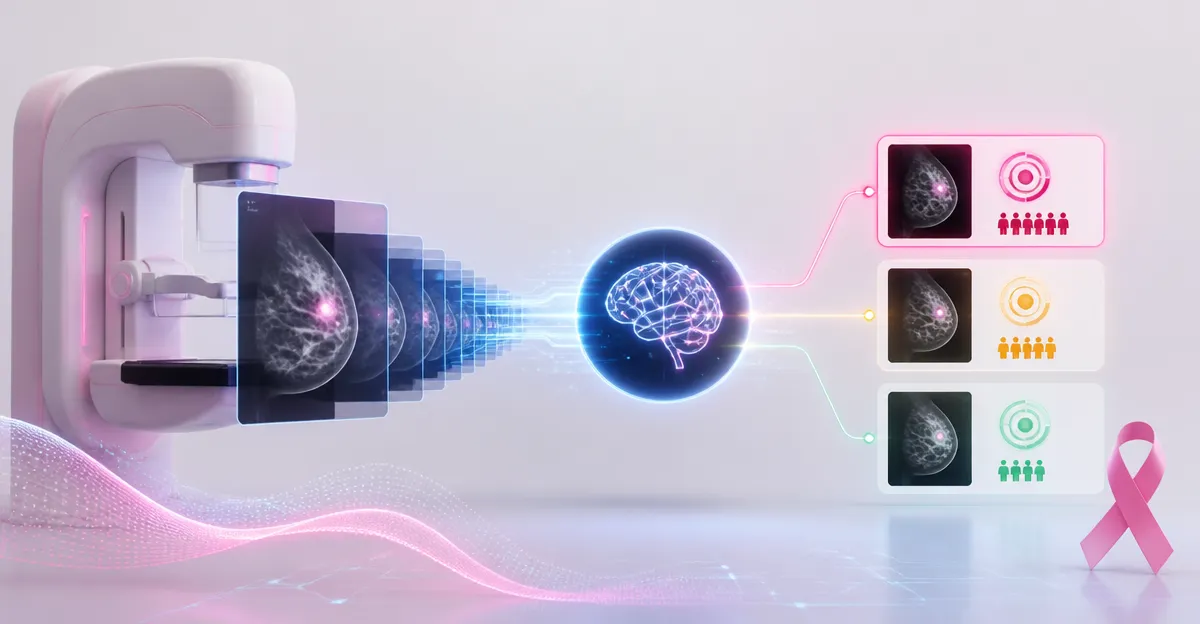
November 24, 2026, (Inside AI) — Artificial intelligence can now rank mammograms by cancer risk, pushing the most suspicious scans to the front of the radiologist's queue. The approach, known as AI triage, is gaining traction as screening programs buckle under rising imaging volumes. But new evidence shows the efficiency gains come with a measurable safety trade-off that hospitals must actively manage.
The core promise is workload relief. A prospective trial of more than 31,000 women found that AI triage cut radiologist reading workload by 63.6% while increasing cancer detection by 15.2%. A separate randomized study showed AI prioritization sped up time to diagnostic imaging and biopsy for high-risk patients without delaying care for others. Those numbers explain why screening centers in Europe and Asia are moving from pilot projects to routine deployment.
The stakes are highest for the women whose scans sit in the deferred pile. Breast cancer remains the most common cancer among women worldwide, and screening programs exist precisely because early detection changes outcomes. Any system that reorders the queue must also prove it does not bury a tumor behind a low-risk score.
The 63% Workload Cut Hides A Missed-Cancer Problem
AI triage works like an automated triage nurse. An algorithm scores each mammogram for cancer risk and sorts the queue. High-risk scans go straight to a radiologist. Low-risk scans wait or get cleared. The design keeps humans in the loop but shifts the order in which they look.
Read: AI Bubble Burst Could Force Fed Rate Cuts, Analysts Warn
That shift is where the risk lives. AI can produce confident but incorrect readings, inventing lesions that do not exist or missing subtle tumors that do. Women with dense breast tissue and cases with faint structural changes or tiny calcium deposits are especially vulnerable to missed cancers. On the flip side, AI can flag harmless changes as suspicious, raising recall rates by nearly 15% and sending healthy women for unnecessary follow-up tests and anxiety.
Threshold settings decide how much risk the system absorbs. A mathematically optimal threshold that clears 75% of routine mammograms could produce more than 100 missed cancers across a large population. Tighter thresholds catch more cancers but erase much of the workload benefit. That trade-off is not a software bug. It is a policy choice that every screening program must make explicitly.
The deeper issue is that AI catches some cancers humans miss while missing cancers humans easily spot. That asymmetry means the algorithm cannot serve as an autonomous judge, no matter how strong its average performance looks on a validation set.
Why Radiologists Correct AI Twice As Often
Safe deployment rests on layered checks. The first is confidence-based referral. Scans with low AI confidence or borderline findings route automatically to a radiologist. Combining AI processing with human review only when the AI is uncertain yields higher accuracy than either operating alone.
The second is the second-reader safeguard. In double-reading programs, human clinicians hold final authority. Studies show radiologists scrutinize AI opinions far more rigorously than human opinions, correcting AI mistakes twice as often. That skepticism is an asset, not friction.
The third is continuous local monitoring. Regulatory approval is only the starting line. Hospitals must audit deployed models for accuracy drift caused by software updates, calibration shifts, or changes in local patient demographics. Automated quality-assurance monitors should trigger alerts when performance moves.
Read: Global Markets Brace for More Volatility After AI Stock Sell-Off
The fourth is regulatory oversight. Bodies such as the US Food and Drug Administration and national screening committees require real-world evidence of how clinical teams interact with AI before and after deployment. The FDA's AI-enabled device framework is evolving to cover post-market surveillance, not just pre-market clearance.
One underreported factor is liability. When an AI-cleared mammogram later reveals an interval cancer, the question of who bears responsibility remains unsettled in most jurisdictions. Hospitals that deploy triage without clear documentation of human sign-off may find themselves exposed in ways their malpractice insurers have not yet priced.
"AI is a powerful accelerator, not an autonomous doctor," said Dr Sandeep Nayak, Chairman of Oncology at the MACS-Renova Oncology Institute, KIMS Hospital in Bengaluru. "It offers unprecedented potential to reduce radiologist burnout and expedite care for patients who need urgent intervention. But AI works precisely because human experts remain in the loop to catch its hallucinations, oversee its queues, and ensure patient safety."
The broader lesson extends beyond breast imaging. Every clinical AI deployment faces the same tension between throughput and safety. Triage is attractive because it keeps a human in the decision path. But the human must actually review the deferred cases, not just the escalated ones. Programs that treat AI clearance as final will discover their error rate the hard way.
For now, the evidence supports AI triage as an accelerator inside a human-led system. Screening centers weighing adoption should publish their threshold choices, audit missed cancers openly, and treat the algorithm as a queue manager rather than a diagnosis. The technology is ready. The governance is the variable.

Shamil has a low tolerance for AI that only works in controlled demos. He covers agentic systems and generative AI with the skepticism of someone who has seen too many “revolutionary” tools quietly disappear six months after launch.