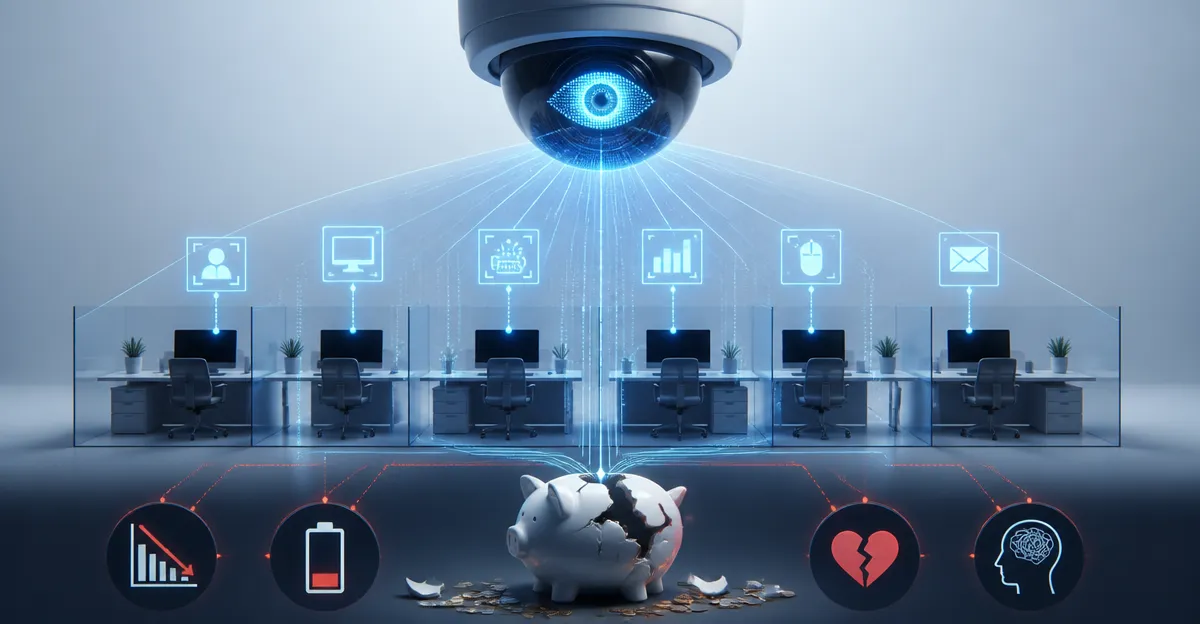
September 17, 2026, (Inside AI) — A new phenomenon is quietly reshaping how concerns surface inside organizations. It is called safety by proxy, and it happens when an employee asks an AI tool to make the strongest case against a decision, then circulates the output anonymously. The practice bypasses the interpersonal risks that have long silenced dissent, and it is forcing leaders to rethink what psychological safety means in the age of generative AI.
The term was coined by Amy Edmondson, a Harvard Business School professor who pioneered research on team psychological safety, and Jayshree Seth, a corporate scientist and chief science advocate at 3M. In a recent analysis, they describe how AI's perceived neutrality is interacting with workplace culture in four distinct patterns. Each pattern offers leaders a signal about what their teams cannot say out loud.
The first pattern is the workaround. When psychological safety is absent, employees use AI to surface concerns without owning them. A 2026 peer-reviewed study of board directors found that AI's perceived neutrality enabled concerns that would otherwise have been suppressed. One director explained the dynamic bluntly.
"If a director voices criticism, they might face negative repercussions. But if it's AI that says it, then it's out there, without being tied to a particular director." (Anonymous board director, 2026 peer-reviewed study)
Read: AI Adoption Outpaces Productivity Gains as Economic Data Lags
The second pattern is the equalizer. Psychological safety is rarely uniform across an organization. It varies by team, status, and identity. AI can bypass that asymmetry. An underrepresented employee can route a concern through AI and have it arrive without a name attached. A non-native speaker can ask AI to structure their argument with precision. The technology functions as a communication coach, helping people find words for concerns they already hold.
The third pattern is the testing space. When organizations are trying to build a more open culture but still face challenges, employees may use AI as a low-stakes environment to test whether an argument holds up before bringing it forward directly. Whether this accelerates psychological safety or substitutes for it remains an open question. The evidence is not yet clear.
The fourth pattern is the mirror. Power suppresses honest input, one of the oldest findings in management research. The higher a leader's authority, the more people modulate what they say. A leader who proactively asks AI to generate the strongest concerns about a decision gains access to input that their authority inhibits. The machine has no stake in the leader's reaction.
These patterns are not theoretical. At 3M, the New Product Introduction process follows a rigorous stage-gate methodology. The company's culture has long held that the best ideas can come from anywhere, a conviction embedded in its 15% time culture tenet and intrapreneurial grant programs. The equalizer pattern is visible when established scientists use AI-assisted analysis to challenge assertions outside their domain. A principal scientist who hesitates to question a marketing claim in a cross-functional meeting can use AI to surface market perspectives. The tool does not give the scientist marketing expertise, but it provides a structured way to ask good questions across functional areas.
The testing pattern shows up among newer team members preparing for stage-gate reviews. Early-career scientists, those working in a second language, or those newer to the organization can use AI to test their arguments before raising them to a more senior audience. The mirror pattern is where the stage-gate work sits. Encouraging cross-functional teams to hold dedicated AI sessions before key decision gates, asking AI to surface the toughest questions on technical feasibility, market assumptions, and regulatory risk, can change the quality of the conversations that follow.
Seth makes the mirror discipline a personal practice. Before presenting generative AI use-cases to a new technical team, especially teams that have been told they need to adopt AI but may not feel ready, she asks AI to push back on her use-cases, to voice the skeptic in the room, to find where the logic breaks down. What comes back is almost always clarifying. AI does not necessarily surface anything new but often makes visible what she had not yet consciously articulated. She arrives at those sessions with cleaner examples, a more honest account of limitations, and a genuine openness to challenge.
Read: HCLTech CEO on Doubling Revenue with Half the Workforce in AI Era
The workaround pattern, or safety by proxy, was captured in a single observation at a recent symposium on generative AI in R&D attended by Seth. Her insight: the era in which a manager could control what concerns reach the table has passed. "Someone can just AI it."
Research confirms that 83% of business leaders believe psychological safety directly impacts AI initiative success. Building psychological safety is a strategic imperative, not just a cultural aspiration. But leaders must also recognize that AI's perceived neutrality can be deployed as a tactic by someone dressing up self-interested resistance as principled concern. The advice is to evaluate the content on its merits, ask who benefits from the conclusion, and treat the channel as a reason for curiosity rather than as a verdict on the content's validity.
There is also a practical limit to anonymity. Even these workarounds require someone to find the courage to put an AI document into circulation. What AI removes is the attribution of the view, but not attribution of the act. Most AI platforms log who ran a query. Anonymity is real in the meeting room, but not in the system.
Edmondson and Seth recommend a better sequence than announce-and-react. Engage with concerns before announcing a decision by asking AI the same questions your team would ask it. What are the strongest arguments against this direction? What risks have not been addressed? What assumptions have not been tested? It is rarely best practice to announce a decision of any importance without stress testing it first with a thoughtful group. This allows concerns to be named and signals that the leader values questions.
But AI stress-tests are only as useful as the content the system has been provided. A general-purpose tool surfaces general patterns of risk, useful as a starting point but not a substitute for organizational knowledge. And the practice only works if the leader is genuinely open to what it reveals. Running an AI stress-test and ignoring the results is psychological safety theater. Teams notice the difference quickly.
After running an AI stress-test, leaders should engage with people before making any decision announcements. Not to pre-empt or convince them, but to genuinely hear them. AI can surface general categories of concern. Only human conversation can tell you which concerns are most alive in your specific team, and why. The recommended sequence is think with AI, then listen to people, then announce.
When concerns surface, however they arrive, leaders should engage genuinely. Acknowledge them, explain your reasoning, or adjust your position. This demonstrates something no AI can replicate: that speaking up actually changes something. Responding to input does not mean agreeing with every concern. A leader can take a human or AI surfaced concern seriously, explain why the original decision still stands, and this can still build safety, provided the response is genuine and the person who raised the concern is not made to feel foolish for having raised it. The goal is consistent, respectful engagement, including engagement that ends in a respectful no.
The window created by AI's perceived neutrality will not stay open indefinitely. As AI becomes more organizationally embedded, its perceived neutrality will erode. Leaders who build genuine psychological safety now, while AI is still perceived as neutral, can create something durable. Leaders who rely on AI-mediated signals as a permanent substitute for direct voice will likely find that substitute disappearing as AI matures.
The organizations furthest ahead on this journey are those where leaders have learned to read and respond to these signals, to see AI-surfaced concern as signal, AI-amplified voices as intelligence, and AI-assisted preparation as discipline. The messenger that cannot be shot is not the problem. It is one of the more honest signals an organization has sent in a long time. The question for leaders is whether they are listening, and whether what they hear makes them curious about their culture or defensive about their authority.