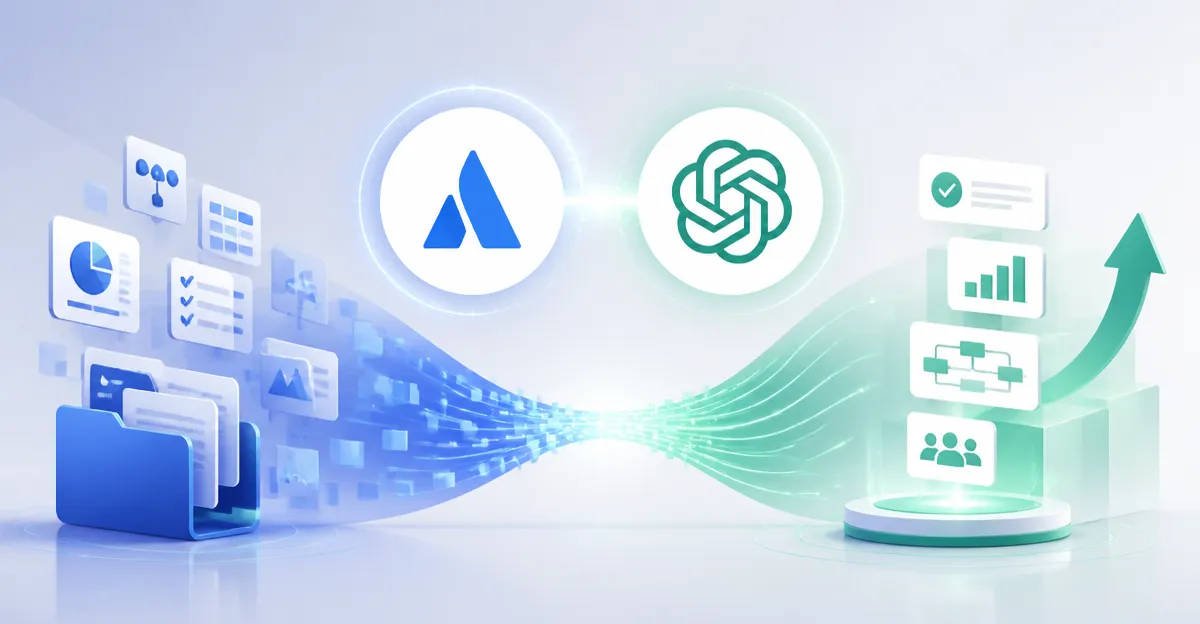
October 7, 2026, (Inside AI) — Atlassian and OpenAI have deepened their three-year alliance, embedding OpenAI's GPT-6 frontier models across Atlassian's platform and its Rovo AI assistant. The deal, announced today, gives Atlassian expanded access to models including GPT-6 Astra and the GPT-5.6 series, and moves OpenAI's reasoning engines into the heart of enterprise planning, coding, and project management.
The partnership arrives as Atlassian accelerates its own internal AI adoption. More than 3,000 Atlassian developers now use OpenAI's Codex across terminals, integrated development environments, and code review workflows. Through plugins powered by Atlassian's Teamwork Graph, Codex users can pull relevant work items and technical documentation directly into their coding sessions, helping them write, test, and ship software faster.
At the center of the expanded deal is Rovo, Atlassian's AI assistant that combines OpenAI's intelligence with the Teamwork Graph, an enterprise context layer connecting people, projects, documents, and decisions. The companies say this combination gives AI a deep understanding of how a specific company operates, not just generic knowledge.
The agreement builds on a collaboration that began in 2023 and has steadily expanded. OpenAI will continue to rely on Atlassian's Jira to manage critical workflows across the company. The two firms aim to bring frontier intelligence into the tools businesses already use, making AI agents a natural part of how teams get work done.
Read: Kimi K3 Enters OpenAI's Enterprise Codex Channel via Baseten
Atlassian's own adoption of OpenAI tools extends beyond Codex. The company uses ChatGPT Enterprise broadly, and recently launched a plugin extension that brings Jira work items, Confluence content, and people directly into ChatGPT and Codex prompts. A pinned Atlassian Home also surfaces assigned work, recent Looms, projects, and Bitbucket pull requests, helping teams access relevant context and take action.
For joint customers, the integration promises practical benefits. A product manager preparing for a launch could ask Rovo whether the team is on track. Drawing on the Teamwork Graph, Rovo can connect Jira tickets, Confluence documents, and relevant discussions to identify engineering blockers, flag missed milestones, and surface decisions that need attention. OpenAI models help turn that information into a clear assessment of launch readiness and recommended next steps.
The collaboration also extends to the command line. Through the Atlassian and Teamwork Graph CLI plugins for ChatGPT and Codex, customers can connect ChatGPT and Codex to their existing workflows, giving AI access to relevant project information, documentation, and development context, subject to appropriate permissions.
The companies are exploring deeper integrations with Jira that would make it easier for teams to assign work to AI agents, track progress, capture decisions, and review results. Paired with DX, Atlassian's platform for measuring developer productivity and engineering performance, these capabilities could help engineering leaders measure AI's impact on development speed, cycle time, and developer experience while keeping humans in control.
This partnership reflects a broader trend of enterprise software vendors embedding frontier AI models directly into their platforms. By combining OpenAI's reasoning capabilities with Atlassian's deep enterprise context, the two companies aim to reduce the friction of piecing together information across tools. The move also positions Atlassian to compete with rivals like Microsoft and Google, which have integrated their own AI assistants into productivity suites.
OpenAI gains a major enterprise distribution channel through Atlassian's millions of users. As model capabilities advance, Atlassian can bring new reasoning features into Rovo via OpenAI APIs, giving customers access to increasingly capable AI within the tools they already use. The partnership underscores a shift toward AI agents that don't just answer questions but take action within existing workflows.
Read: OpenAI Partners with America's SBDC to Train Small Businesses on AI
For now, the expanded agreement is a clear signal that both companies see enterprise knowledge as the next frontier for AI. By turning static information into actionable intelligence, Atlassian and OpenAI are betting that the future of work will be defined by how well AI understands the context of a business.