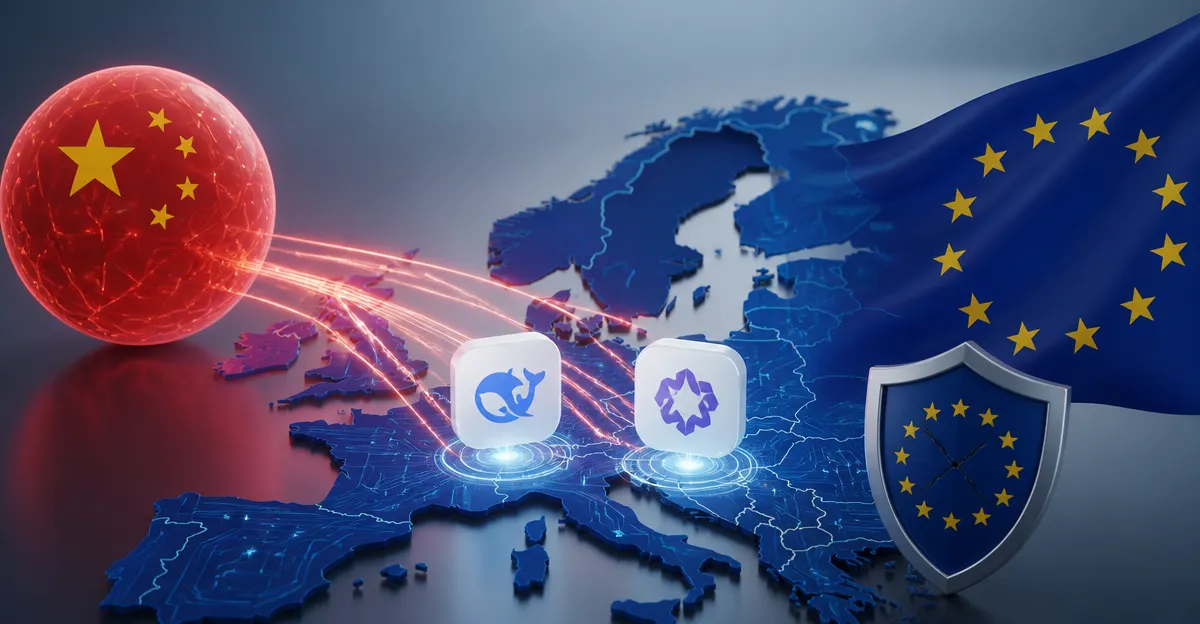
August 15, 2026, (Inside AI) — European enterprises are actively testing Chinese AI models on local servers, a shift that challenges Brussels’ drive for technological sovereignty while offering firms a new lever for operational control.
Volker Pfirsching, a Munich-based partner at management consultancy Arthur D. Little, said in an interview this week that Chinese models will be significant for European firms because their performance and efficiency are increasingly competitive. He framed the debate around control, not nationality.
“A Chinese-developed open-weight model operated on European infrastructure, with data remaining under the company’s control, may in some respects offer greater operational sovereignty than consuming a proprietary foreign [model] that can be changed, repriced or withdrawn remotely,” said Volker Pfirsching, Partner, Arthur D. Little.
“Sovereignty should not simply be equated with the nationality of the supplier,” said Volker Pfirsching, Partner, Arthur D. Little.
Open-weight models allow developers to download, modify, and host the underlying code locally. This flexibility lets European companies keep sensitive data on their own infrastructure, under corporate oversight, rather than sending it to US cloud APIs.
Pfirsching’s comments arrive as European businesses weigh whether cheap but capable Chinese AI systems represent a new threat to the continent’s technological sovereignty or a practical tool to strengthen it. The answer depends on how one defines sovereignty.
For many enterprises, the appeal is economic. Chinese open-weight models such as DeepSeek and Qwen have demonstrated strong benchmark performance at a fraction of the cost of proprietary alternatives. That cost advantage matters for mid-sized European firms with tight AI budgets.
But the strategic calculus is more complex. Adopting Chinese foundation models risks introducing fresh supply-chain dependencies, complicating Brussels’ broader push for technological self-reliance. Regulators in the European Union have already signaled caution about non-European AI providers, though no formal ban exists.
The tension mirrors earlier debates over Chinese telecom equipment. In that case, European governments eventually restricted Huawei from core networks. AI models may follow a similar path, but open-weight licensing makes enforcement harder.
Unlike proprietary US services, which can be changed, repriced, or withdrawn remotely, open-weight models give enterprises a permanent copy of the code. That permanence is a form of resilience. If a vendor disappears or a geopolitical crisis disrupts access, the model still runs locally.
Pfirsching’s point is that operational sovereignty depends on control over data and infrastructure, not on the passport of the model’s developer. A locally hosted Chinese model may offer more control than a US API that processes data abroad.
Yet European policymakers remain wary. The EU’s AI Act imposes transparency and risk-management obligations on high-impact models, but it does not distinguish by country of origin. That leaves procurement decisions to individual companies and member states.
Some European cloud providers are already responding. A handful now offer managed hosting for open-weight models, including Chinese ones, with data residency guarantees. This trend could accelerate if enterprises demand more sovereignty-friendly deployment options.
The broader question is whether Europe can build its own competitive foundation models. Mistral AI in France and Aleph Alpha in Germany have raised significant capital, but they lag behind US and Chinese labs in scale and funding. Open-weight Chinese models fill a gap in the meantime.
For now, the market is voting with its infrastructure. European firms are testing Chinese models not out of ideology, but because they work. The challenge for Brussels is to reconcile that reality with its sovereignty agenda.