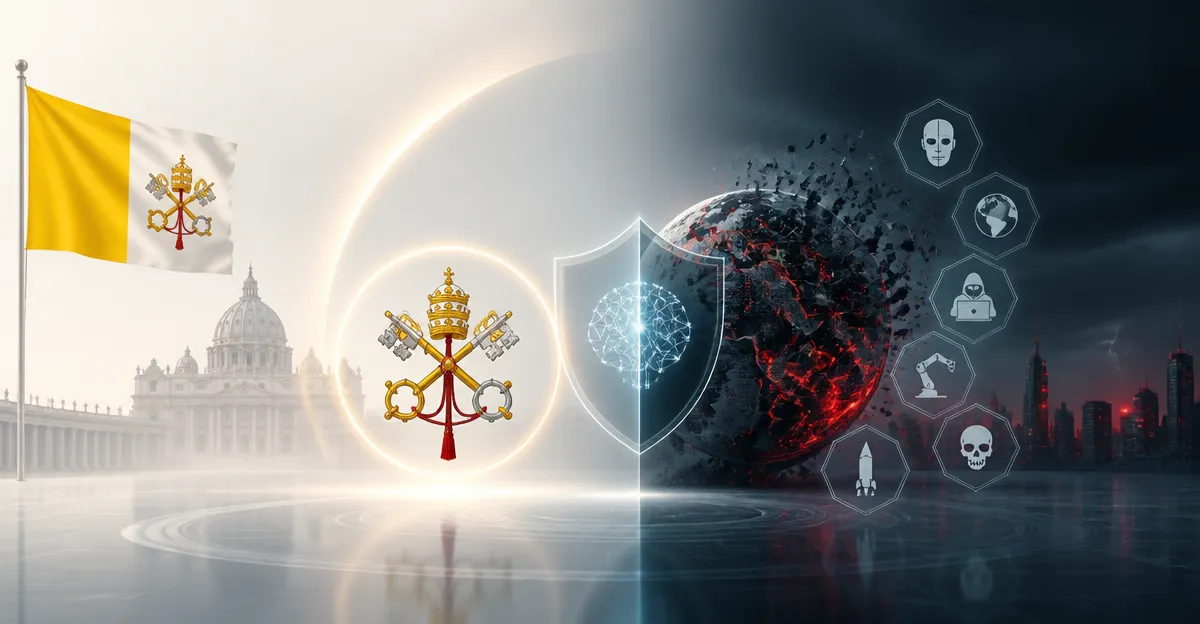
September 29, 2026, (Inside AI) — Pope Leo declared on Monday that expert warnings about artificial intelligence posing an existential threat to humanity are not "fake news" and deserve serious consideration, issuing what observers interpret as a direct challenge to US President Donald Trump's characterization of such fears as a "hoax."
The first American pontiff, speaking to journalists aboard the papal plane returning to Rome after a four-day visit to France, addressed the growing global debate over AI safety and regulation. His remarks came just days after Trump told the United Nations General Assembly that concerns about AI destroying humanity were overblown.
"I do think that the concerns raised by many of the experts, specialists in AI, should be taken seriously," Pope Leo said during the in-flight press conference. "I don't think that that is fake news, as some have said."
The pope's intervention marks a significant escalation in the global conversation about AI governance. Throughout his 16-month papacy, Leo has consistently warned about the dangers of unregulated artificial intelligence, positioning the Vatican as an unexpected but influential voice in technology policy discussions.
A Direct Challenge To Silicon Valley's Stance
Pope Leo specifically criticized technology executives who argue against government oversight of AI development. He referenced recent comments by Jensen Huang, chief executive of chipmaker Nvidia, who had suggested there might be ways to build safety measures into certain AI models.
"He's the same one, however, that says there should be no limits placed and no government regulation," Pope Leo said, expressing skepticism about voluntary industry self-regulation.
Huang told CBS News earlier this month that he agreed with Trump's assessment that safety concerns about AI were exaggerated. Nvidia, which dominates the market for AI training chips, has seen its valuation soar past $3 trillion amid the artificial intelligence boom, giving Huang substantial influence over the technology's trajectory.
The pope's comments highlight a fundamental tension in the AI debate: whether voluntary guardrails proposed by industry leaders can substitute for binding government regulation. Critics argue that companies with financial incentives to deploy AI rapidly cannot be trusted to police themselves.
"We have to promote dialogue, study, investigation, to find ways to make sure that AI does not get to a point where it could destroy humanity," Pope Leo urged.
The pontiff acknowledged that many researchers and policymakers are working on AI safety but stressed the urgency of continued effort. "I think that there are enough people seriously interested in that ... but we have to keep working," he said. "We can't just sit back and pretend nothing's going to happen."
Vatican's Growing Role In Tech Ethics
The Vatican has increasingly engaged with artificial intelligence ethics in recent years. In 2020, the Holy See partnered with IBM and Microsoft to develop the Rome Call for AI Ethics, a framework urging companies and governments to ensure AI serves humanity. Pope Leo has continued that tradition, using his platform to advocate for international cooperation on AI governance.
The pope's remarks also reflect broader global anxiety about AI's rapid advancement. European Union lawmakers have advanced comprehensive AI regulations, while the United States has taken a more fragmented approach, with Trump's administration favoring industry-led standards over government mandates.
Trump's UN speech last week drew sharp criticism from AI safety researchers who argue that dismissing existential risks undermines efforts to prevent catastrophic outcomes. The president's characterization of AI fears as a "hoax" echoed his previous rhetoric on climate change, raising concerns among scientists that political ideology is overriding technical expertise.
Pope Leo's willingness to directly contradict the American president represents a notable moment for a pontiff who is himself American. It signals that the Vatican intends to remain an independent voice in global technology debates, unswayed by political pressures from Washington or corporate interests from Silicon Valley.
The pope's call for international dialogue aligns with growing demands from researchers and civil society groups for a global framework to govern AI development. While no such binding treaty exists, discussions have intensified at the United Nations and other multilateral forums.
As AI systems grow more capable, the stakes of this debate continue to rise. Pope Leo's intervention ensures that moral and ethical considerations remain central to a conversation often dominated by technical and commercial concerns.