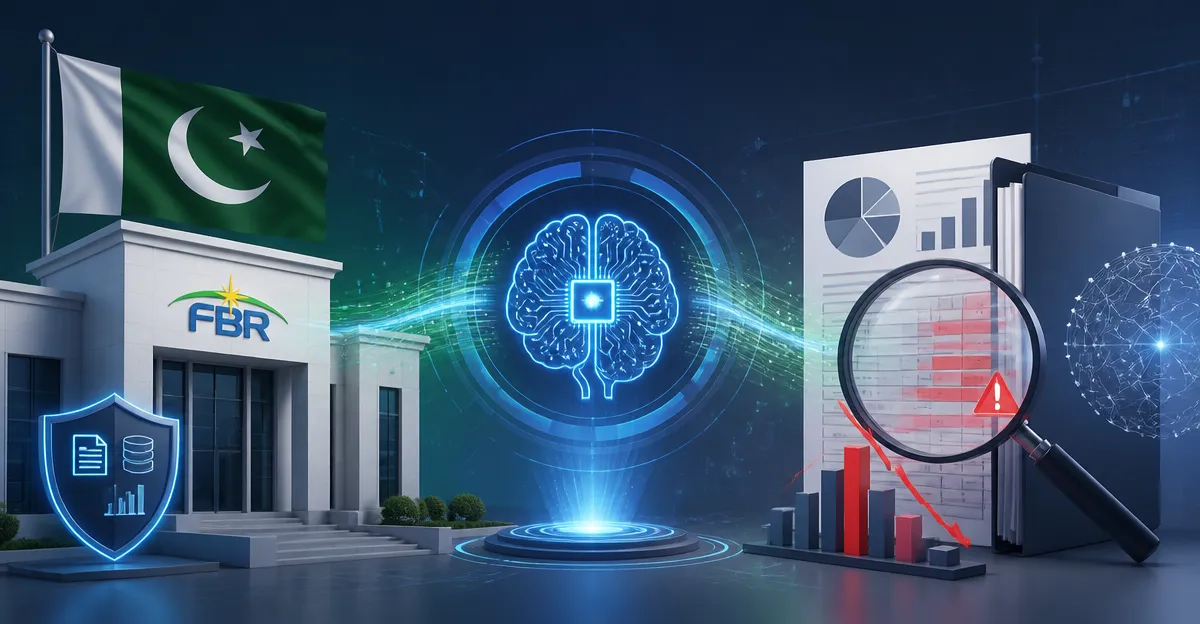
August 11, 2026, (Inside AI) — The Federal Board of Revenue (FBR) is deploying artificial intelligence to systematically dismantle income underreporting, Chairman Shafqat Mahmood Langrial announced, signaling an end to an era where tax consultants gamed detection probabilities.
Langrial revealed that AI tools, third-party data integration, and a faceless assessment system now allow the FBR to scrutinize individual returns at scale. Previously, the board lacked analytical capacity despite holding substantial internal data.
“Tax consultants previously considered both a taxpayer’s actual tax liability and the likelihood that the FBR would detect any misreporting when advising clients,” Langrial said, describing a calculated risk approach now rendered obsolete.
He illustrated with a striking example: a taxpayer owing Rs. 50 in actual liability might have been told to report far less, banking on low detection odds. That calculus has collapsed.
Read: Punjab Approves Rs7.4 Billion Cloud System to Power AI Governance in Pakistan
“This situation has changed significantly with the introduction of AI and improvements in the FBR’s ability to analyze tax returns,” Langrial stated, emphasizing that third-party financial data now cross-checks declared income, surfacing inconsistencies automatically.
The faceless assessment system eliminates personal influence. “Taxpayers could no longer expect personal relationships with FBR officials or their associates to help resolve issues arising from tax assessments,” Langrial warned, urging consultants to pivot from exploiting loopholes to ensuring lawful compliance.
He stressed the September 30 filing deadline, noting some extensions run to December, but cautioned that traditional underreporting tactics invite “unexpected consequences.” The FBR’s objective, he clarified, is not harassment but a technology-driven culture of accurate filing.
Algorithmic Audits Reshape Taxpayer Risk
Pakistan’s move mirrors a global trend where tax agencies harness machine learning to close compliance gaps. The UK’s HMRC, for instance, uses its Connect system to analyze billions of data points, while India’s Central Board of Direct Taxes deploys AI to detect evasion patterns. These systems typically flag anomalies in deductions, income spikes, or lifestyle mismatches.
Critics, however, raise concerns about data privacy, algorithmic bias, and due process. A 2025 study by the International Centre for Tax and Development found that AI-driven audits in low-capacity environments risk disproportionately targeting small taxpayers if models are trained on biased historical enforcement data. The FBR has not disclosed its model’s training data or fairness audits.
Moreover, faceless assessments, while reducing corruption, can depersonalize disputes. Taxpayers may face automated notices without clear recourse, a challenge seen in India’s faceless scheme, which saw a surge in litigation over procedural lapses. The FBR must ensure its AI outputs are explainable and challengeable to maintain trust.
Read: AI No-Parking Cameras Now Issuing E-Challans in Karachi, Pakistan
Data Integration’s Hidden Leverage
The FBR’s reliance on third-party data from banks, property registries, and utility records is a force multiplier. Pakistan’s 2024 budget mandated financial institutions to report high-value transactions, feeding the AI engine. This integration closes the gap between reported income and visible consumption, a method proven effective in Australia, where data-matching programs recovered AUD 2.4 billion in 2025.
Yet, data quality remains a hurdle. Inconsistent digital records and fragmented provincial databases could yield false positives. The FBR will need robust data-cleaning pipelines and human oversight to avoid erroneous demands that erode taxpayer morale.
Langrial’s warning to consultants underscores a professional shift: tax advisory must now prioritize compliance over evasion probability. As AI narrows the detection gap, the economic incentive for underreporting diminishes, potentially broadening the tax base if executed fairly.