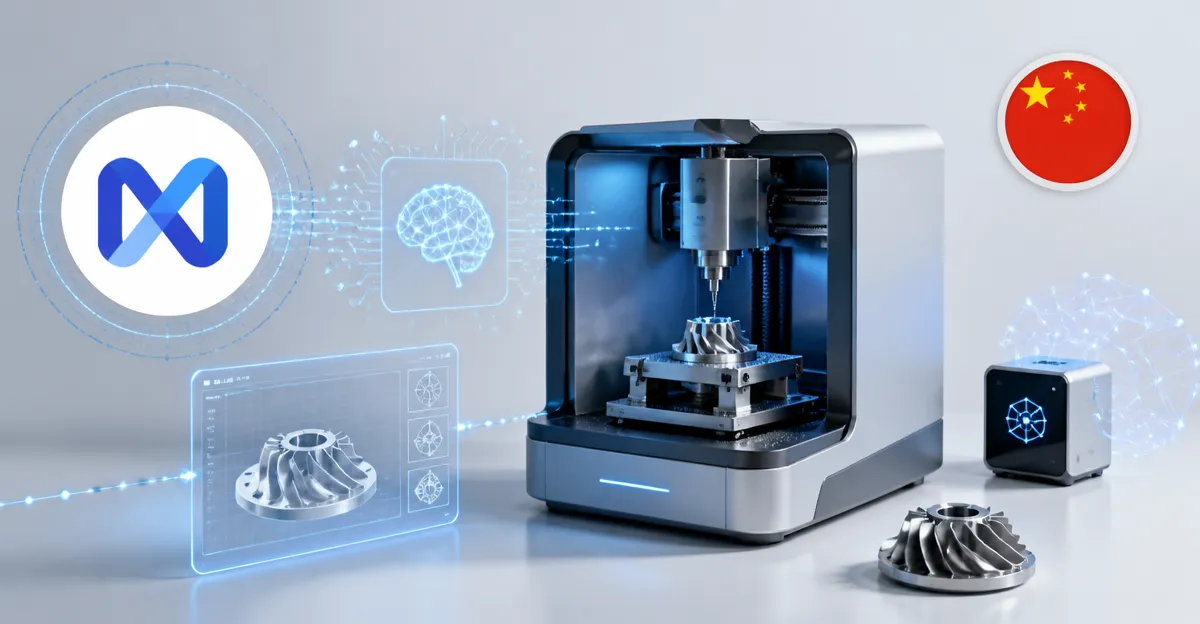
July 28, 2026, (Inside AI) — A startup founded in 2024 is attempting to shrink an entire factory into a desktop device. InfiMaker has launched the K1, a desktop 5-axis CNC platform that uses artificial intelligence to automate the complex workflows that have long kept advanced machining locked inside industrial settings.
The K1 is not another entry in the crowded market for 3-axis desktop mills. InfiMaker deliberately skipped that segment to tackle 5-axis machining, a process that can shape parts from multiple angles in a single setup but traditionally requires costly machines and expert operators.
"The market does not need another desktop 3-axis CNC machine because launching a similar product would do little to improve the user experience. Instead, the biggest obstacle to wider adoption of 5-axis machining is not the hardware itself, but the complexity of traditional software workflows and the expertise required to operate them," Bowen Xie, Founder and CEO of InfiMaker, told TechNode.
Conventional 5-axis CNC machines demand proficiency in computer-aided manufacturing (CAM) software, machining parameters, and toolpath generation. InfiMaker's in-house CAM software, InfiStudio, uses AI to generate machining parameters, recommend strategies, optimize toolpaths, and provide material-specific recommendations. For decorative projects, users can upload a reference image and let AI generate a 3D model before machining. For precision parts, the software automatically generates toolpaths from imported CAD files.
An onboard camera further simplifies operation by reading material tags and automatically loading the corresponding machining profile and cutting parameters. The goal is to reduce manual configuration and shrink the time from design to production.
"We're not trying to build a CNC machine with a more powerful spindle," Xie said. "We're trying to shorten the distance between a CAD model and the final machined part."
AI Lowers the Knowledge Barrier, Not Replaces Engineers
InfiMaker's approach reflects a broader shift in manufacturing where software, not hardware specifications, defines user experience. The company argues that AI will not replace manufacturing engineers but can lower the knowledge barrier, making advanced capabilities available to designers, developers, entrepreneurs, and makers.
This philosophy aligns with research on automated toolpath generation. Studies have shown that AI-driven CAM systems can reduce programming time by up to 80% while maintaining accuracy comparable to expert-generated paths (Automated Toolpath Generation for Multi-Axis CNC Machining Using Deep Learning, arXiv, 2023). However, skeptics note that fully automated CAM still struggles with complex geometries and material variability, requiring human oversight for critical applications.
InfiMaker's long-term vision extends beyond the machine itself. "We want to make hands-on building possible again, one person, one desk, a whole factory," Xie said. The company is initially targeting North America and Europe, where mature maker communities and strong demand for productivity tools exist. It plans to expand globally by building user communities and incorporating feedback into product development.
The desktop CNC market has seen rapid growth, with the global benchtop CNC machine market projected to reach $2.1 billion by 2030 (Grand View Research, 2024). Yet 5-axis desktop machines remain rare due to software complexity. InfiMaker's bet is that AI can finally bridge that gap, turning a desk into a micro-factory.