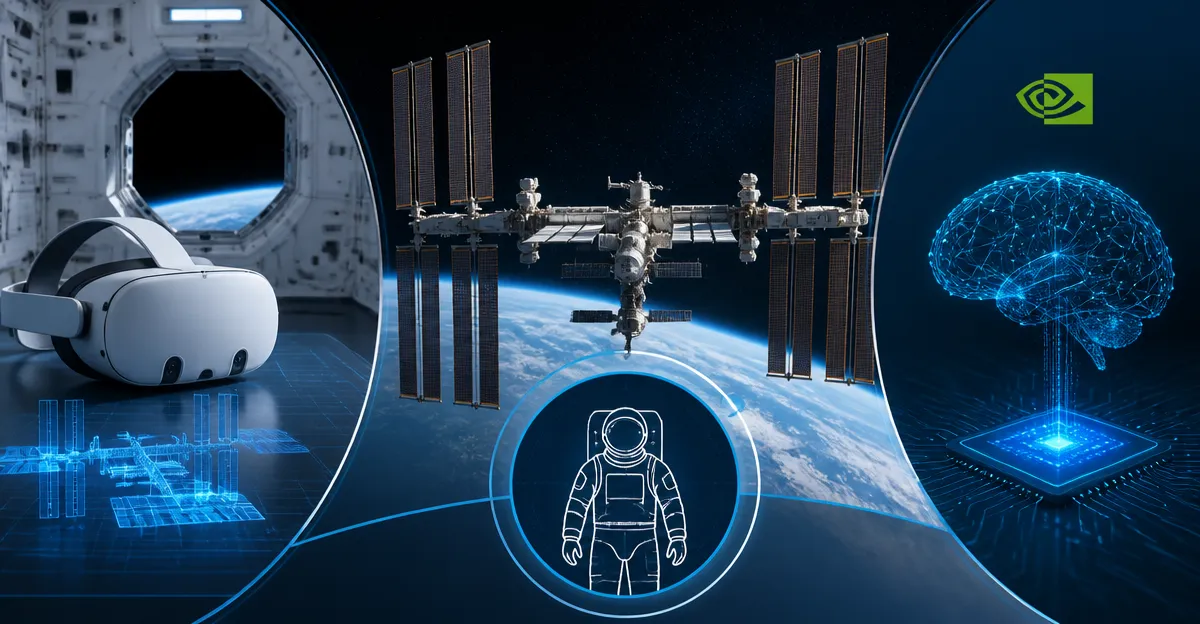
August 14, 2026, (Inside AI) — NASA astronauts Anil Menon and Sophie Adenot of the European Space Agency will exit the International Space Station on August 18 to replace a failed high-speed antenna. The spacewalk is scheduled to begin at 8:35 a.m. EDT and last about six and a half hours.
The pair will leave through the Quest airlock and travel to the Z1 truss segment above the Unity module. They will remove the old antenna, place it on an external stowage platform, retrieve a spare, and install it on the truss.
Inside the station, Jack Hathaway and commander Jessica Meir will assist with suits and operate the Canadarm2 robotic arm. Menon will ride the arm’s latching end effector while Adenot remains tethered to the truss.
The failure of the space-to-ground antenna has limited high-bandwidth communications with mission control. Replacing it restores a critical data link for science and operational telemetry. This is the first U.S. segment spacewalk since a coolant leak investigation paused routine EVAs in early 2026.
Read: SpaceX Earnings to Test If Starlink Can Fund Musk’s AI Spending
Why a failed antenna demands a six-hour EVA
Space-to-ground antennas handle high-rate downlink of experiment data and live video. Without the spare, the station relies on slower backup channels. The Z1 truss location is awkward, requiring the robotic arm to position Menon precisely.
On Thursday, Menon and Hathaway checked Menon’s spacesuit, refilling water tanks and the liquid-cooling ventilation garment. Meir and Adenot reviewed specialized tools for electrical and data connections on the replacement antenna.
The crew held safety briefings with mission controllers and robotics specialists. On Wednesday, all seven Expedition 75 crew members ran emergency drills for pressure leaks, chemical leaks, and fire, using tablets to coordinate with ground teams.
NASA has not disclosed the antenna’s failure date. The unit was installed during a 2021 spacewalk and had exceeded its design life by nearly two years.
Cosmonauts test AI tools and VR balance research
While NASA and ESA crews prepped the EVA, Roscosmos flight engineers Pyotr Dubrov and Anna Kikina took turns wearing virtual reality headsets. The experiment studies how the sense of balance and direction adapts to microgravity.
Read: SpaceX Q2 Revenue Jumps 92% to $7.8B, But AI Costs Hit Stock
Kikina and Andrey Fedyaev continued work with artificial intelligence tools intended to improve crew efficiency on future missions. Dubrov also ran an automated Earth photography session.
The cosmonauts inspected windows on the Zvezda, Nauka, and Poisk modules. These inspections feed into long-term structural health monitoring for the aging Russian segment.
AI tools on the station have evolved from simple scheduling assistants to predictive maintenance systems. Roscosmos has been testing an onboard assistant that flags anomalies in life support data before they trigger alarms.
The VR balance study builds on earlier research showing that astronauts recalibrate their vestibular system within days of arrival. Data from this session will inform countermeasures for lunar and Mars missions.
With the spacewalk two days away, the crew will continue reviewing procedures and checking equipment. Ground teams will monitor weather in low Earth orbit, though space weather poses a bigger risk than terrestrial storms.