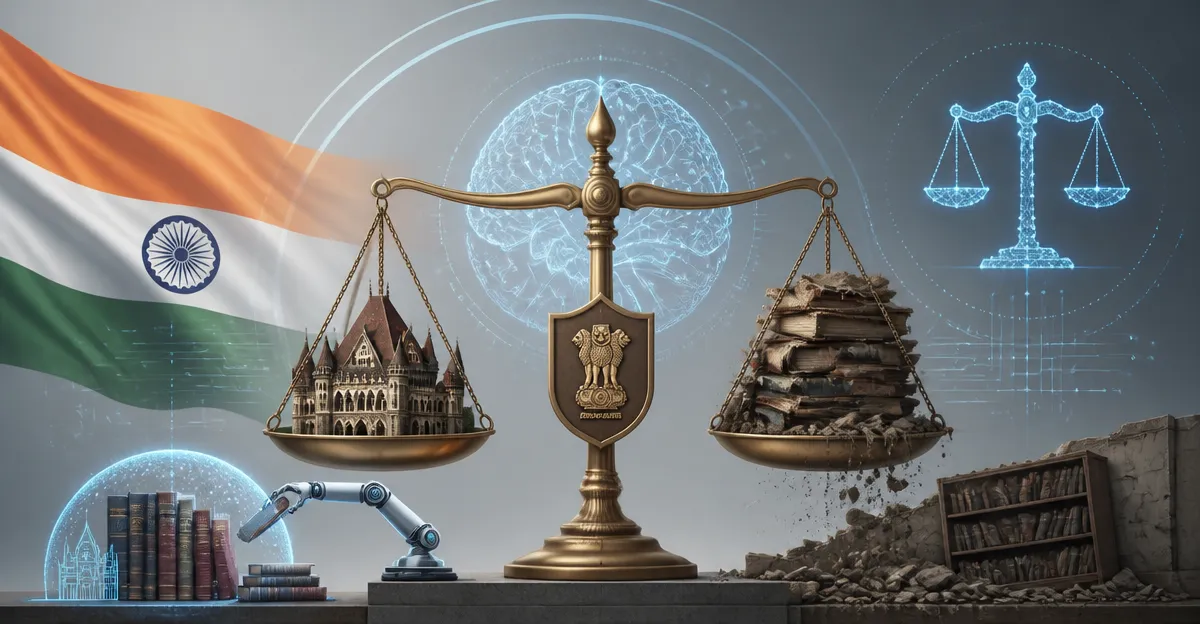
July 22, 2026, (Inside AI) — The Bombay High Court has taken a firm stance on preserving public libraries as vital democratic spaces in the age of artificial intelligence. It registered a suo motu public interest litigation (PIL) to address the deteriorating condition of the Bhaskarrao Jadhav Library in Kolhapur, Maharashtra, after a newspaper report exposed monsoon damage threatening its rare collection.
Justices Milind N Jadhav and Nandesh S Deshpande, hearing the case on July 21, emphasized that libraries remain crucial bridges between society and knowledge, even as AI reshapes information access. They rejected the notion of libraries as mere storage for old books, calling them active centers for learning and community engagement.
The court’s intervention follows a July 14 Marathi newspaper report detailing how heavy rains had created holes in the library’s ceiling, causing leaks that endanger its 21,825 books. The facility serves over 400 regular readers, mostly students preparing for competitive exams, and operates on a nominal annual fee of just Rs 1,000.
“Public libraries are centre for community engaging different cross-sections of the society. They aid in research. Public libraries cannot be treated as a sort of attic where old books go to die,” the bench stated. It highlighted the library’s role as a “second home” for students from surrounding areas who lack study space at home.
The Intersection of Heritage and Digital Divide
Kolhapur holds historical significance as the birthplace of India’s first Public Libraries Act in 1945, a fact the court noted underscores the tragedy of the current neglect. The library, registered in 1972 and maintained by the Kolhapur Municipal Corporation since 1979, houses a ground-floor book collection and a 4,000-square-foot reading hall upstairs.
The bench stressed that libraries bridge the digital divide by providing free access to software, internet, and reference materials—resources often out of reach for low-income individuals. This aligns with research on public libraries as essential infrastructure for digital inclusion, a role that persists despite AI-driven information tools.
“The library in today’s time especially in digital era where the Artificial Intelligence has taken over all facets of life, serves as one of the most important conduit to connect the society at large with regard to the academic pursuits,” the court observed. It described a public library as “a proud symbol of India’s hard-won democracy, of freedom of information, and the ability of any one to access that information.”
However, the court’s framing raises questions about how AI might complement rather than compete with libraries. While AI chatbots offer instant answers, they lack the curated, authoritative collections and the civic space that libraries provide—a point the court underscored by calling the library “the only civic space remaining where an individual can spend time without being required to make a purchase.”
Preservation Orders and Unanswered Questions
The high court appointed advocates Ritesh Thobade and Bhargavi Patil as amici curiae to inspect the library, draft a proper PIL, and suggest remedial steps. The Kolhapur Municipal Corporation claimed a work order was issued in November 2025 and work began in April 2026, but the court noted the newspaper report suggested otherwise and directed the civic body to submit evidence.
The order did not detail the nature of the repair work, leaving uncertainty about whether it addresses the structural decay or just superficial fixes. The court’s directive to preserve the library’s “legacy and heritage” hints at a need for long-term conservation, especially for the rare book collection at risk from moisture and neglect.
This case echoes broader challenges in maintaining public knowledge infrastructure amid rapid technological change. A 2023 study on library resilience in the digital age highlights how underfunded facilities in developing regions struggle to adapt, yet remain critical for equitable access to information—a point the court implicitly recognized.
The matter is scheduled for further hearing on August 18, when the amici curiae will present their findings. For now, the court’s action serves as a reminder that in the AI era, the physical spaces that democratize knowledge still demand protection.