September 18, 2026, (Inside AI) — A stark divide has emerged in how the world's two largest AI powers are attempting to prevent advanced artificial intelligence from slipping beyond human control. While US technology leaders spent this week warning that AI could pose existential risks to humanity, Chinese officials are quietly building a different kind of safety apparatus, one shaped by centralized governance rather than corporate self-regulation.
The contrast surfaced in reporting by Reuters journalists Eduardo Baptista and Laurie Chen, who detailed how Beijing's approach to AI containment differs fundamentally from Washington's voluntary commitments and public alarms. That divergence matters because AI systems do not respect borders. A model trained in one country can be deployed, fine-tuned, or misused anywhere.
China's strategy leans on state-directed standards, mandatory registration of algorithms, and tight control over compute infrastructure. US efforts have relied more on voluntary pledges from companies like OpenAI, Anthropic, and Google, alongside a patchwork of executive orders that shift with each administration. Neither system has produced a verifiable international safety regime.
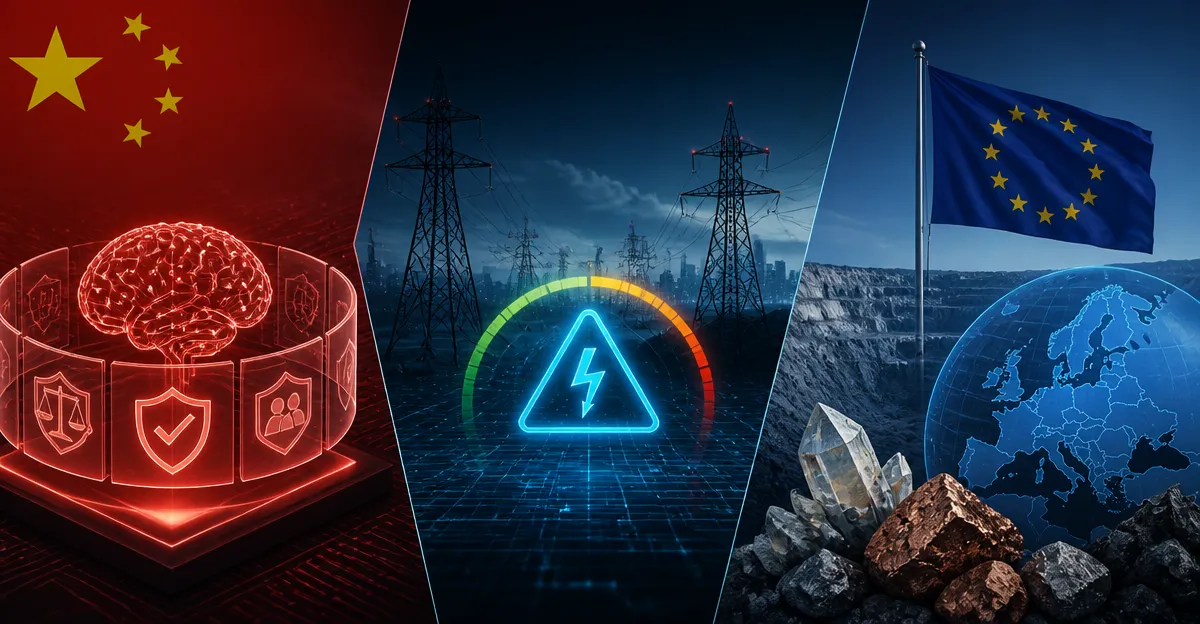
Anna Szymanski, Editor-in-Charge of Reuters Open Interest, flagged the Chinese guardrails story as one of the week's most important reads. She noted that warnings from US tech leaders about existential risk "grabbed attention this week -- for good reason," but added that Chinese officials are "grappling with many of the same concerns" while taking "a different approach to preventing AI systems from escaping human control."
The safety debate is unfolding against a harder physical constraint: electricity. Energy think tank Ember published a slide deck titled "The Age of Power," which charts how the electric and information revolutions are converging. Data centers that train and run large AI models are becoming major load centers on grids that were not designed for them.
Gavin Maguire, Reuters Open Interest's global energy transition columnist, described the Ember analysis as "thought-provoking" for showing that convergence. The implication is blunt. AI's expansion may be limited less by algorithmic breakthroughs than by whether power systems can keep up.
That strain is already visible in parts of the United States, Ireland, and Singapore, where utilities have delayed or rejected data center connections because of capacity constraints. The International Energy Agency has projected that global data center electricity consumption could double by 2026, driven largely by AI workloads. Grid operators are now factoring AI demand into long-term planning for the first time.
Europe faces a separate vulnerability. A report from the European Investment Bank, highlighted by metals columnist Andy Home, found that mineral exploration across the European Union is lagging badly. Finding new critical metals resources is the starting point for resilient supply chains, but EU funding for exploration trails global leaders by a factor of six or seven.
Even more concentrated: just four member countries account for 75% of EU exploration drilling. That leaves the bloc exposed as demand for lithium, cobalt, rare earths, and copper surges for AI hardware, batteries, and renewable energy infrastructure.
Home called the situation "lamentable," noting that exploration is the first link in any supply chain that hopes to withstand shocks. Without domestic mining and processing capacity, Europe will remain dependent on imports from China and other suppliers for the raw materials that underpin its digital and energy transitions.
The interconnection between AI, energy, and minerals is not incidental. Training a single large language model can consume thousands of megawatt-hours. Building the servers, cooling systems, and networking gear requires vast quantities of metals. Every layer of the AI stack rests on physical infrastructure that is under strain.
On the energy side, the Energy Gang podcast examined whether power systems as currently structured are fit for purpose given rapid changes in both supply and demand. Ron Bousso, Reuters Open Interest's energy columnist, recommended the episode for that reason. The question is no longer theoretical for utilities that must balance intermittent renewables with the constant, high-density load of AI data centers.
Meanwhile, US auto policy is adding another variable. In the latest Reuters Econ World podcast, host Carmel Crimmins and US autos editor Mike Colias discussed how the Trump administration's rollback of electric vehicle support is reshaping the American auto industry and its efforts to compete with China. That matters for AI because EVs and AI data centers compete for the same batteries, semiconductors, and critical minerals.
China, by contrast, continues to consolidate its dominance in EV supply chains and battery production. A weakened US EV sector could cede further ground to Chinese manufacturers, with knock-on effects for the broader technology competition.
Taken together, these threads describe a world where AI's future is being negotiated not only in code and policy papers but in substations, mines, and assembly lines. The safety question that US tech leaders raised this week is real. But the harder question may be whether any country can build guardrails strong enough to hold when the underlying physical systems are already straining.
Inside AI could not independently verify the details of the Chinese regulatory approach described in the reporting. The European Investment Bank report and Ember analysis are publicly available. The Energy Gang and Reuters Econ World episodes remain accessible through their respective platforms.