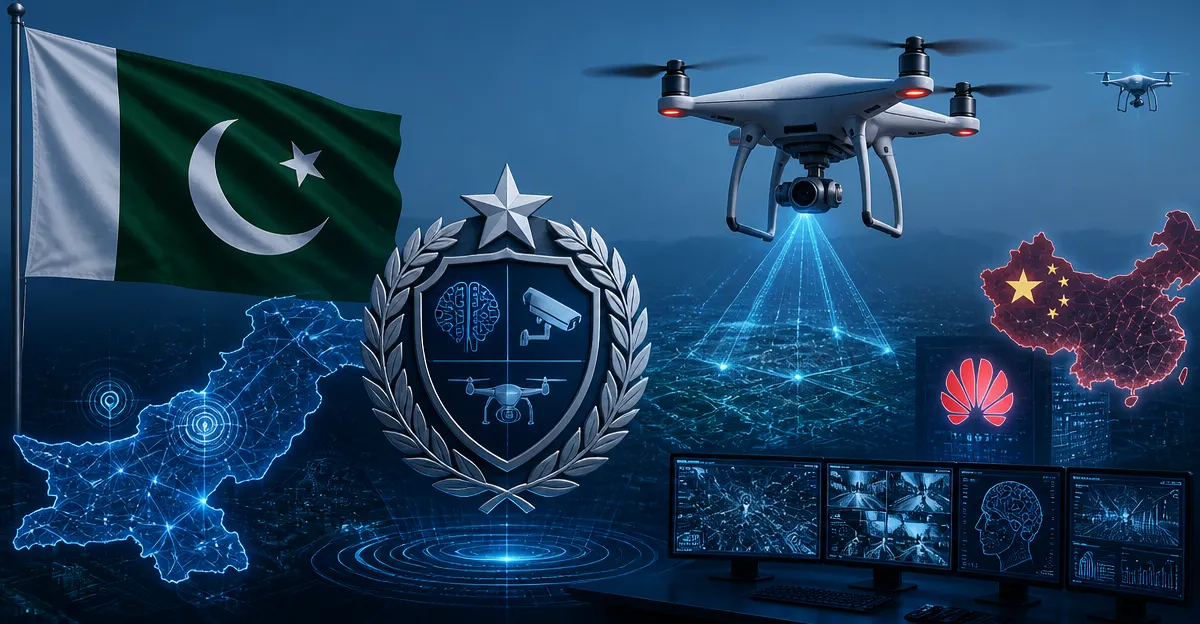
August 7, 2026, (Inside AI) — Pakistan is set to overhaul its law enforcement with artificial intelligence, advanced drones, and modern investigation methods, drawing directly from policing models used in China and Türkiye. The initiative, announced by Interior Minister Mohsin Naqvi, marks one of the most significant technology-driven reforms in the country’s criminal justice system.
The centerpiece is a pilot Law Enforcement Investigation Centre in Islamabad, modeled after China’s integrated policing approach. It will consolidate detention, investigation, and summary trials under one roof to accelerate minor case processing. This mirrors China’s “one-stop” judicial centers, which have been shown to reduce case backlogs by up to 40% in pilot cities, according to a 2025 study published in the Asian Journal of Criminology.
Naqvi detailed the plans while addressing Assistant Superintendents of Police who recently returned from specialized training in China and Türkiye. He emphasized that overseas training will become a permanent fixture, exposing officers to international techniques. The Ministry of Interior’s Aviation Wing will also receive advanced drones for aerial surveillance, enhancing field operations and situational awareness.
The reforms include updating the police training curriculum at the National Police Academy with modern investigation methods, establishing specialized investigation rooms, and introducing a redesigned uniform tailored to operational needs. The government frames this as a move toward a technology-driven, professionally trained force.
China’s Policing Model Under Scrutiny
China’s policing model, which heavily integrates AI and surveillance, has drawn both interest and criticism globally. Its “Xueliang” (Sharp Eyes) program links millions of cameras with facial recognition, while predictive policing algorithms analyze data to forecast crime. However, a 2024 report by the Elsevier book “AI and Policing: Global Perspectives” warns that such systems often lack transparency and can perpetuate bias, particularly against minority groups.
In Pakistan, where privacy laws are nascent and oversight mechanisms weak, civil society groups have raised concerns. The Digital Rights Foundation noted in a 2025 statement that drone surveillance without clear regulations could lead to mass surveillance and chilling effects on dissent. Naqvi’s announcement did not address data protection or algorithmic accountability, leaving a gap in the reform narrative.
Drones and Data: The Missing Framework
The drone expansion, while promising for operational efficiency, lacks a public legal framework. Pakistan’s existing drone regulations, under the Civil Aviation Authority, primarily cover commercial and recreational use, not law enforcement. Experts argue that without clear rules on data collection, retention, and sharing, the program risks abuse. A 2023 paper in the Modern Law Review highlighted how unchecked police drone use in the UK led to legal challenges over privacy violations, offering a cautionary tale.
The training component, while valuable, may face hurdles in implementation. Past efforts to professionalize Pakistan’s police have been stymied by political interference and resource constraints. The success of these reforms will hinge on sustained funding and institutional independence, which remain uncertain.
The pilot center in Islamabad is expected to be operational within 18 months, with drone deployments beginning earlier. The government has not disclosed the cost or technology partners, though Chinese firms like Hikvision and DJI are likely candidates given the model inspiration. As Pakistan steps into AI-driven policing, the balance between efficiency and rights will be closely watched.